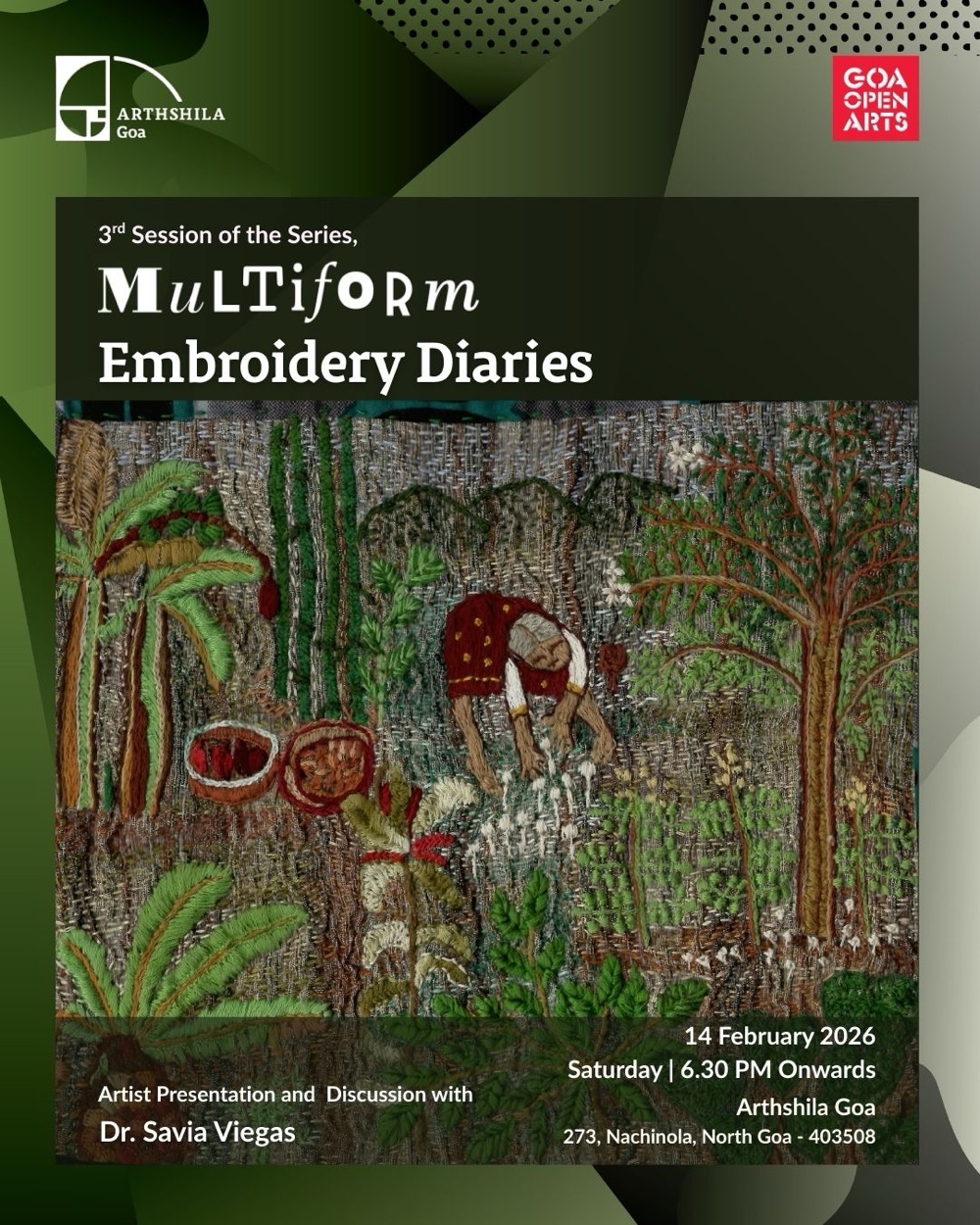
Embroidered Diaries was a talk given by Dr. Savia Viegas at Artshila, Goa, where one spent the evening listening to her speak about her embroidered narratives — works that hold village stories, whispered histories, remembered scandals, and impossible romances drawn from dining-table conversations of her childhood.
Her mother was a seamstress who worked until her last breath, yet did not want Savia to learn the craft. Having given up her own education to stitch and make ends meet, she was determined that her daughters would be educated. For Savia, embroidery entered her oeuvre by this sense of denial. She yearned to stitch but couldn’t. Later she taught herself and embroiders narratives much like a writer would — plots that are spicy, melodramatic, romantic — centred around her village of Carmona. These are real stories, and listening to Savia recount their intrigues was a treat.
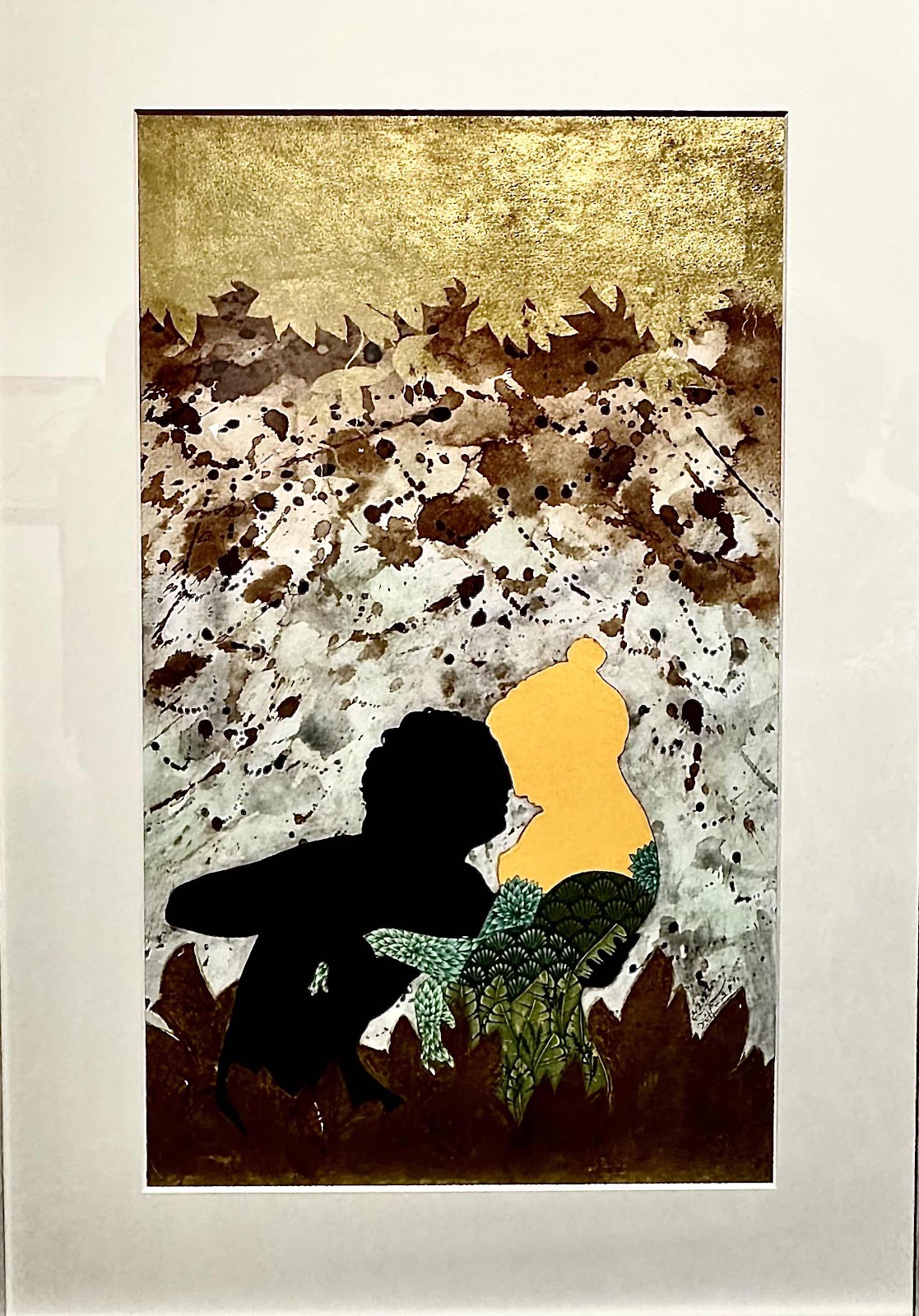
Visually, the narratives unfold in layered, non-linear ways — sometimes circling clockwise or anticlockwise, sometimes breaking into fragments. In one piece, Patricia’s Prenup, a young woman is shown glancing out of a typical Goan window on her 27th birthday and sees a young man on a bicycle, his path blocked by buffaloes returning home from grazing. She steps out to help him; eyes meet, hearts soften, and they are betrothed — only for him to marry another. Rejected, she dresses in her bridal gown and lies upon a lotus pond, meeting an Ophelia-like end.
In another work, Magnu’s Penance, a man in love with a wealthy girl travels to South Africa to make his fortune. When he learns that her father is parading suitors before her, he overturns a poker table where his employer and friends have been gambling with gold ingots, seizes the gold, and sails back to Goa. He returns rich, marries his beloved, and lives well — until, on his deathbed, a priest tells him that restitution is required for his confessed theft if he wishes to enter heaven. As he fades, his wife scrambles to organise carpenters and construction as specified by the priest, while the village murmurs in curiosity.
The stories linger. They are quaint. They are real, and embellished with many threads.
The embroidered pieces draw from flattened figures reminiscent of folk embroidery traditions such as Kantha, from village memory, and from lived anecdote. For Savia, the visual field carries the narrative weight. The image seems primary; the stitch operates as vehicle rather than subject, and its tactile qualities are not fully utilised to augment the texture of each story.
I found myself thinking about how differently these stories might live in thread — how stitch could amplify texture, density, silence. Create tactile nuances to augment the intrigue in the narration of memories. Nonetheless, it was an engaging evening—compelling to see memories stitched onto cloth.
When you look at the world around you, what do you see? Do you ignore the chaos or do you engage with it?
I live in Goa and it’s really easy to see wonder in every footstep, every car ride or cycling down the village roads. When I’m in Delhi, it’s still in the natural world that I find that same sense of awe and see a reflection of my own nature. I can’t quite feel the same about the high rises, chaotic traffic snarls, road rage, lack of civic sense, persistent honking and beggars knocking at the car window. The crush of city life, brings forth another kind of experience. One that pushes out thoughts and feelings I may not be as willing to acknowledge when the pace is slower and less threatening.
However, last evening, I walked into Gallery Espace to see the work of Ashok Ahuja and had to marvel at how he was able to find order in this kind of chaos - find himself in a pristine space beyond the cacophony of crowded spaces and conversations of the figurative dimensions of the physical world.
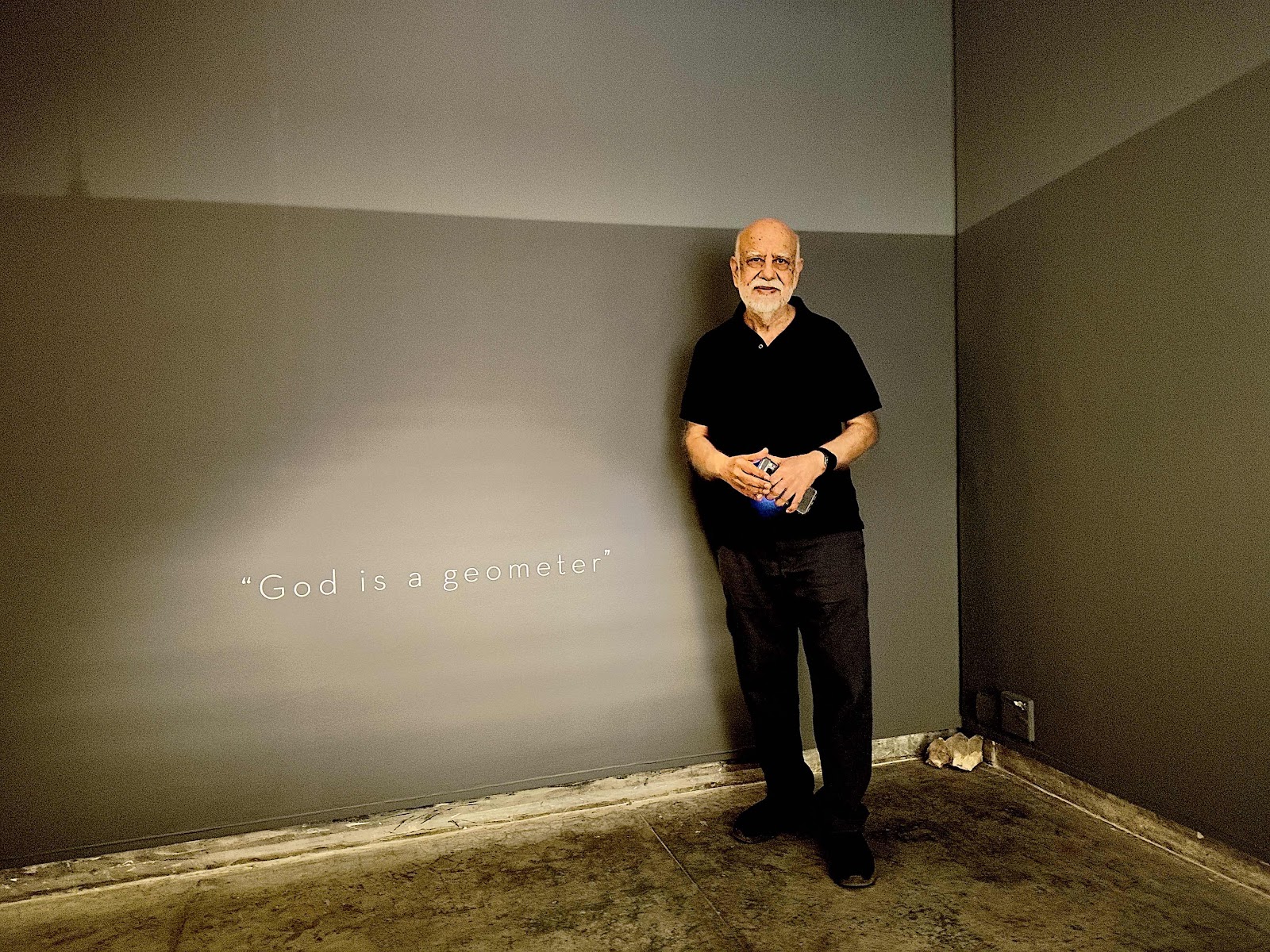
The artist had printed “God is the geometer” on one of the gallery walls. Pertaining to the belief that a god created the universe according to a geometric plan. The idea is attributed to Plato who said “Convivialium disputationum, liber “ meaning God geometrizes continually" Mathematics has been linked to cosmology and geometric forms are continually found in nature and the architecture of temples. If God is the geometer who creates our illusion of the world with mathematical precision of various permutations and combinations of light versus dark, then Ahuja becomes the geometer of his own world view.
Geometric forms, lines, shade and light form the very basis of his cosmology. He walks through cities of the world seeking light. He finds light in everything he sees. And then, he manipulates what he sees - his viewed reality, to find a window into the complex construct of his own mind. Chatting with him about his thought process and his philosophy, was fascinating. It’s not often that one meets an artist who can find clarity in the urban chaos of over-populated, badly planned Indian cities.
Carl Gustav Jung, the Swiss psychiatrist had said that design arises from amidst the chaos of form. Ahuja demonstrates this with a masterful stroke in his solo show entitled ‘Matrix at Seventy-three Square’. I’m no mathematician, quite the contrary, my accounting has inherent flaws and none trust my calculations. So don’t let the title intimidate you. The visuals are far more evocative and you don’t need to have a degree in physics and mathematics to appreciate the way he distorts form to create a whole new way of looking. In fact, his art works cause you to pause and reflect on life beyond what you think you see.
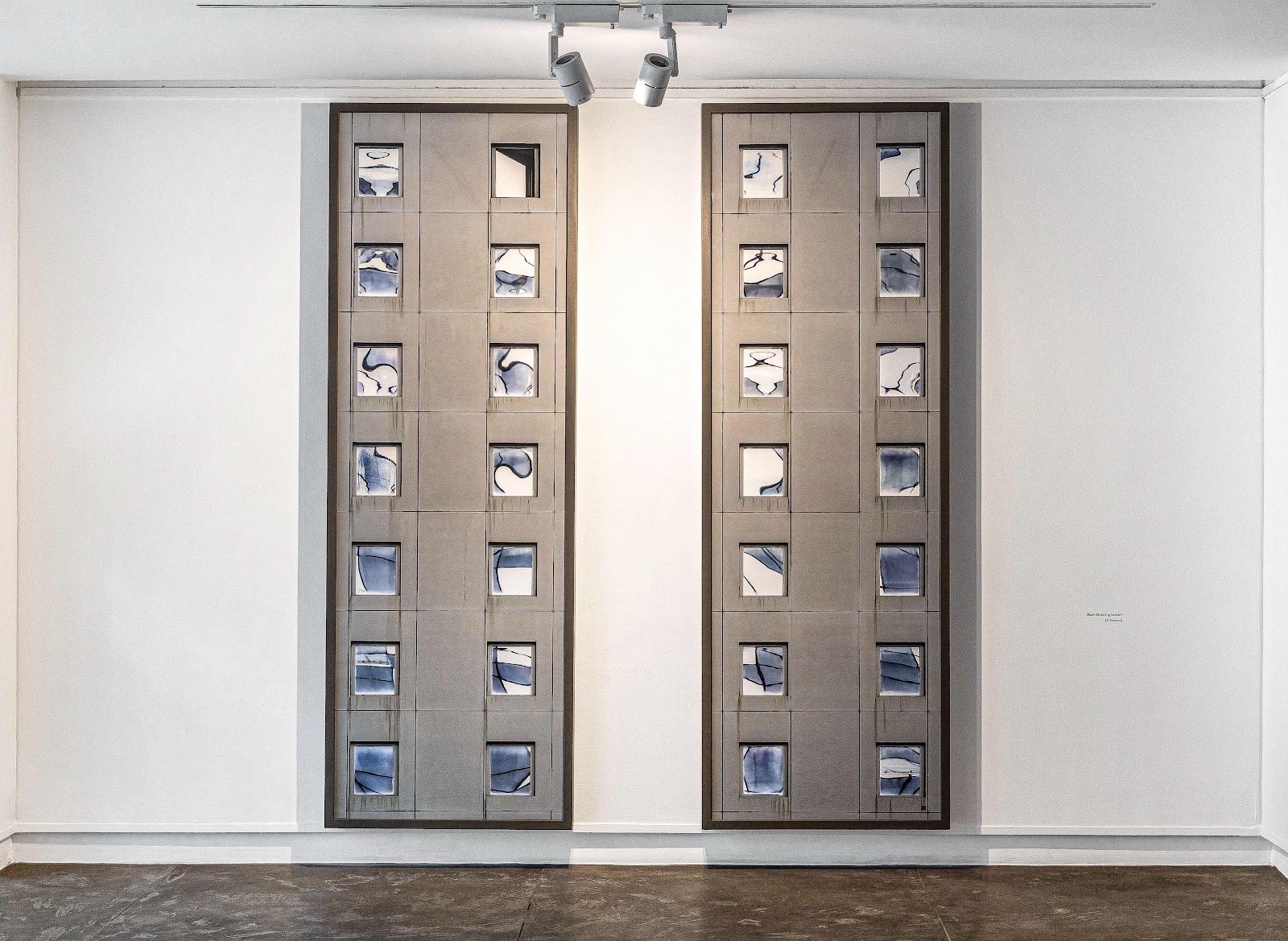
‘Open Drawing Lesson’ is a set of multiple visuals where Ashok evokes the “dynamic, ever-responsive, ever-changing universe” loading its brush with light “to draw simple, wondrous forms as reflections on the windows of the mind fixed in the walls of everyday reality streaming in open streets, reflecting beauty and truth” becoming a lesson in art and life. The images are abstracted visions of light that could be mistaken for ripples of water. The reflections are manipulated, distorted, diminished or expanded in an exploration that goes beyond the forms manifested by sacred geometry. He’s not really interested in recounting the physical aspects of life, the figures and forms. He is attempting to transcend them, go beyond form to another reality seen only by the minds eye. Ordering his universe in symmetrical windows despite the varied images they display.
His medium of exploration and expression is digital which lends itself well to the idea of ‘bending light’. They’re presented to us ‘archival pigment ink on canvas. A concrete vision of a nebulous, transient inner journey of engaging through the manifest world with the intangible self.
In ‘Navajivan Nagar’ he finds stacks of books printed by the Navjivan Trust, founded by Mahatma Gandhi, in their basement. They remind him of high rises so he removes the musty basement walls, replacing them with a pale cobalt blue aether with floating white cumulus in the background, to create the illusion of a cityscape. As if to say that it’s our knowledge, our study of the universe through centuries of contemplation on this mysterious creation that can take us beyond the weightiness of the cityscape into the lightness of being.
“House of Cards” was a telling commentary on the fragility of our colossal pillars of steel with tinted glass facades. For try as we might, we cannot hide forever behind these towers and escape the veritable museum of our minds. The ever-growing archive of memory that reassures as much as it haunts. And unless we examine it as we do the art works in a museum, reflecting and relating to our humaneness it may well bring us crashing down, without the much needed humility of knowing ourselves. The tall building buckles, as we do at the knees, in discovering our inadequacies, ineptness, and dysfunctional patterns of behaviours. Humbled in our own eyes, the building doesn’t fall, shattering to the ground. It kneels as if in prayer.
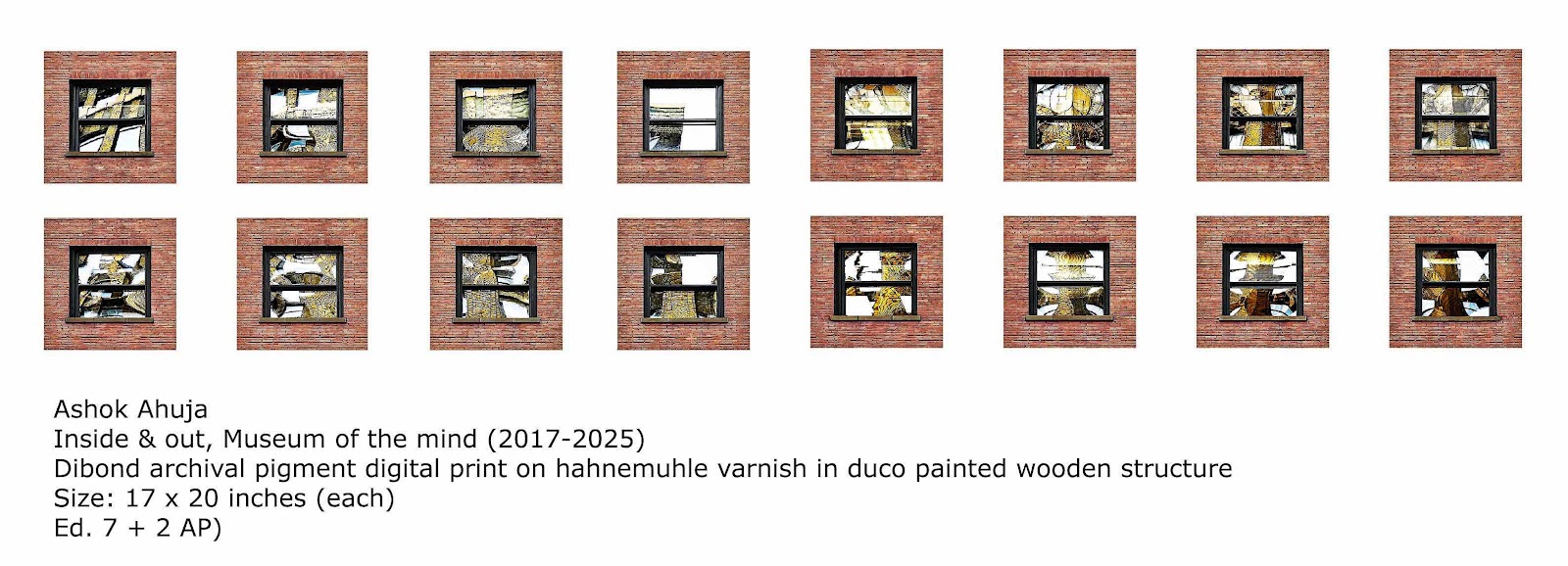
Inside & Out - Museum of the Mind is a large body of work spanning eight years in contemplating and executing. Ahuja creates the illusion of brick walls with a large square window embedded in each. And each window is a glimpse of how he manipulated mortar and steel into deep reflections on existence itself. It’s as if these concrete structures dissolve in his mind. There is a dynamism in this dissolution that is never complete, but it’s suggested that he can take himself and us into that non-figurative, abstract, energetic field through this study of the museum of the mind. Leaning on its creative potential, it’s imagined archives of being.
Given the growing chaos of being. The emerging idea that living life to the fullest is about rushing around the world, where our constructs can come crashing down. Ashok Ahuja gently suggests you pause and examine this precarious house of cards and delve deeper into how much more powerful you could be as the geometer of your own existence, if you began exploring the museum of your mind.
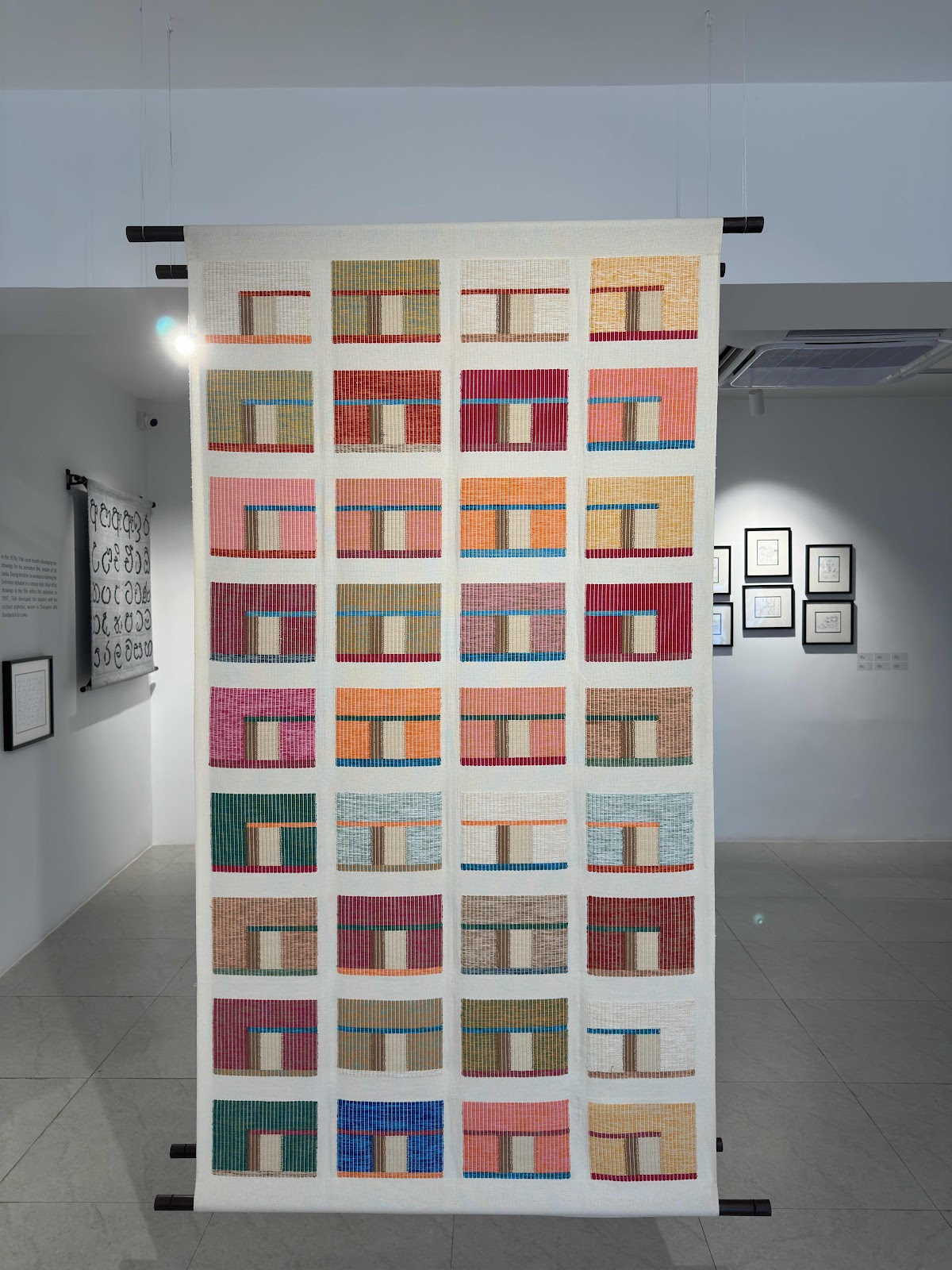
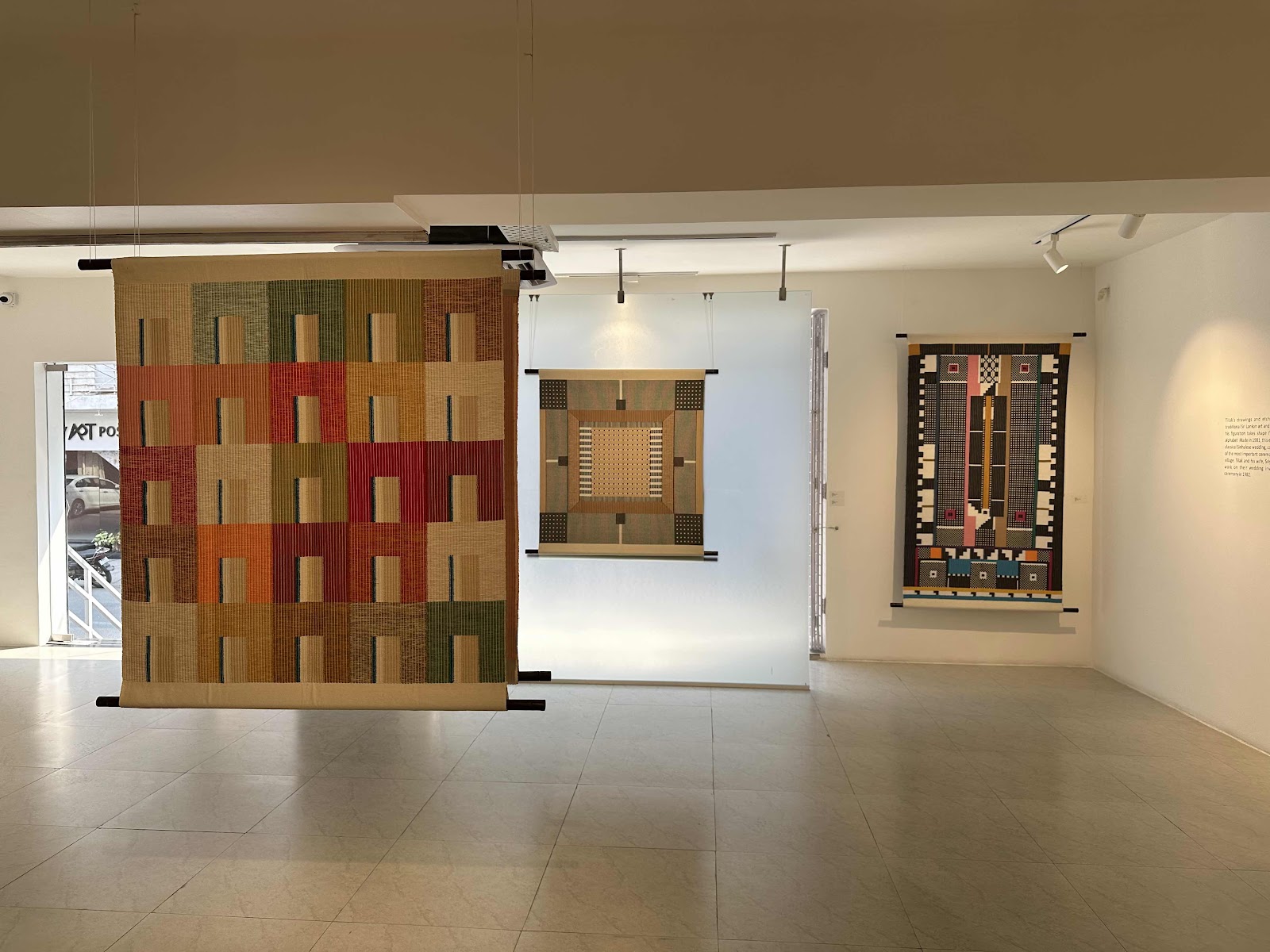
This afternoon I went to Gallery Ragini in Lado Sarai to see the work of Sinhalese architect Tilak Samarawickrema. ‘Not just a doodle’, curated by Ina Puri, had on display drawings, animations and textile wall hangings by the octogenarian. It was the textiles that dominated the gallery space and occupied my attention too.
I was fascinated by the complexity of patterns achieved by an extra weft effect. Even though embroidery and crochet dominate my own art practice, I trained as a weaver and it’s still something that fascinates me. The technique is a traditional Sinhalese weaving style called the Dumbara that utilises the floating extra weft to create geometric patterns.
Samarawickrema spent over a decade in Milan l, Italy, and one can see the lines of vintage Georgetti chairs, the interior designs of Jose Colombo and knits by Missoni all come together in Samarawickrema’s textiles, taking the Dumbara weave to another level. Some works are dated 1990’s and some more recent were made in 2012.
Front view
Back view
I had seen some of his textile pieces displayed at The Abraham and Thakore showroom in Defence Colony, earlier this year as part of The India Art Fair 2025. These were different but within the same parameters of the show at Gallery Ragini. At A&T, the effect was striking for it went well with their minimalist style of furnishings and was tastefully displayed.
At the exhibition in Lado Sarai I got to see the weaving up-close and marvelled at the complexity, the skill and patience of the maker. And wish he/she/they had been named and that we could have seen some images of them at work. In India, we are familiar with extra weft effects as used in Jamdani and Banaras Brocades, but I had never seen it on this scale and the intricate mix of multi hued wefts in one woof.
Front Back
I’ve shown the back of some of the woven pieces because that really brings out the intricacy of the weave, despite the heavy wefts.
Do go take a look. It’s on for a month. I would strong recommend it for all textile buffs, especially students.
As a student in London in the 1980’s, visiting the museums was de rigeur. I loved the Italian masters especially Botticelli , Titian and Canaletto. And of course there was Rembrandt and those portraits with incredible lace collars. Caravaggio was often mentioned but I can’t say that I was impressed. But that’s youth for you and ignorance too, no doubt.
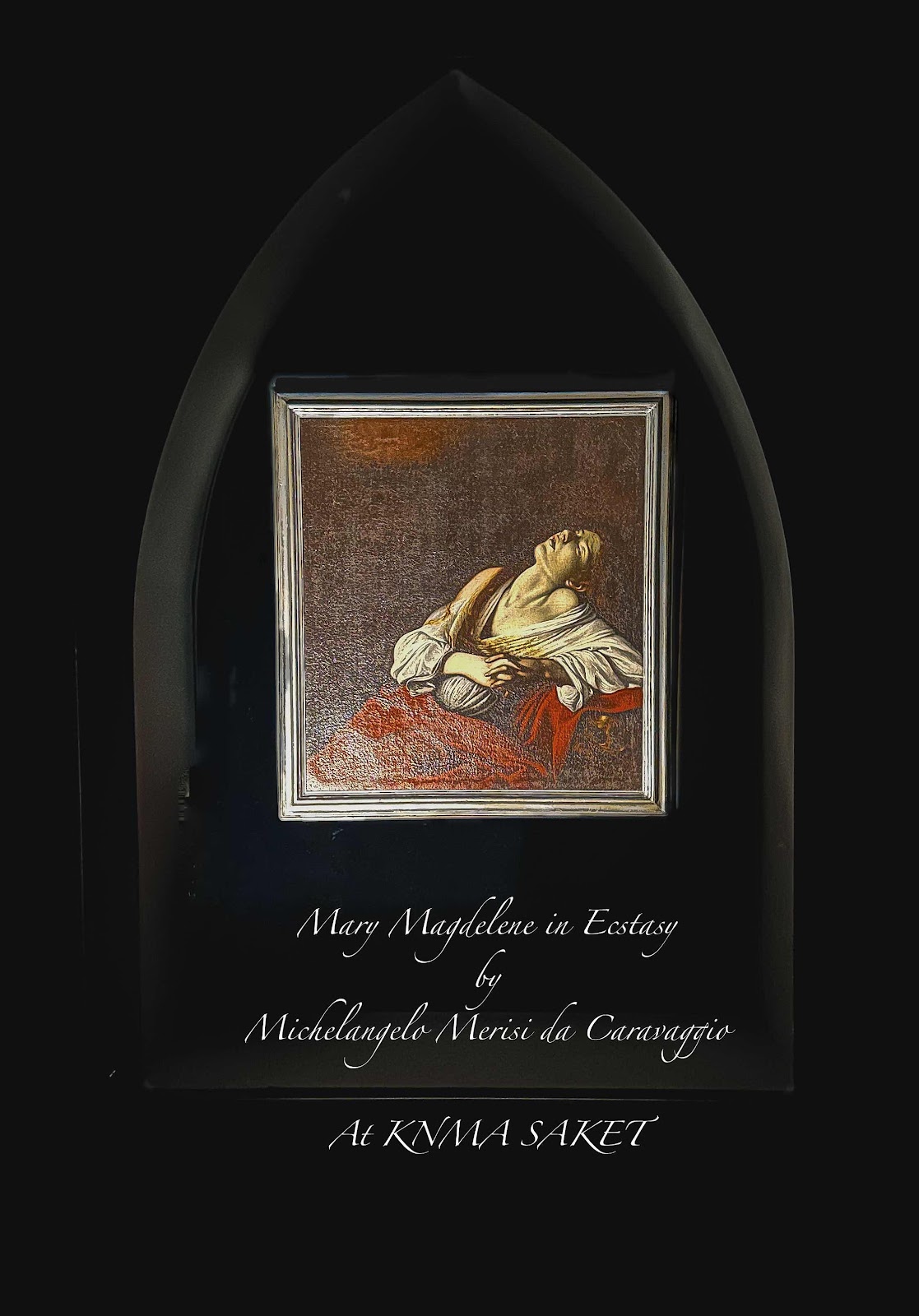
This evening at a special preview of Magdalene in Ecstasy, at KNMA Saket, one got up as close as the sensor lights and protective museum glass would allow. The seventeenth century painting is old, it’s been restored and there’s little the ordinary eye can discern with regard to its brushwork. Some facets of the painting are almost obscured by age The cross and the skull balance the painting compositionally, but we can just about discern the momento mori and crown of thorns.Nonetheless it’s a mysterious work of art that requires some deep looking and reading up on the historical perspective.
Is Magdalene pregnant or is she carrying a mendicants pouch. After witnessing Christ’s crucifixion, she is said to have wandered around like one, living off crumbs that came her way. Caravaggio is known for his portrayal of Biblical characters where he creates a dramatic play of chiaroscuro using contrast of light and shadow. Among all his works, in‘Magdalene’ chiaroscuro is present even more and well defined. Its presence the fruit of observations of light that he was the first to study this way and pave the way for modern painting.
At a first glance, the painting struck me as odd. Why would a master give Magdalena such a big ear. And what’s she holding onto. Some say she’s pregnant, but was she? One could even say, that Caravaggio hasn’t studied pregnant women for there’s something off about the way the baby bump appears. But, as you begin reading the text it seems that he has deliberately chosen this type of visual which raises questions and doubts about her pregnancy.
Believed to have been created during a rough time in the artists life where, in embroiled in an accidental murder, he was forced into hiding and has possibly transformed his own personal anguish into this timeless moment of Magdalene’s ecstasy, making it humane state of transcendence.
Her ear is enlarged for its tuned into by angels who will transport her to heaven “to hear the delightful harmonies of celestial choirs” and, it’s also been conjectured that Mary Magdalene ascended to heaven at childbirth.
Lost to history until its rediscovery in 2014, we are really privileged to view and discuss this in Delhi today. A first hand viewing “of an artist who broke barriers between art and life, high and low culture and brought saints to life in the reflection of the commoner on the street”
It’s on for a month. Do go and see it. A rare opportunity for all of us.
An Alternative Contemporary - a celebration of contemporary miniature art. The exhibition Showcased the evolution of Indian miniature painting and its influence on contemporary artists. Curated by Waswo X. Waswo, telling us how various artists are preserving and re-imagining the art form through innovative narratives and experimentation with the form through video and other media.
Waseem Ahmed
I’ve always been fascinated by miniature paintings. I recall copying them from prints one could buy at Lalit Kala Academy in the 1970’s . I absolutely loved the detailed brushwork as also the stylistic rendering of perspective, trees, dress and people. In the early 1980’s I even embarked on a cross-stitch embroidery based on a well recognised miniature. I worked on it for a year, but never got around to finishing it. I still have the unfinished piece and marvel at the very idea of undertaking such fine embroidery. But, it’s the details that I do love, whatever the form or media.
Vinita Sharma
Monique Romeiko and Vagaram Choudhary
totally transformed the miniature format. It was wild, creative and technically a feat to have created an artwork where the painting is static but people within it moved about doing yogic postures and other activities. The people are dressed in contemporary dress, in total contrast to the painted style. It was perhaps the most innovative work in the show
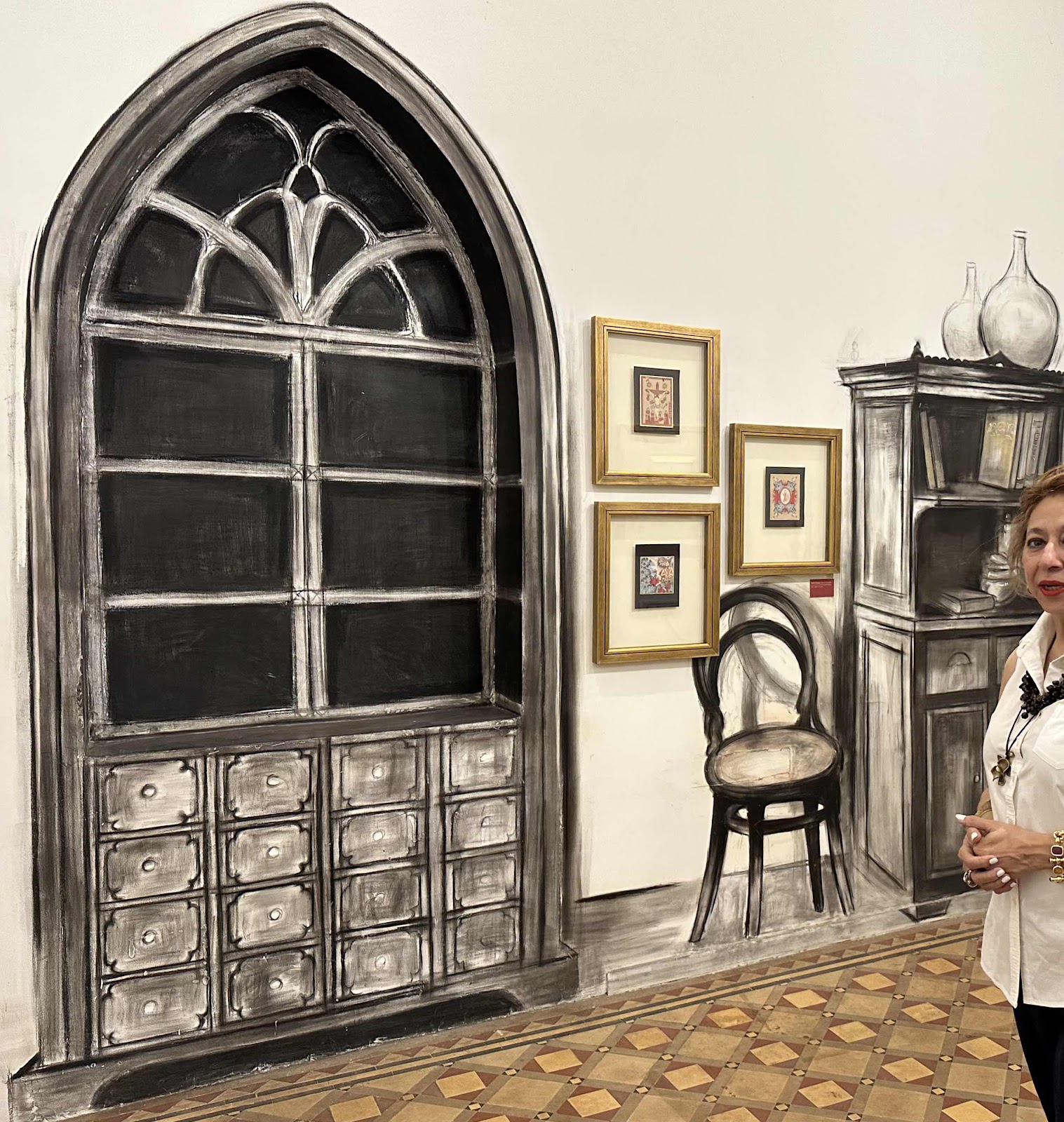
At the far end of Sunaparanta, below the main building, was a small but delightful Gallery tucked away round the back, which showcased the Company Style of Indian Miniature paintings, but with a difference. The paintings were framed by mounts painted with monochromatic patterns in gold on cream background, drawing from ancient textiles and spices - re-invoking the legendary spice Trade that was traded not in currency but with India’s famed textiles. They reminded me of the monochromatic colchas that Portuguese officials commissioned as gifts and for private trade.
The room itself was sheer magic with chairs, sofas, windows, a chaise lounge, chandelier and floor standing candelabra, drawn to perfection in black charcoal on the walls of the gallery. The chair and table beside it, in particular were so realistic that I kept trying to put my glass of wine on it, to free my hands to take a picture. If anything detracted from that charming exposition, it was the gold painted patterns on the mounts that lacked the finesse of brush that painted the miniatures they framed. These works were a collaboration between eight artists. Tulsi Nimbarak, Ghanshyam (chotu), Pawan, Raju Sharma, Sridhar , Kailashchand, Siddharth Gosavi and Dr. Seema Bhalla
Alongside the video by Romeiko and Choudhary, was a video by Eeman Masood literally re-inventing the miniature painting in a digital format. Rendered in true miniature style, the colours and medium transformed the traditional art form. It’s worth the minute watch, as Masood explores dreamlike qualities of a forest painted like a miniature, highlighting the spiritual aspects of miniature painting - where attention to detail and perfection of strokes in minute forms, evoked the very spirit of creation.
Almost akin to the magnificent formation of many creatures we find in the natural habitat of Goa. These days it’s the blue, brown and red dragonflies that charm : how nature has crafted them so small, so intricate, so perfect. Recently, I spied a couple mating as they hovered over the pool as I swam - floating on the aquamarine waters, mesmerised by natures craftsmanship
I missed the works from Waswo’s own studio, but he said that when curators include their work it reeks of self-promotion, so they decided not to participate in the main exhibition but painted the walls of the cafe, which is a covered courtyard. Here, he’s posing beside his painted image in the Angan.
Piyush Sharma
Vinita Sharma, Piyush Sharma, Olivia Fraser, Waseem Ahmed and Manisha Gera-Baswani among others are also part of the exhibition and it was an eye-opener to see the range of work that is being created.
Olivia Fraser
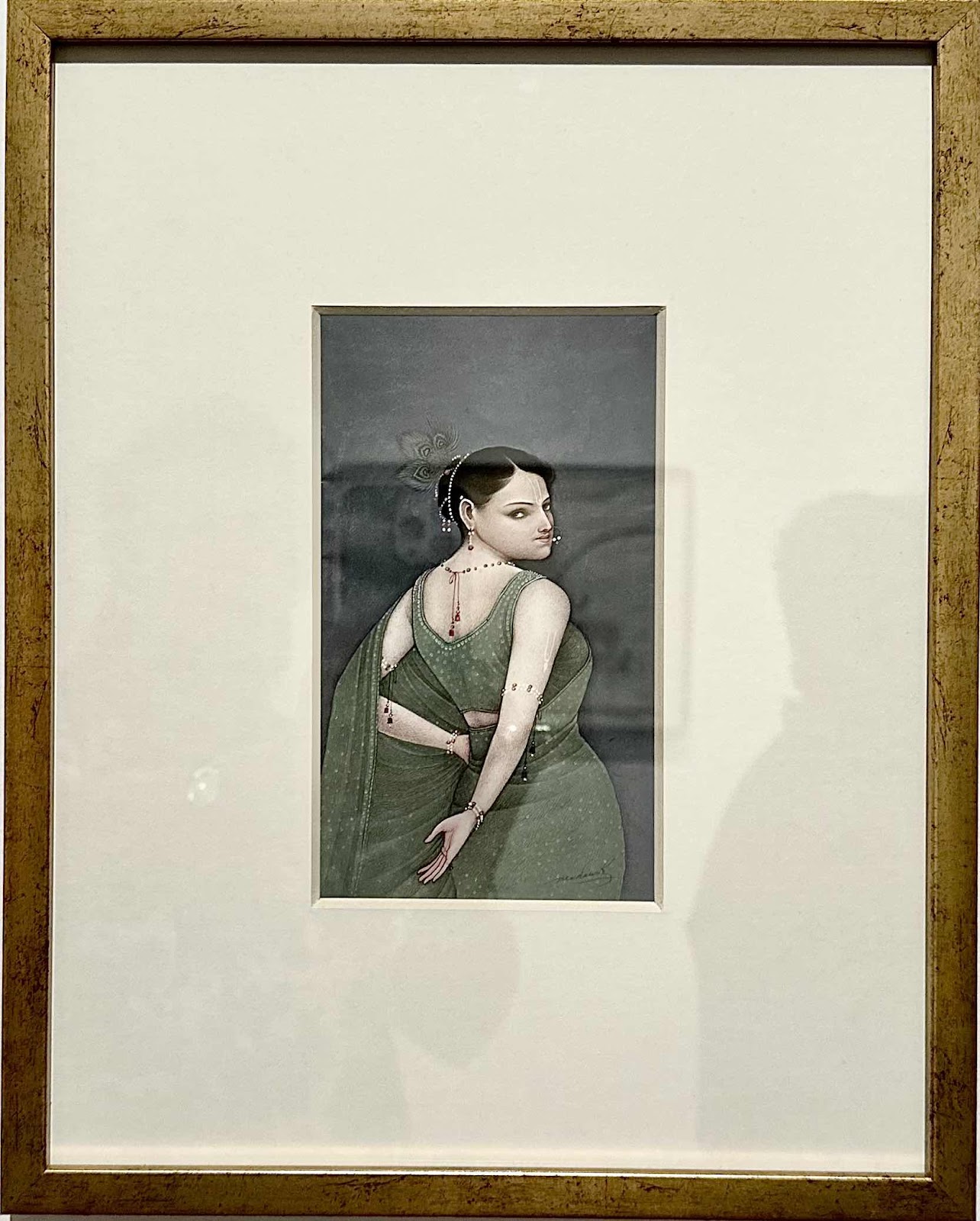
Mahaveer Swami paints the contemporary woman, her gaze ever-so seductive in a nivi-style draped saree. Something one hasn’t seen before in the traditional miniature format.
Mahaveer Swami
In Jignasha Ojha’s depiction of modern buildings, one finds a petite woman in a ghaghra down at the right hand corner of the works, tugging at the delicate strings “of all she owns in her home”. As it’s the woman who is attached to everything in the house that she’s made a home with. Taking them with her wherever she goes. Jignasha shared her own attachment to such things and was devastated yet also fascinated that contrary to her imagination there was a woman standing before her art, who had no sentimental value attached to anything in her home. That I had sold almost everything in my Gurgaon home before moving to Goa and hadn’t missed a thing. I remember looking at the emptied apartment and sensing how complete it looked empty as it did before, when it was a lived space, furnished with my stuff!
Jignasha Ojha
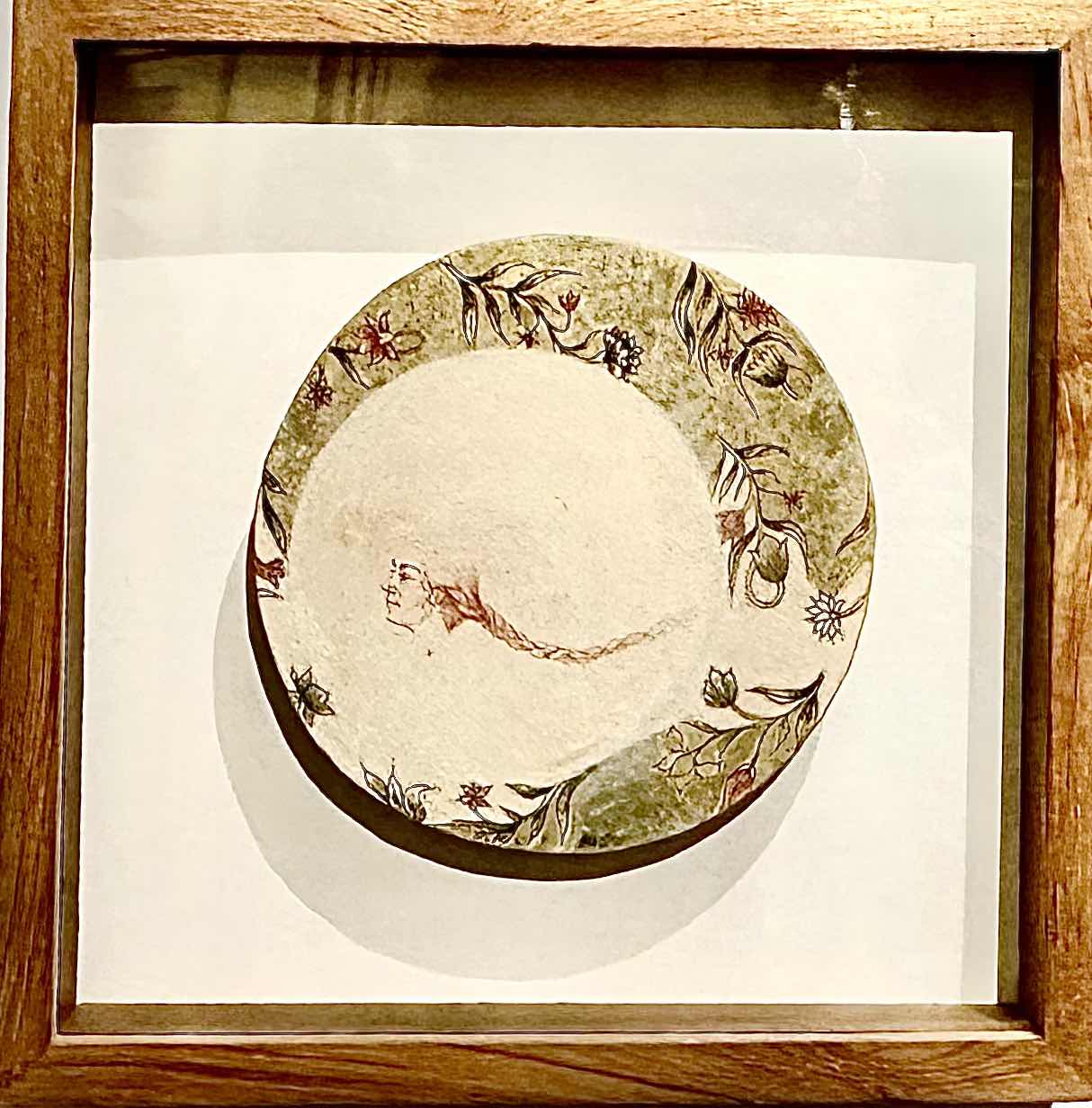
Ekta Singha interprets of layers of experiences with design motifs and other elements derived from Mughal, Persian and Rajput miniature paintings, evolving a contemporary vocabulary for the form on surfaces that are painted with metaphorical and personal references to miniature paintings.
Ekta Singha
The circular plaques with unevenly placed floral borders which are fading, broken and disfigured in parts, frame delicately painted forms like a broken fragments of a tea-cup, a woman with a long braid being pulled by unseen hands, a beetle-nut cracker and other such quirky images outlined in a dull tone of crimson, placed in a discreet curve of the plague, drawing one’s attention to their significance.
Ekta Singha
I was, of course, drawn into the broken cup, looking for the tea that was spilt, the stains it created, but it was bone dry. Without the memories of hundreds of pints of tea one has drunk through the mornings of living, without evoking the energy of stains. Just something so barren, so stoic in its brokenness.
Ekta Singha
Alexander Gorlizki’s work seemed to reference some elements that we’ve seen in Waswo’s own work, particularly the inclusion of western elements like a Beetle Volkswagen trailing a horse, a man dressed in jodhpurs blowing a bugle, an astronaut pushing a pram and a rotund gentleman replete with top hat and breeches riding a massive seagull. However, Waswo informed me that Gorlizki had been here long before Waswo, as his mother was a buyer from the US, so he frequented India a lot, was familiar with her culture and ideas such that aged eighteen he created a sculpture with Mahatma Gandhi’s trademark round spectacles. Which “was quite precocious”
Alexander Gorlizki
Alexander Gorlizki
All in all, a really refreshing experience. If you haven’t been to see it yet. Do go see the show
Unfinished embroidery (cross-stitch) based on miniature painting. (NOT IN EXHIBITION)









 Back
Back