Showing posts with label 2009. Show all posts

Friday, 18 December 2009

Careless Interplay of Threads and Words - Rakhi Peswani [Vadehra]

Rakhi Peswani’s show at Vadehra Art Gallery does not seduce with lushness of fabric or embroidery. On the contrary, she presents an unusual perspective of sewing. It is its trivialness in everyday living that spurs the artist to pick up needle and thread. Her facility with the process is yet inept. She chooses to underline this, bringing our attention to awkward stitches offset by lofty ideas, generating questions and curiosity.


Rules of the Game
The concept of textiles as Art was prevalent before the advent of the painted canvas and is a vibrant dimension of contemporary art across the world. However, it has yet to find its space in India where embroidery is better associated with high fashion. Peswani’s endeavour is not to focus on the medium. She is not a textile artist but challenges herself experimenting with various techniques from photography to textiles and ceramic.
As you Sew

This is probably why the exhibition seems gauche and irksome. Rakhi Peswani hasn’t yet learned to communicate through the use of textiles. ‘On the Rules of the Game’ she attempts to address sexuality in saying “a stitch is also a prick”. She presents two hands in the process of sewing a maroon appliquéd velvet fabric, with these words sewn above using stitches reminiscent of marks made on fingertips as you sew. She attempts interplay on the sensation of being pricked while sewing and its reference to the masculine gender, without a convincing link. The fingers attempt a feeble penile reference but she needs to be more lucid about the connection she wishes to make, visually drawing this out in the work. Her idea appears diminished rather than augmented by the written word which seems to have been used to compensate lack of creativity. 
Detail of  'As You Sew'

Her preoccupation with cliché is evident throughout. In ‘As you Sew…’, multiple small shelves comprise a larger whole where she delineates ideas like ‘Slow’ or ‘Habit’ and ‘Desire’. Each of these are developed through the language of stitch, wherein ‘Slow’ employs chain-stitch, embroidering a snail-like ‘Slow’ and ‘Desire’ is evocatively sewn on disintegrating material as that which eats away the fabric of being. For ‘Habit’ she uses cross stitch, showing how repetition of something as inane as a stitch becomes a habit. Although these are small-scaled and don’t attempt grandiose statements, I found them most successful because here word and stitch complement each other.

In ‘Seductive Myths of Lightness (Sightscapes of an Insomniac) I’, I particularly like the way thread has been wrapped on wire, and the opened scissor pointed at an eye to present turmoil of a mind that cannot sleep. It is provocative, however if some of the threads encasing the wire armature had been left to hang loosely, they would have been more integral to the idea and not a mere prop. In addition, the canopy around this armature interferes with viewing. Eclipsed by over-lapping, semi-transparent panels of appliquéd patterns denoting the body, it is virtually closed on all sides so you are either looking inside the head or outside, unable to view the ‘sightscapes’ in totality. Squeezing yourself between the panels was not a convincing experience, leaving doubts about the need to define the anatomical body.

Misnomers - Heave
The 'word' reappears again in ‘Misnomers’, to explain rather than intertwine with the visual to bring out the sub-text of meaning. ‘Breathe’, is presented with ‘hope’ drawn with safety pins and ‘Breathe’ neatly machine-sewed below, while two almost child-like lungs are presented above. She uses net, filled with cotton to represent lungs which end up looking like two pods hanging off a wooden stem, about to pop open. In ‘Heave” she uses a stuffed ready-made bra to evoke a female torso, gauchely presented with velvet in dark brown and ‘Heave’ appliquéd below, using cut-out lace. Here Rakhi overlooks associations of the bra in history of feminism, using it merely to represent the female torso but not as nude. Thus the work appears both gauche and confusing.

Most of the pieces in this exhibition reflect an air of carelessness despite lofty titles and clichés. Some of the imagery is strong, especially when she uses scissors, but after considered work [‘Being and Becomings…’], dressing them with gauze bandage and velvet and creating an elaborate assemblage of tiny brass safety-pins, which the scissors are poised to cut, Rakhi leaves the idea of the pillow as a torso fluidly developed, almost incomplete. She draws your attention and then lets you down, as if tired of working.

Textile making is a painstaking process, demanding commitment and dedication. Peswani’s ‘Intertwinings’ exhibit a lack of information and intimacy in working with the material but her inability to speak consummately cannot be attributed to this alone. Art making is the human response to our lives and the environment we exist in and Peswani falls short of a convincing dialogue because her experiences appear not to have touched her enough to provide insights to share with us.


Monday, 26 October 2009

Embracing The Unavoidable - A Profile of Ruby Chishti


Looking at the stitched, doll-like figures crafted by Ruby Chisthi, you may imagine as I did, that she would be as ample-bodied as her textile sculptures. Consider then my surprise, when she emails her photograph and I find myself glancing at this slightly built, almost waif-like woman.

In our subsequent email correspondence and conversations, she emerges from within the slits and folds of her sculpted forms, as expressive and candid. Born and educated in Pakistan, Ruby migrated to the U.S. seven years ago where she now lives in Brooklyn, New York. This physical location is not of much consequence to her and therefore her art practice, through which she expresses primarily the trials and trauma of being a woman and life in Pakistan. Her displacement evokes a sense of loss and also liberation for she feels that once you’ve left your ‘home’ then the whole world is yours and there is such freedom, for “no-body knows, no-body watches” and you do not have to live up to social and cultural expectations. To be free; unfettered by constraints to discover, express and be; is what she relishes.

Born as the fourth daughter to Safia Begum and Khushi Mohammed, in the Jhung district of Multan in Punjab, in 1963; her paternal grandmother once told the young Ruby that they were expecting a second son and cried in disappointment when she was born. This created a tremendous impact and each year thereafter “on the blessed night of Ramadan” she “prayed to become a boy”. In ‘My birth will take place a thousand times no matter how you celebrate it’, she seats five women in a circle, their arms hugging their heads, dropped in despair onto their ample laps.

She makes a statement about the grief of being born a woman and the attitude faced in giving birth to one, without expressing resentment and violence for her own predicament as a consequence of this prejudice. By presenting women who lament the birth of a girl child, she brings out the irrational domination of perception that distorts a woman’s view towards her own gender, re-enforcing the paradoxical nature of the circumstance, where a woman decries her own birth.

The choice of materials and how she crafts the figure highlights the plight of these women. The use of stitch, recycled fabric carelessly stuffed with straw, coupled with an indifference towards the survival of the created artefacts, are powerful in evoking the predicament that compels them to decry the birth of a girl child, even as she states that ‘she’ will be born a thousand times. Through the gesture of needle piercing the fabric she enunciates the process of repeated wounds, where the fabric becomes ‘skin’ ; and through the act of joining fragments she links the experiences of subjugation and rejection, expressed as despairing forms, crafted fragile yet resilient .

Presenting herself as well worn, soft and supple; tired and exhausted but still capable of being moulded again and again at will, through the nature of textiles whose warps are well known to endure the rigours of time, is evocative. The rounded form she uses is culturally associated with feminine passivity and accommodation and the figures are dependant on anatomical resemblances, not analogies; evoking rural rather than urban influences. Her father, a civil engineer employed with the government of Pakistan worked on developing highways, which involved a lot of travel for the family, with spartan living in villages Travelling frequently, Ruby remembers the charpai, as the only constant loaded onto trucks each time they left a particular destination. The ephemeral nature of a life lived in transit from these early years is reflected in the artist’s selection of material.

This is further emphasized in her installations such as ‘Altar’ and ‘Sketch’, where she collects twigs from the location of the gallery or site of exhibition and attempts to incinerate the memories, burning the installations at the end of each showing. The wood turns to ash but she admits that the memories remain in her consciousness. Burning may be deemed an act of violence in itself, but Ruby does not burn effigies of hate, she sets alight her pain and in the case of ‘Sketch’, a sculpture created of her deceased mother.

Ruby has lived close to death; witnessing the debilitation of disease and early demise of her brother aged 27 and father who was 47 yrs old. Both died of cancer. She then spent 11 years nursing an invalid mother when she was unable to make art. She also recounts living in perpetual fear of death by bomb blasts and murder in the dictatorship regimes of Pakistan. Listening to Ruby Chisthi speak is a touching encounter. She draws you into the ambit of her experience for the simplicity with which she speaks of prejudices and practices that underlie the thread of life in the sub-continent. These come alive not as ‘issues’ but as a very personal story, compelling you see it as such. She communicates without hesitation, welcomes any question and answers spontaneously without rancour. In recounting her memories of the days after Bhutto was hung, she says that newspapers were heavily censored; each column had patches of white, often after every two to three words, eliminating whatever was deemed offensive. She speaks of how a ‘hatoda’ gang was invented, spreading news of their exploits in the daily papers to put fear into the populace, so that the government was unhindered in their plans. She says it was impossible to sleep at night, as this gang supposedly inserted a pipe through the window, gassed entire families and then bashed their brains out with a hatoda.

The picture is gruesome, but Ruby Chishti’s work is generous in spirit despite the angst and her attempt to burn memories. We are informed of the pain where the artist in her rebels, but she also embraces it as unavoidable without hatred and repugnance; a wisdom that few of us have the capacity to adopt. Life has put her through unimaginable rigour. As an artist, she prizes the liberty to express and believes that what she has experienced as her life is what she brings to this world and what she wants to share with us. Her work inspires. We live in troubled times, everyone feels persecuted for something or other; leading to the burgeoning terror situation which is a constant threat across the globe. Many artists of the subcontinent are obsessed with violence and terror, but Ruby invokes this element not merely as a means to “comment upon the changing world in our surroundings, it is also a way to deal with her own situation – of a de-situated citizen.” What you cannot escape is what you must reconcile with; is her message, where life as a series of circumstance defines who we become. Chisthti accepts this, rather than rejecting herself as a consequence of experiences that have left an indelible mark. She transcends through her art.

Graduating with a BFA from the National College of Arts in Lahore, Pakistan in 1988, Ruby was drawn to sculpture, but allergic to the materials she graduated instead with a thesis in painting. Her current practice employs material that is non-permanent such as straw and twigs and also used fabric, collected over the years. As a child she made dolls with cloth and later sewed her own clothes but discovered cloth as a medium for her sculpture only in 1999 when she found a connection between the “exhausted cast-offs and the frail body of an inert mother.” In the tradition of the sub-continent she stitches them, not as quilts or decorative assemblages, but to make dolls, neither miniature nor life-sized, employing a diminutive scale; she aptly reflects the status women have been accorded in her cultural environment.

Chisthi’s work has been exhibited in U.K., U.S.A, Hong Kong, Canada, Australia Pakistan and India. She has been awarded a fellowship from Vermont and has attended numerous residencies and workshops across the world. Her work is well received and the common denominator is the response that everyone wants to hug the women she creates. What I find inspiring and admirable is that she expresses uninhibitedly despite the social constraints she grew up with, but with a certain humbleness that evokes empathy and sympathy rather than making the viewer recoil in horror; for she accords the view a place as it surely has, while stating her own emotively, but not as an emotionally distraught and defensively violent statement.

Her rendition of the buffalo conveys her sentiment well. “A symbol of abundance, sustenance and earth energy” Ruby identifies with them as she says “I feel very close to this creature called buffalo. As woman, mother, Mother Nature always giving, struggle has been planted into her deeply that it has penetrated her bone marrow. She has been betrayed and defeated so many times by injustice that defeat has no meaning to her, after each hardship she gathers more energy and make herself stand on her feet so that she can walk again even without the promise of gods” Stuffing them with straw, she felt she was filling their empty stomachs but despite this, they were fashioned as tired, lost, drained of energy, almost of their own volition. Thereby Ruby speaks for both the predicament of the buffalo and herself too, recounting her early days in the U.S where she worked as a mail sorter in a corporate mail centre for 12 hours a day; lifting heavy trays weighing 30lbs to 50lbs. As part of an assembly line, she felt that anybody could take her place anytime, that she was no more than a replaceable spare part – a ‘purza’’.

Life has immeasurable value for anyone who has lost so many loved ones, who has witnessed brutal killings, and so Ruby creates ‘Armour’ expressing the belief held by women in Pakistan that giving birth to a child secures them from threats of survival they may otherwise face. Using cast sanitary napkins and thread, she fashions a sleeping baby suspended from the ceiling like a ghost or ethereal being. Chishti herself does not subscribe to this view. She and her husband have consciously opted not to have children and they are constantly subjected to scrutiny by well-meaning compatriots. Here ‘’Armour’ then takes on another meaning, where the sanitary napkin denoting menstruation and therefore the non-creation of the foetus could be considered ‘armour’ for those who choose not to bring a child into this world, where life is not cherished and nurtured as they would like it to be.

This material is unusual but appropriate for Chishti who does not follow any rules. She confesses not knowing many sewing techniques, often hindered by this, but determined to sew: if she imagines something, it will be made. Cloth here then becomes emblematic. It speaks of wounds, of memories, violence and politics. It is both a challenge and a triumph for the artist. She uses it in an effacing way to serve as a figure or code or concept, wherein the fabric itself becomes nothing and yet it is also everything - the fulcrum of Ruby Chisthi’s emotive narrative.


Friday, 31 July 2009

Innovative...But is it Art?


Genius is 1% inspiration and 99% perspiration
                                                                           -  Thomas Alva Edison


Art is today an experience that goes beyond painted canvases, sculpture and etchings; to include video, installation, ceramics and more. Artists are not confined to a single media. We see painters and potters working with steel and printmakers extending their repertoire to include fabric. In addition, intellectual boundaries that separated art from design are diminishing. However, this wide spectrum is also aiding confusion and frequently the question arises, is this art? 
                                                                                                     
Since art mirrors life, it will reflect the confusion that is part and parcel of contemporary living, but is that good enough? Is a chaotic existence reason to produce confused art? The role of the artist has changed with each decade and we are continually re-defining its criteria. Art as the manifestation of a creative human response to the environment is predominantly emerging as a comment on society, rather than a preoccupation with the self. In fact, much art that I have seen seems to preclude the self in its commentary, implying a deficient honesty in researching ideas which are therefore presented with lack of clarity.

Baptist Coelho
Baptist Coelho, recipient of the Art India, Promising artist of the year award 2009 presented some video works and installation at India Habitat Centre, where he reflected his position vis a vis the armed forces and within it the role of the soldier, which he mentioned in conversation, was to his mind “a really stupid thing.” His video entitled: ‘I was not born for the Three Point Contact’ focuses on the evolution of man from ape to Homo erectus. With each stage he wears an additional garment until he is clad for weathering snowy, mountainous terrain. This clothing is without markings that identify race or nationality. The man carries a pick-axe which Coelho informed is the most valuable tool for mountain climbers and soldiers patrolling the Siachen glacier.

He may be forgiven his naive comment about a soldier, being “a really stupid thing”; for battle as an essential element of life, from the personal level to that of nations is perhaps something we understand through the process of living, where the Bhagavad Gita has been accorded sanctity, precisely because it reflects the truth of confrontation as inevitable when power is abused. However, the video in question did not reveal anything more than a visual presentation of how man may have evolved. The layers could signify a veneer man hides behind; representing emotional protection adopted in the course of daily living, but the army reference was singularly absent.

Seema Kohli

Technology permits us present a point of view without the rigour of first having to master the craft of drawing and painting; tackling perspective and presentations of a verifiable, physical reality. With the digital camera and video, ‘reality’ can be recorded and presented with ease. However, what makes this ‘Art’ is how the artist locates himself, emotionally and intellectually, within the context; distilling personal angst to reflect an objective view, resonating with the truth of this predicament - universal to the human condition. If Coelho had focussed on finding himself in his idea, he may have found it more appropriate to appreciate the rigour, both physical and emotional that soldiers endure to protect our safety, allowing us the luxury of making art; rather than position it as irrelevant. The sentiment against warfare and the arduous situation of the soldier is well taken, but the video fails to evoke the idea as intended.
Remen Chopra
The gallery has seemingly transformed from a space of formal presentations to one of experimental ideas. Jindal Steel has been actively promoting the use of steel in art, inviting artists and designers to participate. In ‘Ashtanayika’, curated by Dr.Alka Pande we saw Manisha Bhattacharya and Trupti Patel meld steel with ceramics; Kanchan Chander re-create her trade-mark torsos in steel, and others attempt a dialogue with the medium. The delicacy of Manisha’s porcelain, steel-stemmed flowers was regrettably lost in a space that was too brightly lit to accommodate large-sized doors, books and lotus seats. Remen Chopra had been working with steel for about a year prior to this invitation and her deeper engagement and understanding of the medium is reflected in the resultant art-work, where she displayed sensitivity in handling the material that was largely absent elsewhere.
Pankaj and Nidhi
From painting canvases with delicate filigree work, Seema Kohli is open to exploring the cold hardness of steel, but neither the lavish-scaled book with water flowing through it, representing the Yajur Veda or the voluptuous contours of an ill-conceived lotus seat; bring out facets of a philosophy that has occupied Kohli for over a decade, nor render a fresh perspective on steel. While it is laudable that artists are willing to experiment and ‘The Stainless’ has become representative of such endeavour, experiments such as these, when presented as art, do not succeed.

Design and Art have long been separated by the notion that design is for the masses and art is unique and precious. Mekhala Bahl still holds this view, even though she works with textiles, which are integral to our daily living and its design vocabulary. Bahl is a sensitive artist who is however not making any overt social statements, she speaks of an inner state with clarity of its confusion and it is this honesty that endears. For her, working with textiles commenced as a convenience, allowing her to make large-scale prints and she tentatively explores its further potential in ‘The Geometry of Error’ [Gallery Espace].  Based in a studio atop a textile fabrication unit in Gurgaon, Mekhala is well placed to do this, but to understand the medium, I think it would be instructive to work with one’s own hands. This proximity with the medium, lends an intimacy which allows the fabric to reveals itself to you in ways that cannot be comprehended with the industrial distance of delegating in a factory environment. The work on paper is far more sensitive in its portrayal of her ideas than the mechanically quilted fabric.

Archana Hande

Mumbai based Archana Hande is also a print maker who has worked on Textiles [Nature Morte Annex – ‘All is fair in Magic White’]. Here she exhibits rebus like pictures made with the traditional method of block-printing on fabric. Hande attempts a satirical account of a dirty, over-populated Mumbai aspiring to become a global mega polis of the future, The works revolve around a story of three friends who initiate a ‘Clean Mumbai’ campaign, abandon it upon seeing a report on Dharavi to “help the government of India turn Mumbai into Shanghai one day” but end up launching a product which “makes the skin white.” Her commentary lacks authenticity, for Hande appears to disassociate herself from the women, when by virtue of her physical and cultural location; she is also part of the psyche that moulded them. In distancing rather than immersing herself in the complexity of the post-colonial predicament, she is unable to present an insightful view. The textile block prints are accompanied by a digital film. It is interesting to see this diversification in media but the Hande does not exhibit an affinity with textiles nor does the medium add a relevant dimension to her presentation.

In Vistaar II curated by Peter Nagy; Manisha Parekh, N. Pushpmala, Reena Kallat and others, create products where ‘art’ is invited to engage with ‘design’. Ideally design will emerge as an essence of the experience tabulated through art. Pushpmala however, does not allow scope for this but imprints/transfers a selection of photographs by printing them directly onto dinner plates, rather than extracting the essential aesthetic of her photographed experience and applying this as a design for fine dining. Reena Kallat’s table in two parts is arresting but her inability to exercise discretion with regard to the quantum and variety of its legs diminishes the calibre of the product designed. There are also too many lines etched upon the surface, detracting from its contour which is the most creative element.

Pankaj and Nidhi
To see a good marriage of art and design, one should look at the work of fashion designers show-cased at India fashion weeks. These designers are veterans of the commercial world that will not entertain such careless lapses. The artist in them is indulged, but the product is ruthlessly edited and the final result is a true engagement of art and design where the experience is examined with depth and its essence portrayed with finesse.
Gunjun Gupta’s concept of using the bicycle to create a chair is innovative. She began work on this with a design company in Amsterdam, where cycles are integral to contemporary urban life. Her design/product evolves from a very gawky, one-cycle-seat apparition to this rather sophisticated base, using multiple seats. She further incorporates the idea that cycles in parts of India are used to ferry masses of stuff, way beyond the norms of decency. She presents it too literally, making a statement that conforms to the present trend of incorporating concepts used in small town/rural India, which is getting a lot of attention abroad; but the disconnect between the aesthetics that govern the design of the base and that of the back-rest, make  the chairs look visually awkward.

Gunjan Gupta
Manisha Parekh’s attempt at making bean bags was disappointing. The numerous bags with faux leather ribbons and other similar lines and fronds extending randomly from a basically traditional bean bag, seemed an irrelevant endeavour. Parekh is an artist who has so far not taken part in the theatrics that surround the art-making world. Her earlier work has evolved forms using jute wrappings that would have been well suited to making unusual bean bags, but she says her product-partner was unable to give the requisite production support. This highlights issues that are ignored when such exhibitions are planned where it seems to be more about innovation at a peripheral level, rather than a considered project where all facilities are well thought out and provided for. The bringing together of art and design is not a new idea. It is indeed relevant towards forging a new and authentic vocabulary of Indian design, and needs to be carefully considered.

Chitrovanu Mazumdar
Material abundance and our dependence upon ‘things’ has possibly created an environment where we have more relationships with the things around us than people and therefore the objectification presented  in  ‘Re-claim/Re-cite/Re-cycle’, curated by Bhavna Kakar was pertinent. Prajjwal Choudhury generates interest with printed match boxes; simmering in a cauldron or passing inanely through a mechanical assembly line to represent the way we re-cycle icons and ideas. The irony and humour in Manujnath Kamath’s digital print of ‘Paneer Pizza’ was noted; but it was Chittrovanu Mazumdar’s ‘Ice-cream factory, Chill tubes and a Love Song’ that drew all ears. The idea of re-cycling refrigerator pipes to re-create them as a complex trumpet-like instrument was novel indeed, but the instrument was mute and sound played through massive speakers behind the ‘Chill tubes’, defeating the purpose of such an exercise. In this age of advanced technology it would require a simple engineering solution to get the re-constructed ‘Chill tubes’ to sing.  Lacking that one extra degree of perspiration the potential for excellence remained at the level of mediocre.

This attitude sums up much of what is being shown as art, where it is inspired but lacks the commitment; where the distinction between art and design is not diminishing but the integrity of creative representation is being replaced by the novelty of innovative ideas. Is this then a re-definition of Art - the change we’re in the process of initiating?


Friday, 6 March 2009

A Journey Into Personal Engagement - Samar Jodha Review [Phaneng]

Savouring the adventure of travelling on the hitherto closed road from China into India in 2004; Samar Singh Jodha encountered a hamlet in the remote eastern reaches of Upper Assam, nestled between the Patkai rain forests and the Terap River near Ledo, which inexplicably drew him to undertake a journey of another kind. “Stunned by the natural beauty of Phaneng and mesmerized by the unique culture of its people” he could not remain a mere spectator to the plight of this diminishing community, so decided to use his “skills” to try and bring about change to “improve the chances of survival of the Tai Phakes of Phaneng.”

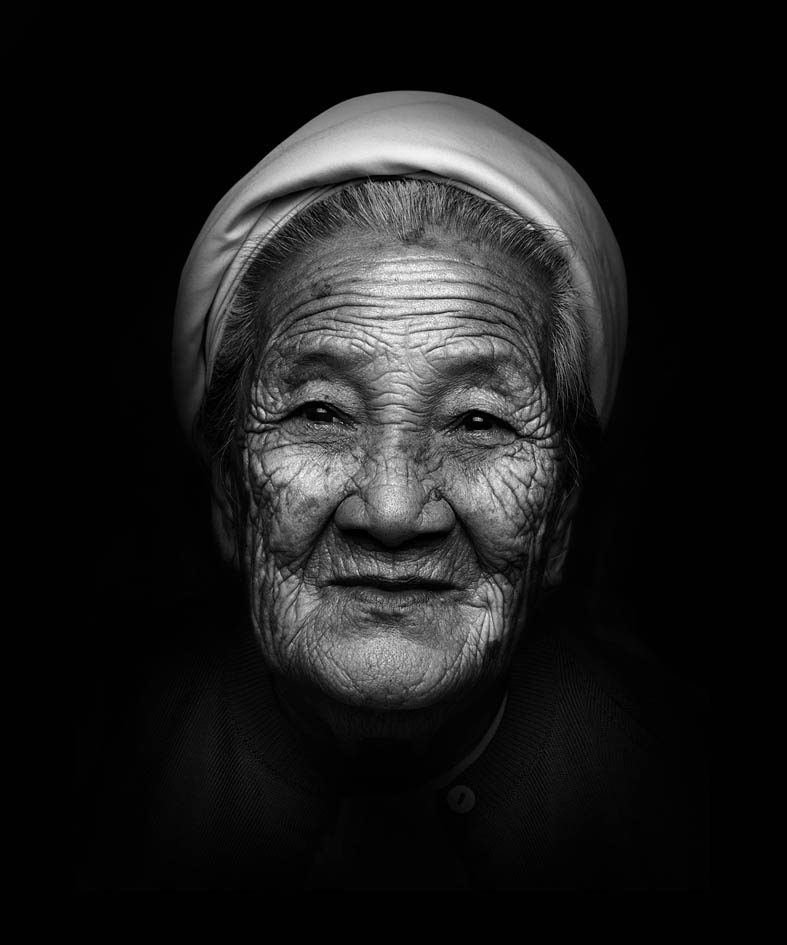
As you enter the darkened space of the ‘Religare art i gallery’, designed to evoke an atmosphere of coal and the ghostliness of a diminishing tribe; the near total lack of light perturbs but the scale of portraits is nonetheless compelling. Realistically captured on 72” x 60” canvas of photographic fine art prints, the facial details appear skilfully presented but viewing these portraits requires more than such obvious observation and the habitual city-dwellers glance, of moving hurriedly from one image to the next. It needs an engagement which is easily missed because the location, the language and culture are barely visible. Although curious about this facet, my initial reaction was that they resembled portraits of Tibetans drawn on silk which I recollect seeing on the Mall Road in Shimla in the 1970’s, so what was the point? However, the images haunted in a strange sort of way so I returned and through my conversation with Samar discovered nuances many others may have missed as well.

Today we are swamped by imagery that provokes and it’s become onerous upon the artist to grab your attention. Samar Singh Jodha desists for he is unable to make an emphatic statement. His engagement is filled with dilemmas and creates an air of simplicity which is deceptive. There are some artists whose work is meant to be looked at while some are meant to be felt and submitted to. The purity of an isolated emotion, its starkness, can be dramatic enough to evoke feeling in an objective viewer. However, when you speak of a people embroiled in the politics of coal, which you seek to help them with and return to the city where you consume the electricity that fuels the very politics you want to address, how does any honest human being even pretend to isolate the conflicting emotions?

The portraits have no titles. It’s almost as if unable to find a unilateral involvement, Jodha distances himself and us, implicit with a sense of guilt and unworthiness to know them personally. Using lighting techniques, Samar Jodha deliberately eliminates all details from the frame except for the facial features which are then dramatically highlighted. He asks you thus to make your own acquaintance with them. It is complex ideas such as these which engage, drawing us into those beady eyes that speak of enduring so much that nothing matters anymore. Each experience is etched in the sinews around the penetrating lens looking out at you and the marks on the forehead that ripple like a turbulent river. He looks straight at you without challenging you to change the world. He is not afraid and there is no sense of blame. It is the forthright acceptance of knowing that the world is a complex place of conflicting interests and that peace lies in reconciling the inevitable paradoxes. He indulges the photographer; enjoys the attention but without desire or rancour. He is an enlightened soul.

A photographer of international repute, Samar’s experience in the field of visual communication includes education and apprenticeship with renowned schools and studios as well as editorial and social communication projects of acclaim; that range from fashion to advertising, a United Nations sponsored presentation on ‘Ageing in India’ and an award winning book: ‘Jaipur – The Last Destination’. His involvement in Phaneng has included an education project, a monastery, and a unique eco-tourism venture that has built local capacity as well as raised incomes. Samar’s proximity to the Tai Phake tribals, their trust in him, evolving over the years spent documenting facets of their life, led him to this project of portraiture where the eyes speak and fleshed lines convey with exquisite subtlety the complexity of his participation.

Her wrinkles are a painting in themselves. Who is she? Is she married to the enlightened one? We don’t know. Does it matter? In our chaotic lives are we likely to meet her? Perhaps not; but somewhere, somehow, we all know someone like her. The quintessential kindness of a nurturing bosom radiates from the eyes of a woman who has given birth many times; saddened by the shadow of infertility that looms because the mining of coal is polluting the water this community drinks. Can we change this reality? Will we consume less electricity to keep alive procreation in a community that is dying out? Why should Samar tell us who she is? Can we be more than the occasional, socially motivated voyeur?

By virtue of the nature of his profession, a photographer would essentially be seen as an observer, but digital technologies have facilitated the camera being more than a mere documentary witness. The world of art has expanded considerably to include much more than painting in its canvas. Today, we see manipulated photographic images that speak more as an excoriation of an artist’s inner reality, than the subtlety of putting forward visages as perceived through patient observation of the external world, which evoke the inner dimension. The distinction between artist and photographer is slowly diminishing, with photography becoming a tool for expression in much the same way as water-colour, installation or video. Images such as these portraits from Phaneng veer away from the dramatization of much that is being seen in art galleries, requiring an informed perspective to evaluate. These photographs emerge through interactions that have progressed gradually where the “gaze is mutual.” The scale of work and its positioning ensure the viewer engages with the eyes of the portrait head-on. Can you look away? Many did.

The angry youth, radiating a deep sense of dejection, the young child, astonished by the blaze of a powerful flash, all have a story to tell. If we had silence in our souls, if we could momentarily eliminate the sights and sounds of a frenetic city life, we may have heard the music of the insects at night; we would have empathy with the disillusioned knowing of their elders, the rebellious gaze of this defiant North-Eastern woman who does not challenge or provoke but simply is. Ironically the coal that is being mined in upper Assam, fuels our eccentrically electrified lives without uplifting theirs, for the locals do not work in the mines, immigrants do. So what does the photographer want us to see? What is his intent of sharing without overtly revealing?

The pace of their lives, contrasted with that which Samar Singh Jodha shares with us, is the essence of what is unfolded. In that environment his stride is different. He brings this to our notice by using the old-fashioned 4” x 5” format camera which he inconveniently lugged across unfriendly terrain, against many odds to record this silent tread that is without rush of purpose or anxiety. The format he uses is tedious, but in his mind it is reflective of the world they inhabit more so than the digital camera. The process of photographing them was in itself an experience. The format does not permit multiple frames and therefore the level of trust, the camaraderie between the community and him is expressed via such sophisticated subtleties that Jodha employs. He brings in the totality of his experience of being a part of this community, accepted by virtue of his involvement and yet never belonging. He faces complex dilemmas and guilt of his complicity with the paradoxical engagement to uplift not because he believes he can change the world, but in slowing his pace, living in their time reveals other dimensions of being that the city has robbed him of and us.

Is there a prayer that reverberates as we look into that middle-aged woman’s face? Did you notice the drawn lines that shield those lips which once readily smiled at the light? Wide eyes startled by an electric flash, lips fulsome with hope, what is the future this child inherits? Are the issues under view relevant to just a distant hamlet in upper Assam; don’t they need to belong in our world with as much engagement as Samar Singh Jodha has ventured into theirs?

In reviewing the nuances etched by the refined details of these black and white portraits one feels chided, for the photographer reminds that viewing is not about being seduced by colour, emotion and digital manipulation. He does not impose his views but prods you to question his reticence and once you touch the core, another whole world is uncovered. Its perspective of time and material so alien to ours, that in not connecting with the initial glance we almost let its beauty pass us by. Samar’s diffidence in the words that accompany the exhibition does not facilitate easy access into the sanctum of his engagement. Is this a telling comment on our viewing facility? Have we have lost the ability to assess the visual dimension which is traditionally equated with a value greater than that of a thousand words? Somehow, it seems evident that no matter how consummate the visual art, we need clarity of thought revealing the artists intent or dilemma. In our hectic over-crowded lives, a worthy vision may well be overlooked without this.