Showing posts with label exhibition. Show all posts

Saturday, 7 December 2024

An Alternative Contemporary, Sunaparanta Centre for the Arts, Goa

An Alternative Contemporary - a celebration of contemporary miniature art.  The exhibition Showcased the evolution of Indian miniature painting and its influence on contemporary artists. Curated by Waswo X. Waswo, telling us how various artists are preserving and re-imagining the art form through innovative narratives and experimentation with the form through video and other media. 


Waseem Ahmed 

I’ve always been fascinated by miniature paintings. I recall copying them from prints one could buy at Lalit Kala Academy in the 1970’s . I absolutely loved the detailed brushwork as also the stylistic rendering of perspective, trees, dress and people. In the early 1980’s I even embarked on a cross-stitch embroidery based on a well recognised miniature. I worked on it for a year, but never got around to finishing it. I still have the unfinished piece and marvel at the very idea of undertaking such fine embroidery. But, it’s the details that I do love, whatever the form or media.


Vinita Sharma 

Monique Romeiko and Vagaram Choudhary 

totally transformed the miniature format. It was wild, creative and technically a feat to have created an artwork where the painting is static but people within it moved about doing yogic postures and other activities. The people are dressed in contemporary dress, in total contrast to the painted style. It was perhaps the most innovative work in the show 


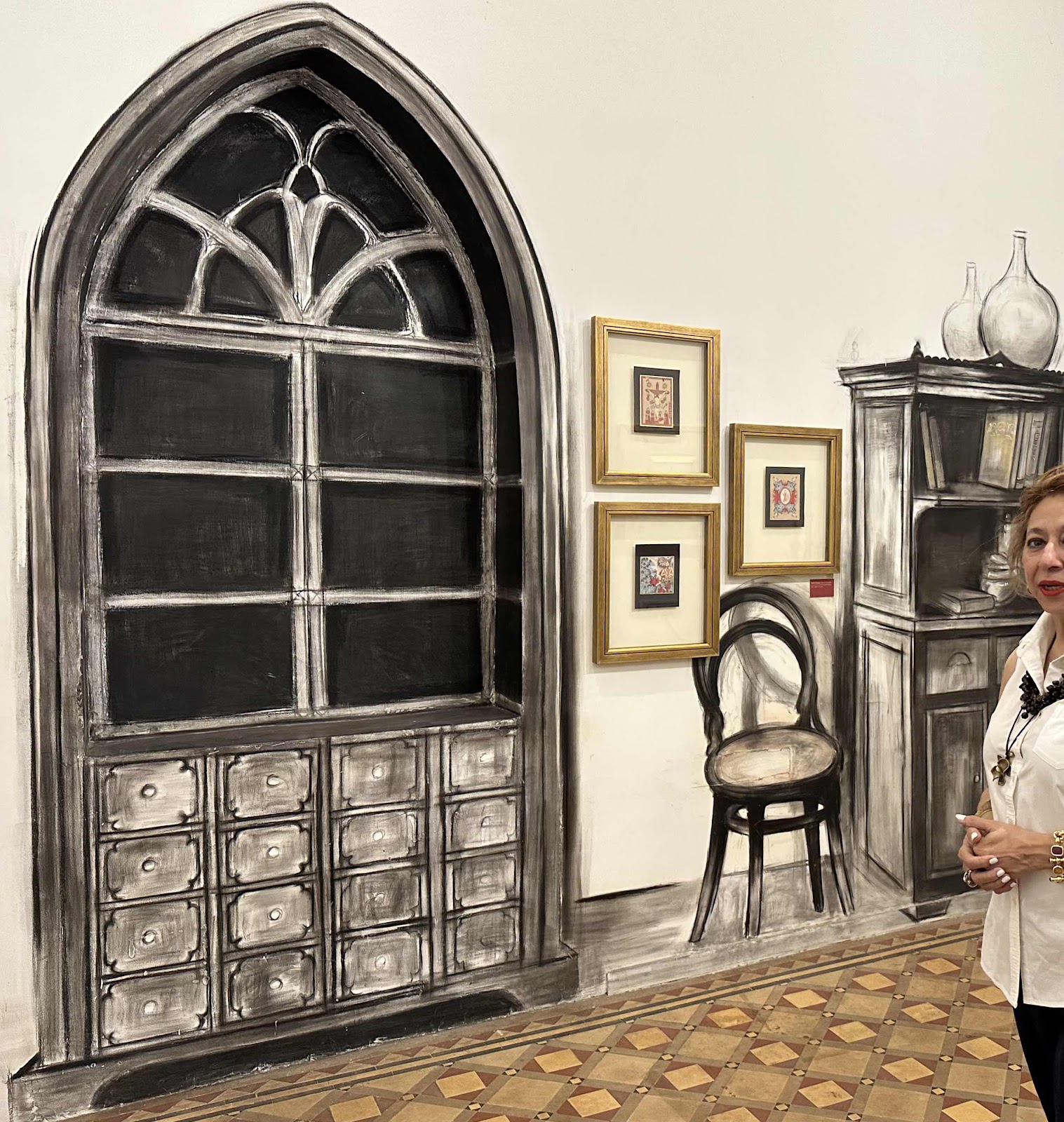
At the far end of Sunaparanta, below the main building, was a small but delightful Gallery tucked away round the back, which showcased the Company Style of Indian Miniature paintings, but with a difference. The paintings  were framed by mounts painted with monochromatic patterns in gold  on cream background, drawing from ancient textiles and spices - re-invoking the legendary spice Trade that was traded not in currency but with India’s famed textiles. They reminded me of the monochromatic colchas that Portuguese officials commissioned as gifts and for private trade. 


The room itself was sheer magic with chairs, sofas, windows, a chaise lounge, chandelier and floor standing candelabra, drawn to perfection in black charcoal on the walls of the gallery. The chair and table beside it, in particular were so realistic that I kept trying to put my glass of wine on it, to free my hands to take a picture. If anything detracted from that charming exposition, it was the gold painted patterns on the mounts that lacked the finesse of brush that painted the miniatures they framed. These works were a collaboration between eight artists. Tulsi Nimbarak, Ghanshyam (chotu), Pawan, Raju Sharma, Sridhar , Kailashchand, Siddharth Gosavi  and Dr. Seema Bhalla 


Alongside the video by Romeiko and Choudhary, was a video by  Eeman Masood literally re-inventing the miniature painting in a digital format. Rendered in true miniature style, the colours and medium transformed the traditional art form. It’s worth the minute watch, as Masood explores dreamlike qualities of a forest painted like a miniature, highlighting the spiritual aspects of miniature painting - where attention to detail and perfection of strokes in minute forms, evoked the very spirit of creation. 


Almost akin to the magnificent formation of many creatures we find in the natural habitat of Goa. These days it’s the blue, brown and red dragonflies that charm : how nature has crafted them so small, so intricate, so perfect. Recently, I spied a couple mating as they hovered over the pool as I swam - floating on the aquamarine waters, mesmerised by natures craftsmanship 


I missed the works from Waswo’s own studio, but he said that when curators include their work it reeks of self-promotion, so they decided not to participate in the main exhibition but painted the walls of the cafe, which is a covered courtyard. Here, he’s posing beside his painted image in the Angan. 


Piyush Sharma 

Vinita Sharma, Piyush Sharma, Olivia Fraser, Waseem Ahmed and Manisha Gera-Baswani among others are also part of the exhibition and it was an eye-opener to see the range of work that is being created. 


Olivia Fraser 

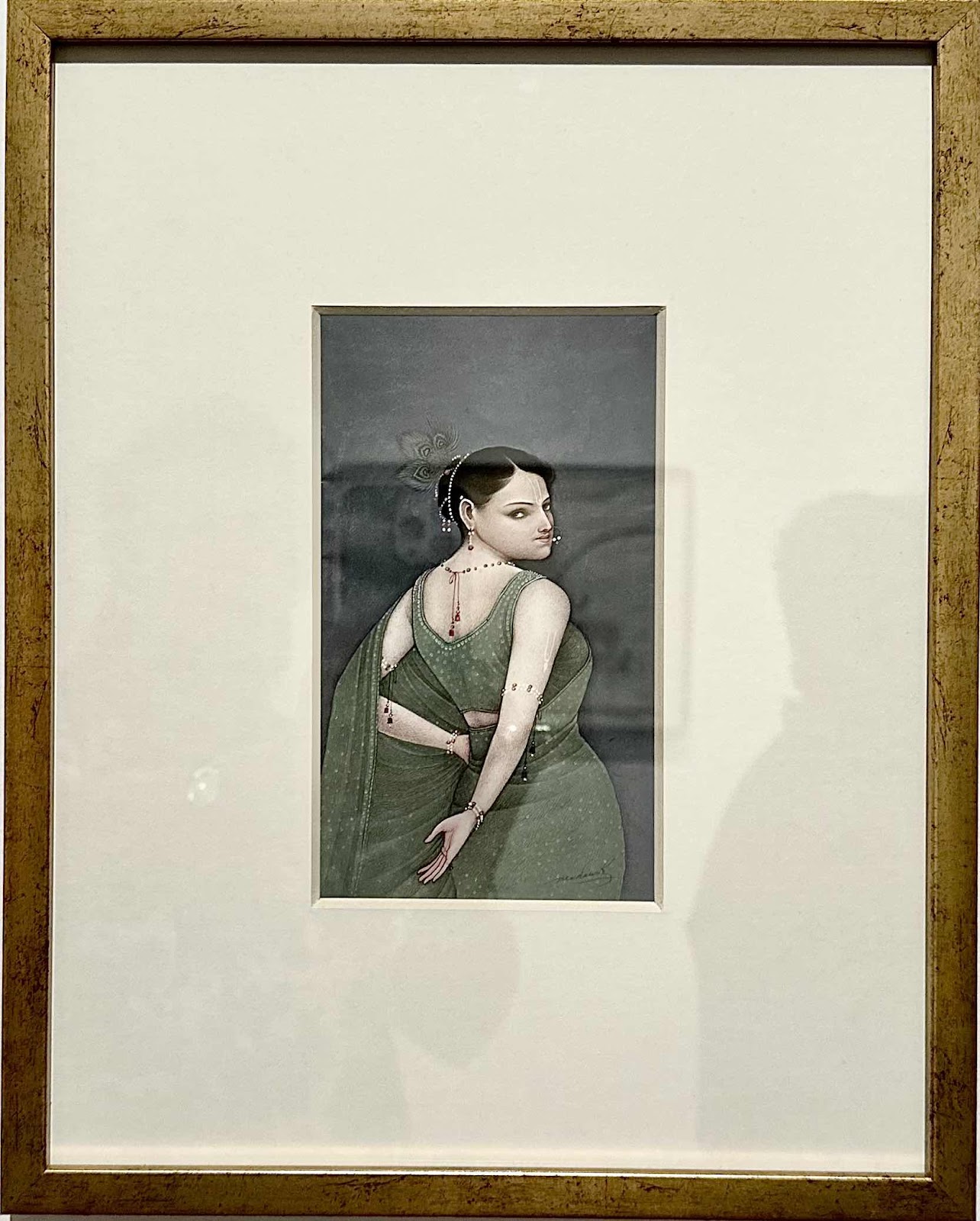
Mahaveer Swami paints the contemporary woman, her gaze ever-so seductive in a nivi-style draped saree. Something one hasn’t seen before in the traditional miniature format. 


Mahaveer Swami 

In Jignasha Ojha’s depiction of modern buildings, one finds a petite woman in a ghaghra down at the right hand corner of the works, tugging at the delicate strings “of all she owns in her home”. As it’s the woman who is attached to everything in the house that she’s made a home with. Taking them with her wherever she goes. Jignasha shared her own attachment to such things and was devastated yet also fascinated that contrary to her imagination there was a woman standing before her art, who had no sentimental value attached to anything in her home. That I had sold almost everything in my Gurgaon home before moving to Goa and hadn’t missed a thing. I remember looking at the emptied apartment and sensing how complete it looked empty as it did before, when it was a lived space, furnished with my stuff! 


Jignasha Ojha 

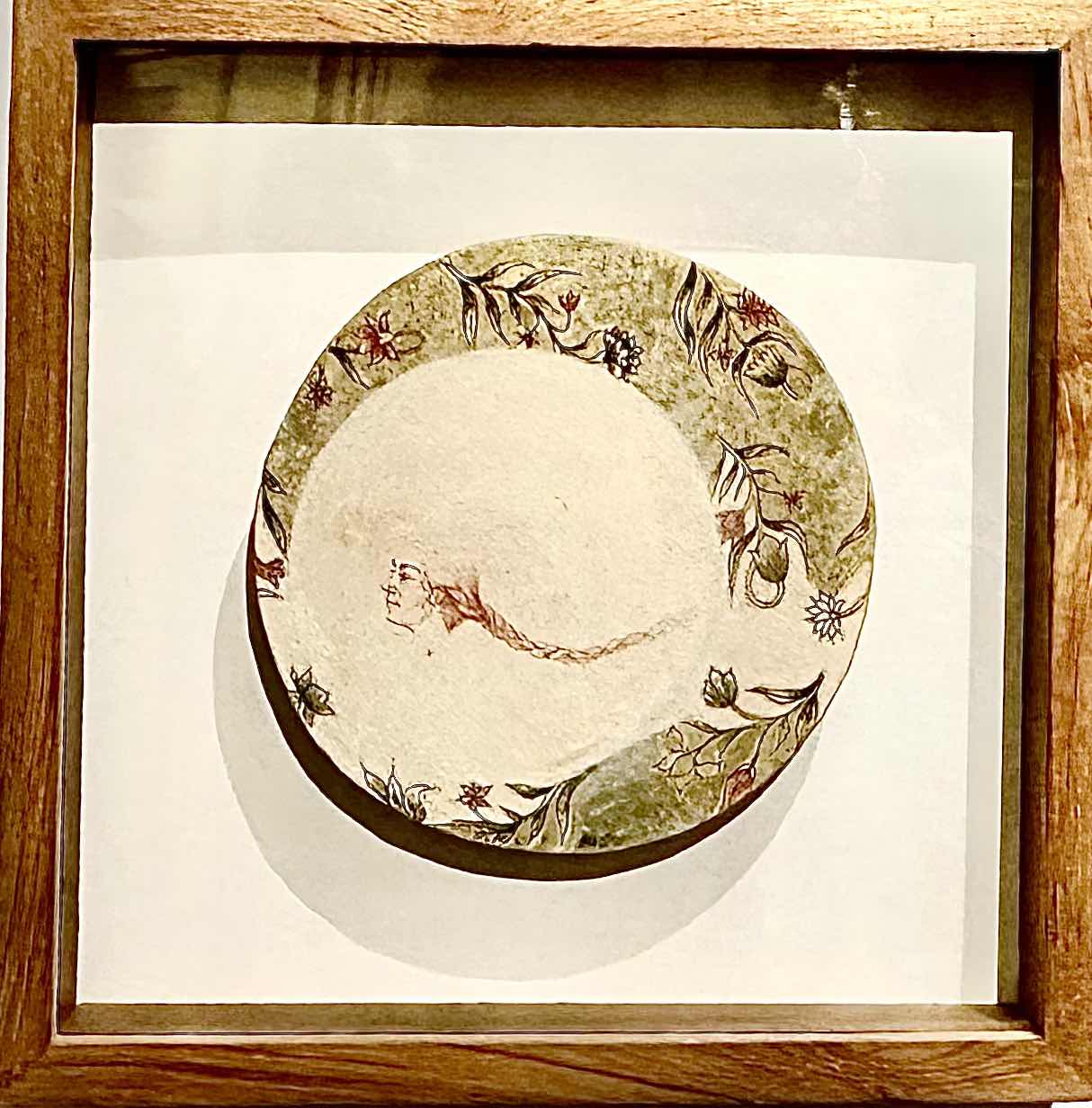
 Ekta Singha interprets of layers of experiences with design motifs and other elements derived from Mughal, Persian and Rajput miniature paintings, evolving a contemporary vocabulary for the form  on surfaces that are painted with metaphorical and personal references to miniature paintings.  


Ekta Singha 

The circular plaques with unevenly placed floral borders which are fading, broken and disfigured in parts, frame delicately painted forms like a broken fragments of a tea-cup, a woman with a long braid being pulled by unseen hands, a beetle-nut cracker and other such quirky images outlined in a dull tone of crimson, placed in a discreet curve of the plague, drawing one’s attention to their significance. 


Ekta Singha 


I was, of course, drawn into the broken cup, looking for the tea that was spilt, the stains it created, but it was bone dry. Without the memories of hundreds of pints of tea one has drunk through the mornings of living, without evoking the energy of stains. Just something so barren, so stoic in its brokenness. 


Ekta Singha 

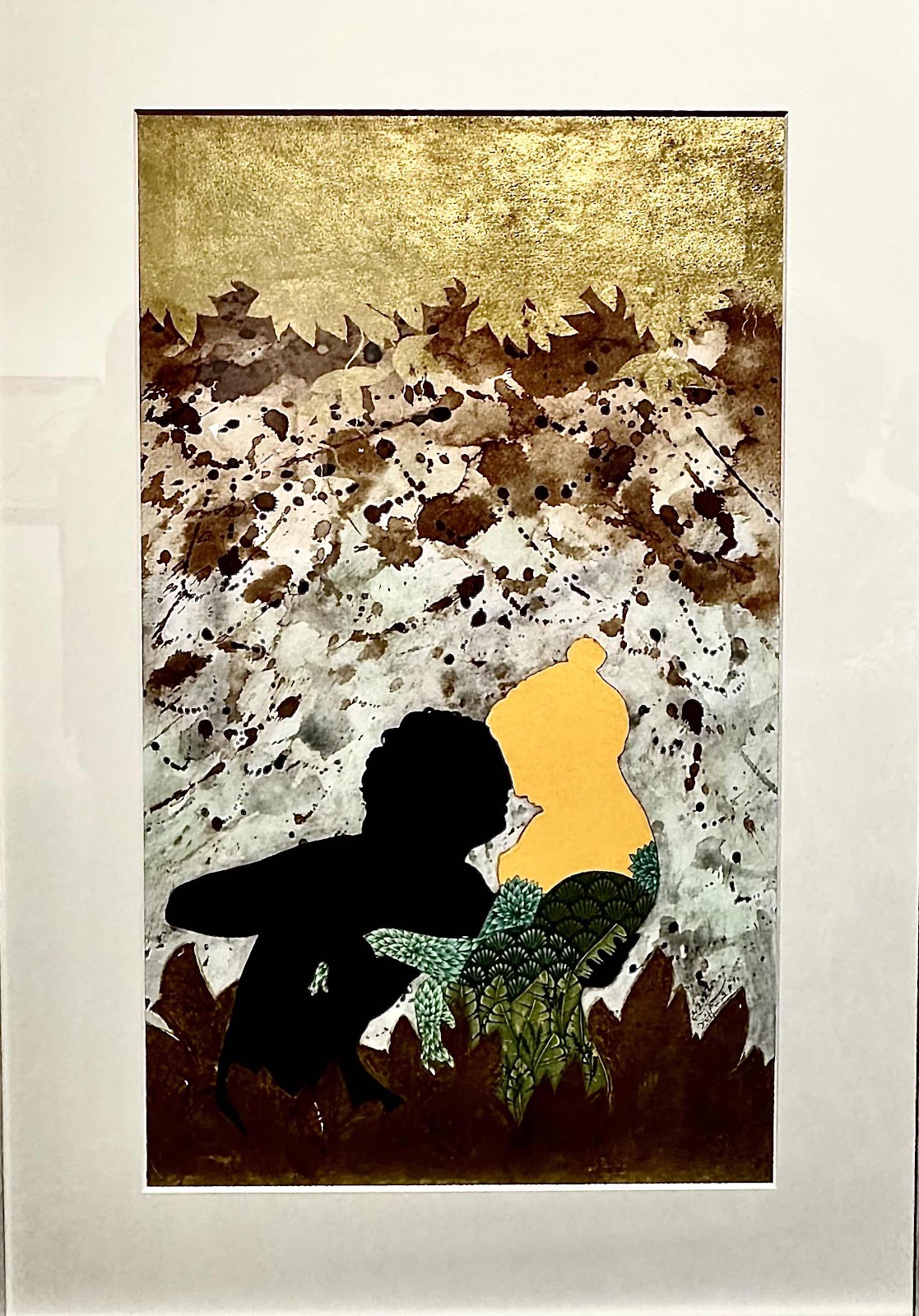
Alexander Gorlizki’s work seemed to reference some elements that we’ve seen in Waswo’s own work, particularly the inclusion of western elements like a Beetle Volkswagen trailing a horse, a man dressed in jodhpurs blowing a bugle, an astronaut pushing a pram and a rotund gentleman replete with top hat and breeches riding a massive seagull. However, Waswo informed me that Gorlizki had been here long before Waswo, as his mother was a buyer from the US, so he frequented India a lot, was familiar with her culture and ideas such that aged eighteen he created a sculpture with Mahatma Gandhi’s trademark round spectacles. Which “was quite precocious” 


Alexander Gorlizki 


Alexander Gorlizki 


All in all, a really refreshing experience. If you haven’t been to see it yet. Do go see the show 


Unfinished embroidery (cross-stitch) based on miniature painting. (NOT IN EXHIBITION) 

Tuesday, 9 March 2021

The Nurturing Forest - Nostalgia for Trees (Exhibition Review) Chandan Bez Baruah, curated by Waswo x Waswo, Gallery Latitude 28


Somewhere In Northeast India, there is a valley. A deep, lopsided and gently undulating ‘V’ covered with dense foliage. Multiple, parallel lines mark the ether above and behind it, as if to denote the parameters of a rising horizon. In this Woodcut print (image 2, 15 x 20 inches, 2020), the artist has chiseled out the surface of the woodblock with minimal lines. Viewed from a distance, the resultant black and white presentation looks like a perfect photographic replica. 


Elsewhere in the same geographic locale, brambles, stems and an occasional leaf-structure form the foreground of another woodcut print (pt ii, 20 x 24 inches, 2020). Within the carved lines of the bramble and leaves – evoking the same minimal mark-making as in the earlier image, a dark space emerges. Is it a cave, a child’s hiding place or sanctuary in the forest, or is it something dark and foreboding – a  forbidden space? A dense formation of insistent, intensely placed horizontal lines define the sky above the rambling shrubbery.  These lines become a recurring pattern in almost all the works on display. 


It was the first art show I was seeing in almost a year. The distress of lockdown and the Covid-19 pandemic aside, being a caregiver is exhausting and emotionally draining. I had been in Delhi for more than three months and hadn’t been able to get out. As my mother got better, I tuned into some on-line viewing but despite the amazing ‘viewing room’ experience, I was itching to see a live exhibition. Not just zoom into the artworks with a digital cursor but get up close - using my body and mind to look, as also imbibe the subtle nuances that one receives from the physicality of art, which a digital experience doesn’t and cannot convey.  And, Chandan Bez Baruah’s exhibition of woodcut prints, curated by Waswo x Waswo, at Latitude 28 ( January 22nd to March 1st, 2021, but may be extended), was just the thing for me. 


Walking into the first floor of the Lado Sarai gallery run by Bhavna Kakkar, I held my breath in awe. Were these really woodblock prints, couldn’t be! The craftsmanship was so magnificent, that I began to wonder if somehow the artist had used laser technology to cut the wodges. But this was more of an after-thought. Surrounded by Bez Baruah’s graphically portrayed black and white photorealist landscapes, one was transported into another world. Not only was the execution mind-blowing, the finely chiselled markings denoting the thriving countryside of the North Eastern region of India was another kind of space. I was imaginatively transported, away from the cacophony of the city and the life-threatening episodes that my mother’s illness had put me and my sisters through. Chandan’s images of dense foliage, were contrarily life-affirming and therefore refreshing. And yet, the blackness of ink instead of lush green was intimidating. I was rejuvenated but only momentarily, as the stark evocation didn’t sustain this restorative effect. 


In addition, the title of the show ‘If A Tree Falls (Somewhere in Northeast India)’ was most curious, compelling me  go beyond the profusion of mountainous growth to consider what the artist sought to imply. Was he alluding to the danger of the earth’s ecology? Threatened by heedless urban projects spreading like an uncontainable tumour, farther and farther into virgin forest. But, it didn’t seem quite so straightforward. Though I could see an abundance of trees or a likeness thereof, the black and white images were contrarily bleak.  Where large areas of black within each frame, created a feeling of gloom. This could suggest the fragility of the jungle -  of flora and fauna endangered by deforestation. But, the artist’s medium of woodcut was a contradiction. I therefore assumed it wasn’t just a lament of the forest, of when yet another tree would fall, and another and yet another. Something deeper was at play, or was it?


As my viewing wasn’t a solitary one, I left the reflections for another time and enjoyed the company of old friends, while admiring the dexterity of Bez Baruah’s block prints.


Historically, block printing on textiles preceded the printing of books using wood blocks and also the famed Japanese Ukiyo-e woodcut prints. Being a textile designer, I’ve been fascinated by this technique since my student days when one learned to print fabric using blocks carved from wood. Engraving a block of wood was not only too specialised a task for novice students but expert ‘block-cutters’, who create the ‘stamps’ from designs drawn on paper, have always been the backbone of  block-printing communities. Wandering through villages that specialise in these textiles, one can hear the inimitable sounds of lumber wodges being chiselled and hammered, emanating from small kiosks and shops of carvers, lining village lanes close to printing units, to provide  ‘chippas’  with blocks ready to print. At the Anoki Museum of Block Printing, just outside Jaipur, I once sat for hours watching fifty year old craftsman Mujeeb Ulla Khan, whose been craving blocks since the age of ten, listening to his stories – of how he learned by watching others, to master the indigenous tools of kalam (chisel), thapi (hammer) and kamani (bow)which he used to intricately carve the surface of the ‘stamp’.


However, artists such as Chandan Bez Baruah, are both carver and printer, making the contemporary art of woodcut prints all the more engaging. One is not just viewing his artistic commentary but also witness to enormous hand-crafting skills, most commendable in an era of technologies that challenge the painstaking work done by hand. With so many printmaking techniques available, it is noteworthy that Bez Baruah chooses this most ancient craft. And that he has perfected his deftness, is even more creditable. 


While many artists across the centuries have worked with woodcut, most didn’t carve the blocks themselves. One of the most iconic, world renowned prints, is ‘The Great Wave’ by Hokusai. This legendary Japanese printmaker and painter, of the Edo period, is said to have been capable of carving his own blocks but probably didn’t, being creative with illustrations and paintings instead. Albrecht Durer, an earlier artist of the fifteenth century German Renaissance, transformed the crude and thick lines of earlier printing with intricacy of detail and subtle gradations. Achieving this through precise carving, he elevated the artform to a level, historically unsurpassed. A notation in his theoretical writings suggests that he carved some blocks himself, deviating from the general practice of assigning this work to a professional woodcutter, but even so it was just an occasional thing. 


Contemplating why Bez Baruah defies convention in this regard I made a study of his prints,  textual material on his art practice and life in the hillsides of the North east region. He was born in the city of Nagoan, Assam, through which flows the Kolong River - a tributary of the mighty Brahmaputra. His mother’s early demise compelled the family to relocate to Guwahati and it  was here that he developed a life-long connection with the woods. Residing in Nagaon, his proximity to indigenous Assamese communities such as the Karbi and Tiwa (Lalung) and their native traditions of living in harmony with the natural habitat, as also the exposure to their spiritual and cultural traditions may have influenced his early association  with nature, but the artist says : “When we shifted to Guwahati city, I became lonely…….Guwahati city is surrounded with hills, and my home also was near the lower end of the hills. I used to go to the green jungle (for) more than entertainment or other activities. In the midst of the jungles, I talked with them. I enjoyed my talks with the jungles more than my friends”.


This intimacy of Bez Baruah’s relationship with the wilderness is reflected in the woodcut images he  crafts. As Waswo,  points out, it is as “if the artist has trekked us through the jungle to his most favoured haunts, asking us to stay silent and observe what he treasures and wishes to reveal……Chandan has heard the songs of birds, the peep of frogs, the swift clicking buzz of beetles and the rustle through the leaves. He has heard trees falling in the forest.”


And yet, I sense that the affability he formed with the woodlands, besides being his sanctuary from the buzzing city of Guwahati, was also a means for him to communicate with the forces of nature and through this, he formed an unconventional bond with an absent mother.  The countryside in her verdure fullness, became the parent. The metaphor of trees falling, becomes as much about deforestation as about loss that human beings encounter, where the demise of a mother is an irreplaceable one. What does a child in the fourth standard do to quell his grief and get on with the business of living? How does he relate to other children at his tender age of nine, who are undoubtedly oblivious of the despair he holds in every crevice of his being: he talks to the trees that stand tall in the untrammelled hills that surround him. And when they start falling, it is as if he is losing his nurturer over and over again. 


The physicality of carving the felled timber becomes  a means to retain this connect with the tree, as also a means to honour and mourn the loss of his sanctuary, his parent. The prints are not mere images of the wilderness that he once lived amidst - a reminder of what we could lose in our carelessness, they are the precious memories of a child that grew up without his mother, who forged a bond with this vegetal environment instead. Gouging out the wood, chiselling indents into its surface, permit him explore recollections as also express his anguish over the fragility of life; something he is all too familiar with. In the process of carving, he both caresses the wood and destroys it. The tree is no longer a living thing, but its memory lives on through the woodcut print – the proverbial paradox of life!  


Initially Chandan used wood blocks to carve with, but when he moved to the National Capital Region, he found it easier to source MDF or medium-density fibre-board. Although I have not seen his earlier work and whether or not he was able to achieve the same fineness of lines and details, the smooth surface of this reconstituted board,  made by fusing fine wood fibre and glue, can be manipulated much easier than actual woodblocks. And the artist has used this to maximum effect with his photorealist prints. 


While the natural habitat dominates most prints, there are some deviations too. In the middle of extensive shrubbery, one can spy the roof of a cottage. In P-II Woodcut print (14 x 20  inches, 2020), the fibre has been scooped out to imply both the crudeness of the construction as to also retain the  hallmark of the traditional woodcut print. Here, the tools that hollowed out the wood leave a distinctive stamp – of history, of naivety and lacking the finessed technique the artist has otherwise cultivated. In the midst of ultrafine carving, this act seems a deliberate harking back to the past and of imaginatively preserving a jungle refuge. A home away from home, perhaps more comforting than the four walls that defined one for the artist. Surrounded by a thick undergrowth, there is no way into this abode nor out. All one sees of what lies within, is a stamp of darkness. Black ink that is retained on the surface of the board – the area that is left intact and not carved or torn away from the resource. The hedgerow expands and lengthens to create an incomplete bower over the cottage and the space in between is hollowed out with a Dremel tool, to create tiny dots. Instead of stars twinkling, I like to think of them as fireflies in the sky.


Bez Barhua is not content with intricately carving and printing single-block prints that are approximately two square feet in dimension, he ventures to create larger landscapes with four such blocks and the precision with which he does so, is riveting. The eye goes over and over these quadriptych prints. The precision of the print and meticulously engraved detail denotes a superhuman effort. I work in hand-crafting textiles and can get utterly frustrated  with the laboured pace or if I fail in trying to achieve the desired modicum of perfection. In this digital age, where machines do anything as good or better than the hand, and most hand-crafting skills and produce serve as mere nostalgia or novelty, it would require incredible discipline to persist with such painstaking endeavour and level of proficiency. Bez Baruah’s tools range from traditional Swiss and Japanese tools and those which he has developed himself. And, even though MDF is markedly easier to carve than the wood blocks he earlier sourced from Assam, I just cannot get my head around his determination to achieve this kind of realistic representation. Especially with digital cameras and photographic prints rendering such effort superfluous. But, the artist deliberately creates this photorealistic likeness, working with photographs that he himself has taken (possibly in recent times).


Yet, if one zooms into the images, putting your eye to the glass that contains them, the impression of marks are minimized, rendering them more abstract than real. Dense foliage is not a collection of perfectly carved leaves as the camera can reproduce, but myriad amoebic squiggles floating over the mountainside. However, stepping back, the impression of every single foliole engraved in perfect detail, is recreated, by the same marks that do not remotely resemble a leaf as recognized by the human eye. Chandan Bez Baruah prefers illusion to exactitude.


In other prints, peering close, multiple cross-hatched lines appear to be placed ad hoc, which along with the amoebic marks on the hills become  cognizant of the output of a contemporary state of mind. But, look again and you realise that each line, each mark, isn’t random or carved with indignation, impatience or angst, reflective of the average modern temperament. It is a kind of meditation. Where each line or mark is evocative of the character of the jungle as he knew it, as Chandan remembers. Looking back on these scenes with a sense of inaccessibility, emulating the photographic capture of light from the surface and texture of foliage as seen from a distance. More illusory and intangible than figurative, is a conscientious attempt at reiterating and recalling the magical comfort provided by the jungle. Where every stem that crossed over the other, did so because that was the only way it could develop. Able to chart its relatively unhindered path because no-one came along to way to prune it, to make it bend to this convention or other. Every leaf, or evocation thereof, that Bez Baruah carved is a deliberation. Every dot is essential to the randomness of the wild, unimpeded growth that nurtured his soul. Snuggling into the ‘anchal’ of an absent parent, exemplified as the omniscient spirit in the forest’s ample lap of nature.





Tuesday, 26 November 2019

Viraj Naik's Imagined World, Sunaparanta Goa Centre for Arts, Goa


The first time that I saw the works of Viraj Naik, was at Gallery Nvya in New Delhi, at the start of the millennium. The recent solo exhibition titled ‘Ordinary Superheroes’ curated  by Leandre D’ Souza, was the Goan artist’s first showing after a hiatus of fifteen years, and was hosted at Sunaparanta Goa Centre for the Arts, by its patrons Dipti and Dattaraj Salgaoncar. The collection of ninety-five ink drawings, etchings and sculptural works on display, was a continuum of his fascination for the anthropomorphic forms of animal-man, which follows a primeval tradition.
 
pen, ink and graphite, 20cm x 29cm,  2018
 
In the modern world, he is preceded by Picasso, who not only painted the ‘Minotaur’ or ‘Bull of Minos’ (conceived by Minos's wife when impregnated by a bull), but is said to have identified with the human and animal principles of the creature that donned the head of a bull on the body of a man. However, ancient man was also familiar with such human hybrids, depictions of which were present in antediluvian lore, appearing in cave paintings as early as the Late Stone Age, approximately 10,000 to 50,000 years ago. Ethnologists conjecture that these portrayals - of beings with human and animal features were not necessarily physical representations of mythical hybrids, but were most likely  attempts to depict shamans in the process of acquiring the mental and spiritual attributes of various beasts or ‘power animals’. Of reaching altered states of consciousness, in order to perceive and interact with the realm of spirit, channelling these transcendental energies into the physically manifest world.
 
enkindle, Etching, 10cm x 8cm, 2016
 
Remains of mythological hybrids have also been found in prehistoric burial sites, where skeletons of horse-cows, sheep-cows, and a six-legged sheep had been formed by joining together body parts from carcasses of different species. A practice that is believed to have been an offering to ancient gods.
 
pen, ink and graphite, 20cm x 29cm,  2018
 
In the midst of viewing this exhibition, we  were celebrating Ganesh Chaturthi across Goa, with much faith, fervour and colour. Known as Ganapati, Vinayaka, or by numerous other names, this elephant-headed god of wisdom, knowledge and new beginnings is one of the best-known and worshipped deities of the Hindu pantheon, especially in Maharashtra and Goa. A short while later, I was in Delhi celebrating Diwali which in North India is a celebration of Rama’s return to Ayodhya. In the epic Ramayana,  the simian god Hanuman is credited for aiding his victory over the demon Ravana and safe return of Rama’s consort Sita.  Both Ganesh and Hanuman are part animal, part human. Animals or their anthropomorphic forms are an integral part of the Hindu pantheon as either god's in themselves or vahanas or vehicles of god's. Many of Vishnu's avatars are also part human and part animal -  Matsya, sometimes portrayed with a  human head  and torso with a fish body below waist, saves Manu the son of god from the great deluge. Kurma appears in the form of a tortoise or turtle to support the foundation for the cosmos and the cosmic churning stick (Mount Mandara) for the Samudra Manthan.  Others, are Varaha (with a boar's head) and Narasimha (with lion's head). In addition, the mythical cow, Kamadhenu, who is considered the mother of all other cattle, is often portrayed as a cow with human head, peacock tail and bird wings. There are many such examples where much of this culture and worship is said to have arisen from a policy to protect animals.
 
 pen, ink and graphite, 20cm x 15cm,  2019
 
While Naik concedes his fascination with the study of mythological gods with animal-like figurines - be it Hindu, Greek or Roman, he also says that it is his perceived relationship  between human and animals that emerge in his hybridisation, bringing out the animal instincts that he feels all humans possess. “For instance, if I feel a person is aggressive like a tiger I would depict him with a head of a tiger" says Naik. Adding a simplistic, contemporary angle to the mythological ‘untamed lion man’ ‘Urmahlullu’  who was, contrarily,  a guardian spirit in Mesopotamian mythology, where  its image was used to ward off destructive demons, including the ogre of death. He is also found in seals of the Indus Valley, evolving into a lion-centaur goddess wearing a head-dress with a long pendant whose body merges with that of the tiger. An image that has similarities to what later became associated with Durga, the goddess of war.
 
Despite the antiquity that precedes his anthropomorphic renditions,  Viraj Naik is not deifying his forms.  Nor is he enacting some shamanistic ritual to connect with any power animals. Some of his depictions are socio-political statements about the animal nature of the contemporary human race, including quirks  that materialize through his imagined beings.  Societies are populated by all kinds of people. Some, aware of their socially undesirable behavioural patterns, manage to project a carefully cultivated but false personality. Presenting his etchings and drawings as a mirror  to detect deceitful, fearful, foolish, conceited or angry animal traits within the homo sapiens frame, Naik could also be suggesting that, like animals we too possess the ability to sense or ‘sniff out’ such untruth.
 
However, his  ‘Super Heroes’ are not necessary pleasant to behold. If you allow yourself the indulgence to get squeamish, it’s like beholding creatures that somehow got mixed up in the creative process. You wonder if the forces of life are experimenting, if Naik is using his own artistic ingenuity to consider what kind of species he would like to inhabit the universe. Speculating, why these perversions would find any value in a world where men and women have devised ways to perfect any perceived imperfections in their bodies and, where animals that presently pervade the planet, do not remotely resemble the organisms that Viraj envisages.
 
pen, ink and graphite,
20cm x 15cm,  2018.
 
What can one make of a fish-face with humanoid teeth, wearing a necktie – or it could have been a fin protruding from inside the buttoned-up white shirt and black suit-coat, of the monochromatic interpretation. Imagine being a  gill-bearing aquatic craniate who swims freely in the vast Arabian Sea, and you force yourself to wear a necktie and suit. But without the biceps and triceps of the human arms, empty sleeves of the jacket hang listlessly. Whether the fish-man had legs or tail is left to conjecture as the drawing focusses only on the torso. While the image generates a sense of the absurd and even as the implied vision of a slippery creature caught within the confines of a corporate suit, does percolate through, it doesn’t really seem odd because the proverbial world of commerce is rife with such characters, isn’t it?
 
 
Not all the animal features were as easily identifiable. There was one face wearing a cap too small for his head. This, in turn,  was too large for its  quadruped body, which was part animal with fur and paws in the forelegs and two sturdy and stocky hind limbs with their feet shod with socks and shoes. His profile displayed a smallish eye, pointed nose and a smile that seemed a bit too cheesy. He was surrounded by trees and shrubbery and I had the distinct impression that he had just stepped out for a game of golf or some such, when the artist transformed his body thus. And, the man remained smiling or unaware, or plain simple didn’t care what he looked like or was seen as. He seemed blissfully absorbed in the machinations of his own extra-large head to care what anyone thought, or notice if anyone else even existed.
 
pen, ink and graphite, 29cm x 20cm,  2019
 
For most part however, Naik focussed only on presenting the face, with no body to distinguish the kind of animal he intended. The eyes in one or two such portraits were definitely shifty. One face donned an adaptation of a fez cap, clenching his teeth, and the other had short horns on his head – actually the horned face didn’t look nearly as shifty as the other, more like the furtive glance of someone scared. If this wasn’t enough to  intrigue, you were confronted by a the otherwise menacing apparition of a boar with an unusually docile, subjugated expression. It had an alligator or crocodile’s body that was stood upon by a diminutive elephant and an oversized parrot with relatively shortened horse legs and hooves, but nonetheless, gleefully towering above the dwarfed tusker, who glowered.


What kind of world is this? What's the necessity of contemplating such unlikely forms that colonize Naik's creative biosphere. If it weren't for Viraj's perfect drawing skills, these images would merely intrigue on an intellectually superficial plane. But precisely because his technique was so marvellous, one got up close and peered at lines, crossing, hatching and layering to create form and shade and superlative textures. His marks were masterful and this ensured that the viewer didn’t  leave the gallery space horrified, disgusted or plain bored. It was through the process of observing, of examining those lines and their gradations that one became less conscious of the oddness of these anthropomorphic and zoomorphic creatures, to maybe find empathy, parity and perhaps some insight, whilst acknowledging the artist’s prowess to  draw you into his weird-weird world.
 
The inventive presentations may look unnatural, which is perhaps an effective tool to get your attention and nudge you cogitate. The images are such that, once you get involved with their characters, you cannot ignore them. Although the artist suggested we find ourselves in these forms, I for one, was unable to locate myself through the visualised hybrids, partly because, barring a few obvious associations, it was unclear what exact animal and its propensities he was expressing through them. The forms were not evocative of organisms or traits that one could easily relate to.  However, if some viewers did spot a measure of resemblance, it would not be in their outer manifestations but in their sense of self or as perceived by others.
 
 pen, ink and graphite, 20cm x 15cm,  2019
 
While employing the elemental modus of human portraiture, the artist caricatured the traditional features with animal physiognomies, which were not always jarring but sometimes even amusing. If we are indeed so, can we not see the humour in our warped-ness? After all, which one of us doesn’t carry some kind of dysfunctional baggage and subconsciously play this out to disastrous or embarrassing consequences. Within his philosophical renderings and pondering upon human-animistic inclinations Naik reminds, that biologically, humans are animals too. And like these quadrupeds, we too commit acts which are an inherent aspect of our natural disposition. But it is the moral code that he proposed, questioning whether our inborn tendencies are acceptable, simply because they are intrinsic to our nature, is where I felt  more than a trifle miffed.
 
For, surely it was with the wisdom of understanding that it is only through acceptance of how we are, that we can hope to control the unnatural expression of human reactions that, an ancient treatise on the arts, such as  the Natya Shastra (compiled between 200 BCE and 200 CE) listed eight bhavas (emotions or sentiments) with eight corresponding rasas (aesthetic flavour evoking emotion or feeling) where, love and laughter are depicted alongside anger, disgust, terror and sorrow. There was apparently no censoring or shaming for any expressive response in those times. Therefore one imagines a limited degree of suppression and consequential hyperbolic emotive outbursts.
 
But Viraj Naik is not alone in voicing such ideas. There appears to be  a growing trend in  contemporary society, to advocate suppressing rather than expressing the uncomfortable-to-deal-with feelings, like anger and sorrow. It is this, more than anything else, which creates the overstatement of passions which then manifest as ugly or unmanageable. For instance, anger as a response is not abhorrent in itself. It is a very useful feeling that reveals what appeals and what doesn’t, which aids in setting personal boundaries. This emotive response only becomes disruptive when, unacknowledged and repressed, it finds articulation as vitriolic rage.
 
While it was drawings and etchings that formed the major corpus on view, one small gallery was dedicated to digitally worked pictographs. I found these fascinating. And, their dark auras didn’t require much analysing or scrutiny. Spaces and mythologies were superimposed and probably came from varying eras of civilization and across cultures, but the specifics seemed secondary to the atmosphere which enveloped you within the gallery space that was occupied by these pictographs.
 
 
Raurava, pictograph, 25cm x 28cm, 2019.

Drawings and etchings require a laborious and mostly meditative process of execution - where thoughts and feelings come and go as the hand continues with its work. The correlation of hand and mind at work where the procedure is relatively mechanical, as in these imaginative drawings - of a technique perfected over years of accomplishment and experimentation, is recognised across spectra of hand-crafting to be a process that aids the sublimation of one’s emotions. In contrast to the pictographic compositions these renderings seemed too finessed, merely skirting the fringes of a much deeper hypothesis. A premise which was disclosed effectively through the dramatic tones of the digitized images. Viewing their dark and foreboding vistas, which exaggerated rather than reduced the intensity of sentiment, the ominous tonality and ghostly apparitions became an inevitable encounter with the menacing aspects of mankind. In effect, the pictographs brought to the fore, the kind of indigence that could befall our world, if humans with untrammelled tendencies are allowed to dominate the planet.

Sunday, 10 March 2019

Tearing The Heart Out


Navjot Altaf -  A Life In Art, curated by Nancy Adjania, NGMA, Mumbai


 It was in 1997, while working on a textile revival project in Bastar, that I first heard of Navjot Altaf. While driving from Raipur to Jagdalpur, when we halted at Kondagaon,  I learnt of the project she had recently started there. I was intrigued because the villages of Bastar were unlike any other in India. The poverty and worldly innocence I had witnessed proved a tremendous test of conscience in resepct of the assignment I’d been hired for, and I wondered about her experiences.  Reading about her art and seeing some videos and sculptures at galleries in Delhi and on visits to Mumbai, had not been enough to get to the nub of her contribution or challenges.  So,  when I heard that Nancy Adjania had curated a retrospective of her oeuvre, slated for viewing in December 2018, I co-ordinated my travel plans to Kutch, returning via Mumbai, to ensure that I didn’t miss seeing this exhibition :‘The Earth’s Heart, Torn Out.’
 
 
Displayed  within  the semi-circular, multi-level galleries at the historical Sir Cowasji Jehangir Public Hall – a late-colonial, Science Society building subsequently converted into the National Gallery of Modern Art, were paintings, drawing, prints, posters, sculptures and videos rife with an emphatic express. Of a radical artist, who as a young schoolgirl, “while running wild in the pine-covered valley of Dalhousie…..felt the first stirrings to be an artist”. And her art, spoke evocatively of an innocent soul’s, almost violent response to a perceived violation of that sense of freedom. Where, as curator Adjania pointed out “She will fight every sullen bureaucrat, hostile censor and pursue every clue until she has a kaleidoscopic view of the situation at hand.”
 
Emergency, Silk Screen Print, 1977, 20 x 15 inches
 
Her artistic yearning to break free, from the binds of authority, gender, caste, tradition and even the physical confines of the body, was seemingly heightened by the spiral stairway - its coils contributing to the excoriated angst, rising towards an imagined goal of liberation. Beginning with images from pre-college years, intermingling with experiments in the socio-economic dialectic of Marxism, weaving through the politics and ideals of feminism, meandering towards the life, livelihood and art making of the Adivasis of Bastar; culled from an art-practice spanning half a century, was a rather overwhelming exposition of over two hundred art-works. Snaking their way up five levels of the gallery, culminating with the iconic dome-ceiling projection of a sublime video.
 
A ‘transcultural’ artist, travelling between Bombay and Bastar, while also collaborating or interacting with artists and researchers across Europe, the US and Latin America. Navjot Altaf’s trajectory could well be termed a quest, centred not on the pursuits of the unseen, abstract notions of self - beyond the physicality of form. But, more like a mission to understand the political dynamics of an unequal social milieu and locating herself, through this exploration.  Defining the tonality of her own voice - speaking from within spaces that were not as privileged; facilitating their discourse vide her own indignation.
 
Video Still of ' Soul Breath Wind'
 
The title for the exhibition is cited as a tribute to voices suppressed by apathetic authorities, presented in the film ‘Soul Breath Wind’. Of assertions of the people of Chattisgarh denouncing unregulated mining of their land in connivance with the State. And where, Nirupama, a farmer from Chattisgarh, in warning of the disastrous outcome of displacing them from ancestral lands and of disemboweling the earth, says: “Purein dharti ka kaleja nikaal diya”. And,‘ The Earth’s Heart, Torn Out’ also becomes symbolic of Navjot’s creative outpouring.
 
Ancient Water Sign, Nalpar, Bastar
 
At the base of the dominant, spiralling, chrome stairwell leading from the ground up into the impressive vaulted ceiling, spanning the fulness of its generous curve and not unlike graffiti, was an odd sort of marking. The blue symbol painted on freshly white-washed, cemented walls turned out to be an ancient water sign. It was part of the Nalpar project in Bastar, which had matured from studying the parallel but different modes of art making, (her own and the Adivasi’s) into creating innovative public sites where women, children, and men of all ages come for the mundane job of drawing water for domestic or other usage. In studying the significance of signs, symbols and objects incorporated by the communities during rituals and social functions, their integration and continuance, over centuries of living and in their spiritual life, this symbol became one of the structures designed in collaboration with the Adivasi artists. Transforming hitherto uncomfortable and unhealthy modes of collecting water into an aesthetic activity. An unusual art project where the participant was also a viewer as well as, a possible, future user of the site.
 
How Perfect Can Perfection Be, 2015-2018, Water colour drawing on Wasli paper and PVC transfer on acrylic, 22.5 x 32 inches each

There was no specific chronological order to the display. Adjania placed Altaf’s photographic series ‘Abdul Rehman Street’, shot during her student days in the early 1970s, alongside recent, millennial water-colours, on the ground level.  Emphasizing the non-linear progression of the artist’s creative development, she collated various other phases, on subsequent ones. With her portrayal as a young woman through Marxism and JJ school of Art on the third floor and effects of ‘violence on sociality’ on the second. Structuring the show such that each phase is self-consistent within its space/level and the curatorial mise-en-scene allows for conversations across the various levels in the spiral-shaped NGMA building. 

 Factory Series, 1982 - Ink of Board Paper, 24 x 30 inches
 
Here, in dramatic, high contrast black and white tones of ink onboard paper, of the ‘Factory’ series, made during the turbulence of Bombay’s labour movement and disruptive textile strike of 1982, Navjot compelled us bear witness to image-fragments that, bereft of human presence, and by implication humane ideologies, implode upon themselves. Exemplifying the militant approach of Dutta Samant - the movement’s trade union leader, which successful to a point, ended in disastrous defeat: of jobless workers and factories converted into real estate assets by factory owners.

On level four, in revealing ‘transgressions’, Adjania tells us that “Navjot was deeply troubled by the gaping lacuna in regard to gender inequality in Marxist discourse”. A question that opened up “both ideological and iconographic problems” compelling her “redefine the representation of the woman’s body… imprinted by the insidious forces of patriarchal socialisation.” Drawing inspiration from female surrealist painters Carrington and Kahlo who refused to “play the muse to male artists……foregrounding their own desires and subjectivities” Altaf appears in a self-portrait, with large spiral coils emerging from her vagina. In another painting, from the early 1990s, colouring the background of the canvas in a powerful shade of red and representing the female body through tactile, pebbled textures, was an endeavour to legitimize the act of masturbation. Navjot thus, drew attention to the pleasuring female self – rarely depicted in contemporary Indian painting.


Being an artist myself,  makes the act of viewing an informed and engaging process. But, seeing effort of this diversity, intensity and scale, one somehow overlooked the details of every canvas or watercolour brushwork and video, going beyond specifics of each, searching for the artist. Where did Navjot Altaf stand in the midst of these marks - the ridges, rents and commentary zig-zagging the complexities of contemporary society which had provoked her art. And what was the crux of her cry?
 
 
I read her commentary as a pursuit for relevance. To find meaning and purpose and also one of frustration in the inadequacy of art alone, to do this. Which almost contradicted the free-spirited run in the woodlands, awakening the artist in her.  On level 3, Through the ‘Proyom’ posters, in “Dreaming of the Revolution” art is designed for modes of public communication, but in that tonality of stark contrasts – of marks weighted with rigidness of steel/ mortar/glass and urban an imprint, it was impossible to trace even a glimpse of the free soul that once roamed the pine covered valley.
 
 Surfaces,  1970, Recreated in 2018. Ink on Gateway
Tracing paper, set of 12,  11 x 15 inches each

 Surfaces,  1970, Recreated in 2018. Ink on Gateway
Tracing paper, set of 12,  11 x 15 inches each
 
As I walked from image to image of strident lines and compositions, listened to the cacophony of videos competing to be heard; the responsive outcome of this audio-visual impress, which crowded and stifled my senses, was empathetic. I too wanted to see her free.
 
 Surfaces,  1970, Recreated in 2018. Ink on Gateway
Tracing paper, set of 12,  11 x 15 inches each
 
Thoughtful, I sat on one of the benches trying to clarify my insights, but multiple videos playing simultaneously with full volume, jarred. The sound of crashing oceanic waves, a woman wailing or something akin to howling and then something else superimposed on these audios, was disconcerting. But uncannily, it also evoked the artist’s many voices. A constant, conflicting inner dialogue externalised through art, overlaid on the walls at all the levels I had ambled through. An attitude that struggled and fought but intended to find a way. A fundamental vision that had the passion, the will, the courage to express its confusion and it's floundering  anxiety. And  the lacunae – not just in the attempt to listen to the testimonies of those affected in the communal riots in Gujarat in 2002, but a generally pervading inadequacy. In the willingness to really listen and the foreboding of not being heard.
 

Lacuna in Testimony, video still of 3 channel video with 60 mirror pieces
 
Reminding again and again of the churning and constant thrust of unequal forces in the social fabric that intimidated and magnetized the artist to seek a larger purpose, beyond the personal. Defying the intellect and its formalized learning, as she  witnessed the fallibility of existing knowledge in tackling the inequalities pervading the socio-economics of contemporary living.


Dev Nathan and Vasanthi Raman, core group members of Proyom and Navjot’s friends from 1970’s, interviewed in Anand Patwardhan’s documentary, Prisoners of Conscience in 1978

 
The 1990s proved a turning point, as art installations paved ways for artistic collaborations that not only altered conventional art-viewer relationships, but provided the potential for collaborative democratisation. And the earlier threads of Marxism, feminism and activism, inspired by debates on demarcations between westernized forms of art and rural craft, coalesced. Where, from 1997 onwards, Navjot began an active collaboration with Adivasi artists sharing in their lives and improvising a two-way learning and art-making process. Cultural-theorist Nancy Adjania, who has followed Altaf’s work closely, informed that the transition from Bombay to Bastar was not easy. “She and her artist colleagues found themselves working hard to overcome the barriers of class, gender, location, language, education and world-view.” And, that it took two decades of engagement with Bastar, to evolve new forms of artistic dialogue through collaborative and cooperative projects such as Nalpar, at the micro-political level of village and district.
 
The retrospective exhibition as a whole had a profound but disturbing effect. It made me revisit my own anxieties with regard to a self-absorbed, isolated art practice. There were no pretty pictures to comfort, nor transcendence to  reassure. It was all about community and the trauma of belonging and unbelonging. A veritable abduction of the self. Yet, when she brought back hope, it was harking back to Marxism. In the capacity to live together, among each other as equals.


They Clean our Compound, 1977, Silk-screen print 21 x 14
 
Wading through the dark messages, doomed social inequity and cries of careless living tearing out the heart of the earth, exhausted by the gloom, I heaved myself up to the last level.  What else could there be to learn about this devastating world, where all her struggles had not achieved enough to let the light shine through – for tranquillity of soul to prevail in the accomplishment of its goals.
 
Links Destroyed and Rediscovered’ (1994)  Site specific installation
 
Reaching the last step, I was confronted with an unwieldly plethora of dark, black, plastic  pipes spilling out like the ghastly excess of sewage in our polluted cities. Contrasted with this, on the opposite side of the stepped passage was a reprieve in the minimalist, meditative grid-mesh of  ‘Between Memory and History’. Where Navjot had created a secular shrine, replacing the traditional vermillion thread prayer-knots of a dargah, with white paper ribbons inscribed with questions and words “from testimonial literature” that the viewer was invited to open.  I did, to find the telling words of “abduction” and some illegibly over-typed text, signifying a lack of clarity, so essential in finding the answer to one’s prayer.
 
‘Between Memory and History’, Site specific Installation
 
From Partition, female infanticide, to factory strikes, unregulated mining, riots and pogroms, to collaborative practices with Adivasi craftsman, the irrepressible artist-activist in Navjot Altaf had involved herself in myriad ways with a chaotic and seemingly unfair world. She had an opinion on many matters and hadn’t averred from expressing volubly.  An artistic journey riddled with the scars of a traumatic path, was an equally dark and distressing passage, for me as the viewer.  She presented  social conundrums, gender issues and artistic concerns, but the overwhelming question that I came home with, was of myself as a creative individual in such a dysfunctional and disparate society. In Fin-de-Siècle (end of 19th century) Europe, when socio-political structures had begun to disillusion, the artist, writer, composer and poet’s inner navigation had provided direction. Today, vide Altaf, this thinking was being re-aligned.  Where the artist could not take her subtle role and subliminal significance for granted, but must strive, against all the odds of an indifferent social ethos, to carve a  relevance, however tenuous.
 
‘Between Memory and History’, detail

‘Between Memory and History’, detail
 
Ingeniously projected, on the concave interior of the dome, was a video of insects and spiders working in perfect tandem. “Inspired by Gregory Bateson’s ideas about patterns which connect both the realms of the human mind and nature, and his belief that if we break those patterns we destroy both the ecology and human lives, Navjot set up a kaleidoscope that promises the possibility of inter-species communication”
 
 
Digitally fashioned this Kaleidoscope reproduced snowflake-like patterns, albeit in the colours of the natural world and not the innocence of snowy white.  Taking me back to the scientific notations of Masaru Emoto and his treatise on the ‘Hidden Messages in Water’. Of his experiments that showed that the greater perfection in symmetry, visible in the snowflake crystal formation, it reflected a higher level of purity in the water source that had been frozen.  Forming 70% of the human physiognomy, water is impacted by words and sound – the music we play and the things we say to each other. The grace and gratitude or hate and anger we express towards the semi-aqueous body of self and others, impacts through this innate feature.  In close proximity of the ‘Shrine’, the symmetrically repeating, Kaleidoscopic patterns of the natural world,  appeared as Navjot’s sublime evocation of a prayer - her life-time’s quest for lived harmony. A wish, a hope that hadn’t dimmed despite the odds - of tearing her heart out. The undying courage of a determined, optimistic soul, creatively devising her out of the wilderness.