Showing posts with label photography. Show all posts

Sunday, 10 March 2019

Tearing The Heart Out


Navjot Altaf -  A Life In Art, curated by Nancy Adjania, NGMA, Mumbai


 It was in 1997, while working on a textile revival project in Bastar, that I first heard of Navjot Altaf. While driving from Raipur to Jagdalpur, when we halted at Kondagaon,  I learnt of the project she had recently started there. I was intrigued because the villages of Bastar were unlike any other in India. The poverty and worldly innocence I had witnessed proved a tremendous test of conscience in resepct of the assignment I’d been hired for, and I wondered about her experiences.  Reading about her art and seeing some videos and sculptures at galleries in Delhi and on visits to Mumbai, had not been enough to get to the nub of her contribution or challenges.  So,  when I heard that Nancy Adjania had curated a retrospective of her oeuvre, slated for viewing in December 2018, I co-ordinated my travel plans to Kutch, returning via Mumbai, to ensure that I didn’t miss seeing this exhibition :‘The Earth’s Heart, Torn Out.’
 
 
Displayed  within  the semi-circular, multi-level galleries at the historical Sir Cowasji Jehangir Public Hall – a late-colonial, Science Society building subsequently converted into the National Gallery of Modern Art, were paintings, drawing, prints, posters, sculptures and videos rife with an emphatic express. Of a radical artist, who as a young schoolgirl, “while running wild in the pine-covered valley of Dalhousie…..felt the first stirrings to be an artist”. And her art, spoke evocatively of an innocent soul’s, almost violent response to a perceived violation of that sense of freedom. Where, as curator Adjania pointed out “She will fight every sullen bureaucrat, hostile censor and pursue every clue until she has a kaleidoscopic view of the situation at hand.”
 
Emergency, Silk Screen Print, 1977, 20 x 15 inches
 
Her artistic yearning to break free, from the binds of authority, gender, caste, tradition and even the physical confines of the body, was seemingly heightened by the spiral stairway - its coils contributing to the excoriated angst, rising towards an imagined goal of liberation. Beginning with images from pre-college years, intermingling with experiments in the socio-economic dialectic of Marxism, weaving through the politics and ideals of feminism, meandering towards the life, livelihood and art making of the Adivasis of Bastar; culled from an art-practice spanning half a century, was a rather overwhelming exposition of over two hundred art-works. Snaking their way up five levels of the gallery, culminating with the iconic dome-ceiling projection of a sublime video.
 
A ‘transcultural’ artist, travelling between Bombay and Bastar, while also collaborating or interacting with artists and researchers across Europe, the US and Latin America. Navjot Altaf’s trajectory could well be termed a quest, centred not on the pursuits of the unseen, abstract notions of self - beyond the physicality of form. But, more like a mission to understand the political dynamics of an unequal social milieu and locating herself, through this exploration.  Defining the tonality of her own voice - speaking from within spaces that were not as privileged; facilitating their discourse vide her own indignation.
 
Video Still of ' Soul Breath Wind'
 
The title for the exhibition is cited as a tribute to voices suppressed by apathetic authorities, presented in the film ‘Soul Breath Wind’. Of assertions of the people of Chattisgarh denouncing unregulated mining of their land in connivance with the State. And where, Nirupama, a farmer from Chattisgarh, in warning of the disastrous outcome of displacing them from ancestral lands and of disemboweling the earth, says: “Purein dharti ka kaleja nikaal diya”. And,‘ The Earth’s Heart, Torn Out’ also becomes symbolic of Navjot’s creative outpouring.
 
Ancient Water Sign, Nalpar, Bastar
 
At the base of the dominant, spiralling, chrome stairwell leading from the ground up into the impressive vaulted ceiling, spanning the fulness of its generous curve and not unlike graffiti, was an odd sort of marking. The blue symbol painted on freshly white-washed, cemented walls turned out to be an ancient water sign. It was part of the Nalpar project in Bastar, which had matured from studying the parallel but different modes of art making, (her own and the Adivasi’s) into creating innovative public sites where women, children, and men of all ages come for the mundane job of drawing water for domestic or other usage. In studying the significance of signs, symbols and objects incorporated by the communities during rituals and social functions, their integration and continuance, over centuries of living and in their spiritual life, this symbol became one of the structures designed in collaboration with the Adivasi artists. Transforming hitherto uncomfortable and unhealthy modes of collecting water into an aesthetic activity. An unusual art project where the participant was also a viewer as well as, a possible, future user of the site.
 
How Perfect Can Perfection Be, 2015-2018, Water colour drawing on Wasli paper and PVC transfer on acrylic, 22.5 x 32 inches each

There was no specific chronological order to the display. Adjania placed Altaf’s photographic series ‘Abdul Rehman Street’, shot during her student days in the early 1970s, alongside recent, millennial water-colours, on the ground level.  Emphasizing the non-linear progression of the artist’s creative development, she collated various other phases, on subsequent ones. With her portrayal as a young woman through Marxism and JJ school of Art on the third floor and effects of ‘violence on sociality’ on the second. Structuring the show such that each phase is self-consistent within its space/level and the curatorial mise-en-scene allows for conversations across the various levels in the spiral-shaped NGMA building. 

 Factory Series, 1982 - Ink of Board Paper, 24 x 30 inches
 
Here, in dramatic, high contrast black and white tones of ink onboard paper, of the ‘Factory’ series, made during the turbulence of Bombay’s labour movement and disruptive textile strike of 1982, Navjot compelled us bear witness to image-fragments that, bereft of human presence, and by implication humane ideologies, implode upon themselves. Exemplifying the militant approach of Dutta Samant - the movement’s trade union leader, which successful to a point, ended in disastrous defeat: of jobless workers and factories converted into real estate assets by factory owners.

On level four, in revealing ‘transgressions’, Adjania tells us that “Navjot was deeply troubled by the gaping lacuna in regard to gender inequality in Marxist discourse”. A question that opened up “both ideological and iconographic problems” compelling her “redefine the representation of the woman’s body… imprinted by the insidious forces of patriarchal socialisation.” Drawing inspiration from female surrealist painters Carrington and Kahlo who refused to “play the muse to male artists……foregrounding their own desires and subjectivities” Altaf appears in a self-portrait, with large spiral coils emerging from her vagina. In another painting, from the early 1990s, colouring the background of the canvas in a powerful shade of red and representing the female body through tactile, pebbled textures, was an endeavour to legitimize the act of masturbation. Navjot thus, drew attention to the pleasuring female self – rarely depicted in contemporary Indian painting.


Being an artist myself,  makes the act of viewing an informed and engaging process. But, seeing effort of this diversity, intensity and scale, one somehow overlooked the details of every canvas or watercolour brushwork and video, going beyond specifics of each, searching for the artist. Where did Navjot Altaf stand in the midst of these marks - the ridges, rents and commentary zig-zagging the complexities of contemporary society which had provoked her art. And what was the crux of her cry?
 
 
I read her commentary as a pursuit for relevance. To find meaning and purpose and also one of frustration in the inadequacy of art alone, to do this. Which almost contradicted the free-spirited run in the woodlands, awakening the artist in her.  On level 3, Through the ‘Proyom’ posters, in “Dreaming of the Revolution” art is designed for modes of public communication, but in that tonality of stark contrasts – of marks weighted with rigidness of steel/ mortar/glass and urban an imprint, it was impossible to trace even a glimpse of the free soul that once roamed the pine covered valley.
 
 Surfaces,  1970, Recreated in 2018. Ink on Gateway
Tracing paper, set of 12,  11 x 15 inches each

 Surfaces,  1970, Recreated in 2018. Ink on Gateway
Tracing paper, set of 12,  11 x 15 inches each
 
As I walked from image to image of strident lines and compositions, listened to the cacophony of videos competing to be heard; the responsive outcome of this audio-visual impress, which crowded and stifled my senses, was empathetic. I too wanted to see her free.
 
 Surfaces,  1970, Recreated in 2018. Ink on Gateway
Tracing paper, set of 12,  11 x 15 inches each
 
Thoughtful, I sat on one of the benches trying to clarify my insights, but multiple videos playing simultaneously with full volume, jarred. The sound of crashing oceanic waves, a woman wailing or something akin to howling and then something else superimposed on these audios, was disconcerting. But uncannily, it also evoked the artist’s many voices. A constant, conflicting inner dialogue externalised through art, overlaid on the walls at all the levels I had ambled through. An attitude that struggled and fought but intended to find a way. A fundamental vision that had the passion, the will, the courage to express its confusion and it's floundering  anxiety. And  the lacunae – not just in the attempt to listen to the testimonies of those affected in the communal riots in Gujarat in 2002, but a generally pervading inadequacy. In the willingness to really listen and the foreboding of not being heard.
 

Lacuna in Testimony, video still of 3 channel video with 60 mirror pieces
 
Reminding again and again of the churning and constant thrust of unequal forces in the social fabric that intimidated and magnetized the artist to seek a larger purpose, beyond the personal. Defying the intellect and its formalized learning, as she  witnessed the fallibility of existing knowledge in tackling the inequalities pervading the socio-economics of contemporary living.


Dev Nathan and Vasanthi Raman, core group members of Proyom and Navjot’s friends from 1970’s, interviewed in Anand Patwardhan’s documentary, Prisoners of Conscience in 1978

 
The 1990s proved a turning point, as art installations paved ways for artistic collaborations that not only altered conventional art-viewer relationships, but provided the potential for collaborative democratisation. And the earlier threads of Marxism, feminism and activism, inspired by debates on demarcations between westernized forms of art and rural craft, coalesced. Where, from 1997 onwards, Navjot began an active collaboration with Adivasi artists sharing in their lives and improvising a two-way learning and art-making process. Cultural-theorist Nancy Adjania, who has followed Altaf’s work closely, informed that the transition from Bombay to Bastar was not easy. “She and her artist colleagues found themselves working hard to overcome the barriers of class, gender, location, language, education and world-view.” And, that it took two decades of engagement with Bastar, to evolve new forms of artistic dialogue through collaborative and cooperative projects such as Nalpar, at the micro-political level of village and district.
 
The retrospective exhibition as a whole had a profound but disturbing effect. It made me revisit my own anxieties with regard to a self-absorbed, isolated art practice. There were no pretty pictures to comfort, nor transcendence to  reassure. It was all about community and the trauma of belonging and unbelonging. A veritable abduction of the self. Yet, when she brought back hope, it was harking back to Marxism. In the capacity to live together, among each other as equals.


They Clean our Compound, 1977, Silk-screen print 21 x 14
 
Wading through the dark messages, doomed social inequity and cries of careless living tearing out the heart of the earth, exhausted by the gloom, I heaved myself up to the last level.  What else could there be to learn about this devastating world, where all her struggles had not achieved enough to let the light shine through – for tranquillity of soul to prevail in the accomplishment of its goals.
 
Links Destroyed and Rediscovered’ (1994)  Site specific installation
 
Reaching the last step, I was confronted with an unwieldly plethora of dark, black, plastic  pipes spilling out like the ghastly excess of sewage in our polluted cities. Contrasted with this, on the opposite side of the stepped passage was a reprieve in the minimalist, meditative grid-mesh of  ‘Between Memory and History’. Where Navjot had created a secular shrine, replacing the traditional vermillion thread prayer-knots of a dargah, with white paper ribbons inscribed with questions and words “from testimonial literature” that the viewer was invited to open.  I did, to find the telling words of “abduction” and some illegibly over-typed text, signifying a lack of clarity, so essential in finding the answer to one’s prayer.
 
‘Between Memory and History’, Site specific Installation
 
From Partition, female infanticide, to factory strikes, unregulated mining, riots and pogroms, to collaborative practices with Adivasi craftsman, the irrepressible artist-activist in Navjot Altaf had involved herself in myriad ways with a chaotic and seemingly unfair world. She had an opinion on many matters and hadn’t averred from expressing volubly.  An artistic journey riddled with the scars of a traumatic path, was an equally dark and distressing passage, for me as the viewer.  She presented  social conundrums, gender issues and artistic concerns, but the overwhelming question that I came home with, was of myself as a creative individual in such a dysfunctional and disparate society. In Fin-de-Siècle (end of 19th century) Europe, when socio-political structures had begun to disillusion, the artist, writer, composer and poet’s inner navigation had provided direction. Today, vide Altaf, this thinking was being re-aligned.  Where the artist could not take her subtle role and subliminal significance for granted, but must strive, against all the odds of an indifferent social ethos, to carve a  relevance, however tenuous.
 
‘Between Memory and History’, detail

‘Between Memory and History’, detail
 
Ingeniously projected, on the concave interior of the dome, was a video of insects and spiders working in perfect tandem. “Inspired by Gregory Bateson’s ideas about patterns which connect both the realms of the human mind and nature, and his belief that if we break those patterns we destroy both the ecology and human lives, Navjot set up a kaleidoscope that promises the possibility of inter-species communication”
 
 
Digitally fashioned this Kaleidoscope reproduced snowflake-like patterns, albeit in the colours of the natural world and not the innocence of snowy white.  Taking me back to the scientific notations of Masaru Emoto and his treatise on the ‘Hidden Messages in Water’. Of his experiments that showed that the greater perfection in symmetry, visible in the snowflake crystal formation, it reflected a higher level of purity in the water source that had been frozen.  Forming 70% of the human physiognomy, water is impacted by words and sound – the music we play and the things we say to each other. The grace and gratitude or hate and anger we express towards the semi-aqueous body of self and others, impacts through this innate feature.  In close proximity of the ‘Shrine’, the symmetrically repeating, Kaleidoscopic patterns of the natural world,  appeared as Navjot’s sublime evocation of a prayer - her life-time’s quest for lived harmony. A wish, a hope that hadn’t dimmed despite the odds - of tearing her heart out. The undying courage of a determined, optimistic soul, creatively devising her out of the wilderness.


Friday, 8 February 2013

A Window of Perception - [Review, American Psyche, Religare arts i]

'Dyanne'. Beth Yarnelle Edwards
Photographs hold a special fascination for everybody, the world over. The facility to grasp a moment as it is; capturing the monumentality or poignancy of the moment with just a click of the camera is irresistible. Digital technologies have made this simpler than ever before, so what sets apart the artist-photographer from a doting parent or enthusiastic tourist?

Photography that engages beyond familial or familiar memories is about the quality of observation a photographer imbues their work with. It’s the measure of a photographer’s engagement with self and subject; exploring facets of looking which draws and sustains a viewer’s attention. This quality of intimacy and engagement noticeably pervaded almost all the images in the exhibition ‘American Psyche’ curated by Janet Delaney, at Religare Art.
'Paul' - Susan Felter
In addition, what made this exhibition a unique experience, was that the earlier construct of the West looking at the East with their limitations of knowing and desire to know, based solely on the narrow self interest of commerce and dominion, was turned on its head. The on-going shift in world economic power with its implications of change in how, once dominant cultures are now viewed by those they dominated, was evinced as we in New Delhi were invited to look at the ‘American’ psyche through the eyes of ‘American’ photographers.  

The selection by Delaney featured some known, predictable icons such as the ‘Cowboy’ from Susan Felter’s portfolio ‘Rodeo Work’, as well as lesser known facets of contemporary daily life, exquisitely captured by Beth Yarnelle Edwards in ‘Suburban Dreams’. This was added to by Brian Ulrich’s statement on the “American love affair with shopping on credit” and subsequent bankruptcy. Chris Churchill’s black and white images highlighted ‘Faith’ presenting a broad spectrum which included various organized religions and also spiritual practices. Leon Borensztein‘s series of commissioned portraits also in black and white, recorded ‘telling details’ and Jim Goldberg’s ‘Teenage’ narrative added a touch of authenticity to the presented socio-political commentary. Issues of governance and civic mindedness also formed part of this montage where Paul Shambroom brought us a close-up view of the American public servant. Mike Steinmetz stealthily captured candid moments of unknown people and Todd Hido kept driving and looking, photographing the outside of houses at night with people at home. Indicated not by silhouettes of them, but implied by the glare or soft haze of electric light shining through windows, that were curtained and sometimes not. He captured a sense of the quietude of night-life, imbuing it with a sense of knowing, despite the physical displacement of him being outside the frame.
 
In this vast panorama of life in America, it was the images by Beth Yarnelle Edwards, portraying the everydayness of suburban living with precision and sensitivity that left a lasting impression. These photographs needed no explanation. They had a timeless, universal quality. Akin to still-life painting of early Dutch masters, Edwards’s keen sense of observation posed not a critical view but provided a perceptive document. In ‘Dyanne’ [1998, 19/25, chromogenic print, 20x24 in], the quality of light and semi-completeness of attire, nuanced a level of tension. There was a sense of expectation, yet also of fatigue and on looking more intently, one noticed that the dinner was not yet over. The table was still set. It was not a sense of let down after the event, but a kind of resigned expectancy after long hours of preparation, that emerged. Such details reveal more than just a stereotypical view of the mundane. In another photograph, she captures ‘Susan’ at work, [2002, 5/25, chromogenic print, 20x24 in] her bejewelled hand polishing the glass top of a dining table. An Andy Warhol print hangs behind her and a large urn of artificial Hydrangeas and exotic Orchids rests on the centre of the table. A William Morris look-alike design on the upholstery of dining room chairs completes the picture of a home where everything is neat, clean, carefully chosen and meticulously arranged; a life-style of successful people residing in the suburbs. Edward’s success lies not only in capturing evocative everyday moments but also in the lack of self-consciousness with which each person appears in the frame.
 
Delaney presented a wide panorama, attempting to cover the breadth of a vast and diverse culture. This however detracted from the subtler perspective each photographer had presented. At times one felt that this ‘psyche’ was orchestrated to present more of a politically correct statement rather than a heartfelt one. This portrayal may not have been conclusive or entirely convincing, but in presenting a view through the lens of American photographers, of nuances most of us here would not be privy to, it opened up another window of perception.


Friday, 30 December 2011

Chronicles of Loss [Interview with Samar Jodha] Art India


The Bhopal Gas Disaster, disappearing North Eastern tribes, tiger conservation and the afflictions of the elderly are all explored by Samar Singh Jodha in his photographs. He talks to Gopika Nath about what drives him to work on marginalised communities.


Gopika Nath: From advertising and high fashion to the Bhopal Gas Tragedy – how did this shift take place? Was it a prick of the conscience?


Samar Singh Jodha: I could make things look amazing using different techniques of photography. But that wasn’t enough. My father was an economist. Talk around the dining table centred on development, marginalization, food security, drought, and water and wasteland management. We travelled with him to Africa, South America, the Far East and other South Asian countries and so I had early exposure to important social issues. As I watched our society changing, with its new material way of living, its lopsided development, the marginalization of certain communities and the lack of basic amenities, I wanted to talk about it.


In 1993, I worked on a book with Aman Nath called Jaipur: The Last Destination and then on Costumes and Textiles of Royal India with Ritu Kumar. Through these projects I saw another India. In 1994, I started working with Mobile Creches and HelpAge India. The latter led to the work I presented in 1999, namely, Ageless Mind and Spirit: Faces and Voices from the World of India’s Elderly.


G. N.: How does your approach vary from other photographers? Do you make a conscious effort to be different?


S. S. J.: Photography is only a tool. Skill is not the issue. I try to give the viewer an experience that is authentic and as close to what I have been through. In many ways, it is the antithesis of commercial photography where you have one meeting with a client, get your brief, shoot in the next few days, bill the client and your work’s done. There is no process going on in your head.


G. N.: The Ageless project involved a great deal of patient, time-consuming observation over eight years during which you documented the lives of 400 elderly people all over India. Did you get involved in the lives of the people you photographed? Did you investigate their histories?


S. S. J.: My brother and I would spend anything between one to five days explaining to them what I was doing. I took three flights to Calcutta for one portrait of a person living in a joint family because everybody had to be convinced. It had nothing to do with looking through the lens, but respecting the subject’s space.
 

G. N.: You have worked on issues like Save the Tiger, labour exploitation in the Commonwealth Games and the Bhopal Gas Tragedy – all of which are part of our history of national shame. Your installation Bhopal – A Silent Picture (2009) has been criticized for packaging ‘failed activism’ in an attractive way. What has it achieved in terms of addressing the issue?


S. S. J.: Well, in the space of three months this year, the installation has been shown at the India Art Summit in Delhi, at the Kala Ghoda Art Festival in Mumbai and at Art Chennai. No curator or gallery was interested in supporting it. I put my own money into it. An artist puts his work out there because he has something to say.


I first went to Bhopal in 2004 to work on a campaign for BBC that raised awareness about the Bhopal Gas Tragedy 20 years after the disaster. I made countless trips thereafter and kept thinking about how I could bring this issue into the public domain. In 2009, I invited Bittu Sahgal, an environment expert, and two others from an NGO in Bhopal and one survivor to speak at a public forum at the National Centre for the Performing Arts, Mumbai. I did all this because I believed that people should know about these issues and respond to them.


Independent monitoring has recorded that over 95,000 people walked through the box-installation Bhopal – A Silent Picture. There was nothing to sell in there, it was purely about advocacy. It is not that the installation will make the Supreme Court change its judgement, but it will educate a whole generation of people in this country who have no idea what happened in Bhopal. As a photographer, I am using my medium to show what corporate irresponsibility can do.
 

G. N.: Your portrait of the Tai Phake tribe of Phaneng Village in Upper Assam was a subtle but dark commentary on their impending extinction. The people were the focus of this project. In Bhopal - A Silent Picture, however, you have shown the starkness of an abandoned factory. Were viewers moved by this? And did you manage to make a point about the human loss?


S. S. J.: Shockingly, dozens of people, especially students, had no idea that the Bhopal Gas Tragedy had happened in their own country. Many urban Indians now live like Americans do – a certain section of the young population has started living very insularly. They only know what is happening in their region and nothing beyond. Many said, “Thanks for bringing this here. Can you bring it to our university?” As a photographer, I have used my medium to increase awareness of crucial issues.
 

G. N.: You are not a dispassionate observer. Your documentation of the Burj Khalifa project in Dubai, like your work in Phaneng, involved months of interaction and observation. Do spaces and people interest you differently?


S. S. J.: Human suffering or celebration does come into play when you are capturing an issue or an event. One has to deal with the human condition. But art is not about going into other people’s living rooms. It is about issues that get sidelined. My work is about how a certain consumerist way of life dominates our so-called development or, for that matter, double-digit GDP growth.


My Through The Looking Glass series (1997) was one of the first environmental portraits project which ‘excluded’ humans. The project provided a counterpoint to the various visual depictions of living spaces in India found in glossy magazines and coffee table books that emphasized stylized order and harmony.  One of the things it did was document the now-pervasive presence of television in Indian life.


G. N.: Why did you choose not to show the people of Bhopal when the gas tragedy caused physical abnormalities, transforming them in terrible ways?
 

S. S. J.: I did photograph people. I went to hospitals and found deformed third generation babies. I also worked in communities that live around the plant. These images would have been easy to sell but to me it was important how human dignity was preserved in the portrayals. I wanted the general public to experience a space they would never have access to. The plant has been sealed for the past 27 years. There is still a chemical residue there and snakes too. Hardly anybody’s been there.


G. N.: Presenting the installation in a container used for the transportation of industrial goods is a smart way of accusing corporations of environmental neglect. To go back to a question I raised earlier, does it speak, however, of the enormity of the human tragedy? 


S. S. J.: The ‘Box’ is at an angle and inside, there is total darkness, recreating that midnight in Bhopal when the trains were pulling into the station. People were gasping and running, and they had no idea why they could not breathe. The five photographs inside the box are lenticular images of what they would have seen through the train windows – images of the factory that was the site of the disaster. As you walk through the box you lose your balance. I had thought of covering the box with a satellite image of the factory, but eventually, put only the information about the chemical composition of the gases, the dates of the disaster and the number of the people who died, on it.


The US Holocaust Memorial Museum in New York has a room with just a pile of shoes. When you enter this space something intense happens to you. Instead of the pictures of the dead men and women you have only a heap of their sorry possessions. I believe in art that leaves room for the viewer to engage.


Review of Phaneng:  A Journey Into Personal Engagement
http://gopikanathartviews.blogspot.in/2009/03/journey-into-personal-engagement-samar.html


Thursday, 29 September 2011

The Sorrows of the City of Joy - Leena Kejriwal [review]

Leena Kejriwal’s installation of photographs, Entropic Sites, curated by Shaheen Merali at Shrine Empire Gallery, New Delhi, from the 21st of January to the 21st February, 2011, presented an intriguing study of the city of Kolkata. Superimposed photographs were hung from the floor to the ceiling. Speaking voices from a documentary on human trafficking jarred with their American accents. Hung light bulbs in the centre of the room evoked an atmosphere rather than illuminate the works on the walls packed with images of Subhash Chandra Bose.

The coloured photographs were re-worked to create caricatures or ghostly ‘absent presences’ of people. An empty cubbyhole added to this, while the disembodied voices created a sense of displacement. Babu on the Terrace augmented this sense of dislocation, where a Babu was seen on a Victorian terrace overlooking a crowded, middle-class residential complex. Dressed in dhoti and kurta, wearing a supercilious expression, he seemed to look into the horizon. The sky above was covered with menacing predatory birds. Kejriwal probably intended to depict the arrogant Babu preying upon a disputable inheritance and through the solarized images she probably intended to comment on the carelessness of the upper class Bengali gentry.

However, the inclusion of a documentary on prostitution in the show confused both the intent and content. Its pertinence was lost thanks to the overloaded commentary. If Kejriwal intended to evoke guilt, she failed, revealing instead, that such complex situations require greater objectivity and sensitivity in selection and presentation.

Friday, 6 March 2009

A Journey Into Personal Engagement - Samar Jodha Review [Phaneng]

Savouring the adventure of travelling on the hitherto closed road from China into India in 2004; Samar Singh Jodha encountered a hamlet in the remote eastern reaches of Upper Assam, nestled between the Patkai rain forests and the Terap River near Ledo, which inexplicably drew him to undertake a journey of another kind. “Stunned by the natural beauty of Phaneng and mesmerized by the unique culture of its people” he could not remain a mere spectator to the plight of this diminishing community, so decided to use his “skills” to try and bring about change to “improve the chances of survival of the Tai Phakes of Phaneng.”

As you enter the darkened space of the ‘Religare art i gallery’, designed to evoke an atmosphere of coal and the ghostliness of a diminishing tribe; the near total lack of light perturbs but the scale of portraits is nonetheless compelling. Realistically captured on 72” x 60” canvas of photographic fine art prints, the facial details appear skilfully presented but viewing these portraits requires more than such obvious observation and the habitual city-dwellers glance, of moving hurriedly from one image to the next. It needs an engagement which is easily missed because the location, the language and culture are barely visible. Although curious about this facet, my initial reaction was that they resembled portraits of Tibetans drawn on silk which I recollect seeing on the Mall Road in Shimla in the 1970’s, so what was the point? However, the images haunted in a strange sort of way so I returned and through my conversation with Samar discovered nuances many others may have missed as well.

Today we are swamped by imagery that provokes and it’s become onerous upon the artist to grab your attention. Samar Singh Jodha desists for he is unable to make an emphatic statement. His engagement is filled with dilemmas and creates an air of simplicity which is deceptive. There are some artists whose work is meant to be looked at while some are meant to be felt and submitted to. The purity of an isolated emotion, its starkness, can be dramatic enough to evoke feeling in an objective viewer. However, when you speak of a people embroiled in the politics of coal, which you seek to help them with and return to the city where you consume the electricity that fuels the very politics you want to address, how does any honest human being even pretend to isolate the conflicting emotions?

The portraits have no titles. It’s almost as if unable to find a unilateral involvement, Jodha distances himself and us, implicit with a sense of guilt and unworthiness to know them personally. Using lighting techniques, Samar Jodha deliberately eliminates all details from the frame except for the facial features which are then dramatically highlighted. He asks you thus to make your own acquaintance with them. It is complex ideas such as these which engage, drawing us into those beady eyes that speak of enduring so much that nothing matters anymore. Each experience is etched in the sinews around the penetrating lens looking out at you and the marks on the forehead that ripple like a turbulent river. He looks straight at you without challenging you to change the world. He is not afraid and there is no sense of blame. It is the forthright acceptance of knowing that the world is a complex place of conflicting interests and that peace lies in reconciling the inevitable paradoxes. He indulges the photographer; enjoys the attention but without desire or rancour. He is an enlightened soul.

A photographer of international repute, Samar’s experience in the field of visual communication includes education and apprenticeship with renowned schools and studios as well as editorial and social communication projects of acclaim; that range from fashion to advertising, a United Nations sponsored presentation on ‘Ageing in India’ and an award winning book: ‘Jaipur – The Last Destination’. His involvement in Phaneng has included an education project, a monastery, and a unique eco-tourism venture that has built local capacity as well as raised incomes. Samar’s proximity to the Tai Phake tribals, their trust in him, evolving over the years spent documenting facets of their life, led him to this project of portraiture where the eyes speak and fleshed lines convey with exquisite subtlety the complexity of his participation.

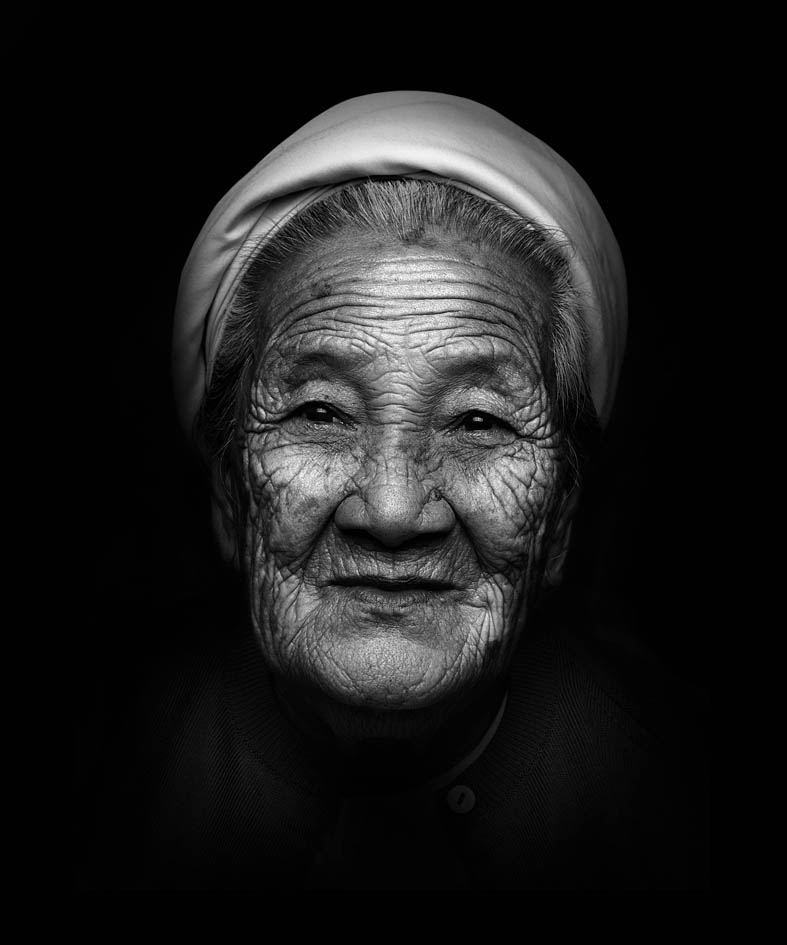
Her wrinkles are a painting in themselves. Who is she? Is she married to the enlightened one? We don’t know. Does it matter? In our chaotic lives are we likely to meet her? Perhaps not; but somewhere, somehow, we all know someone like her. The quintessential kindness of a nurturing bosom radiates from the eyes of a woman who has given birth many times; saddened by the shadow of infertility that looms because the mining of coal is polluting the water this community drinks. Can we change this reality? Will we consume less electricity to keep alive procreation in a community that is dying out? Why should Samar tell us who she is? Can we be more than the occasional, socially motivated voyeur?

By virtue of the nature of his profession, a photographer would essentially be seen as an observer, but digital technologies have facilitated the camera being more than a mere documentary witness. The world of art has expanded considerably to include much more than painting in its canvas. Today, we see manipulated photographic images that speak more as an excoriation of an artist’s inner reality, than the subtlety of putting forward visages as perceived through patient observation of the external world, which evoke the inner dimension. The distinction between artist and photographer is slowly diminishing, with photography becoming a tool for expression in much the same way as water-colour, installation or video. Images such as these portraits from Phaneng veer away from the dramatization of much that is being seen in art galleries, requiring an informed perspective to evaluate. These photographs emerge through interactions that have progressed gradually where the “gaze is mutual.” The scale of work and its positioning ensure the viewer engages with the eyes of the portrait head-on. Can you look away? Many did.

The angry youth, radiating a deep sense of dejection, the young child, astonished by the blaze of a powerful flash, all have a story to tell. If we had silence in our souls, if we could momentarily eliminate the sights and sounds of a frenetic city life, we may have heard the music of the insects at night; we would have empathy with the disillusioned knowing of their elders, the rebellious gaze of this defiant North-Eastern woman who does not challenge or provoke but simply is. Ironically the coal that is being mined in upper Assam, fuels our eccentrically electrified lives without uplifting theirs, for the locals do not work in the mines, immigrants do. So what does the photographer want us to see? What is his intent of sharing without overtly revealing?

The pace of their lives, contrasted with that which Samar Singh Jodha shares with us, is the essence of what is unfolded. In that environment his stride is different. He brings this to our notice by using the old-fashioned 4” x 5” format camera which he inconveniently lugged across unfriendly terrain, against many odds to record this silent tread that is without rush of purpose or anxiety. The format he uses is tedious, but in his mind it is reflective of the world they inhabit more so than the digital camera. The process of photographing them was in itself an experience. The format does not permit multiple frames and therefore the level of trust, the camaraderie between the community and him is expressed via such sophisticated subtleties that Jodha employs. He brings in the totality of his experience of being a part of this community, accepted by virtue of his involvement and yet never belonging. He faces complex dilemmas and guilt of his complicity with the paradoxical engagement to uplift not because he believes he can change the world, but in slowing his pace, living in their time reveals other dimensions of being that the city has robbed him of and us.

Is there a prayer that reverberates as we look into that middle-aged woman’s face? Did you notice the drawn lines that shield those lips which once readily smiled at the light? Wide eyes startled by an electric flash, lips fulsome with hope, what is the future this child inherits? Are the issues under view relevant to just a distant hamlet in upper Assam; don’t they need to belong in our world with as much engagement as Samar Singh Jodha has ventured into theirs?

In reviewing the nuances etched by the refined details of these black and white portraits one feels chided, for the photographer reminds that viewing is not about being seduced by colour, emotion and digital manipulation. He does not impose his views but prods you to question his reticence and once you touch the core, another whole world is uncovered. Its perspective of time and material so alien to ours, that in not connecting with the initial glance we almost let its beauty pass us by. Samar’s diffidence in the words that accompany the exhibition does not facilitate easy access into the sanctum of his engagement. Is this a telling comment on our viewing facility? Have we have lost the ability to assess the visual dimension which is traditionally equated with a value greater than that of a thousand words? Somehow, it seems evident that no matter how consummate the visual art, we need clarity of thought revealing the artists intent or dilemma. In our hectic over-crowded lives, a worthy vision may well be overlooked without this.


Saturday, 1 December 2007

In Conversation [ Essay] Bridging the divide between Art and Design


The Tsunami in Indonesia and Sri Lanka by Amrita Das
Art making is no longer just about paint and canvas or watercolours. It encompasses variety of media from canvas to steel, glass and photographs to digital art, pottery, textiles and jewellery. The whole gamut of human experience, invention and endeavour is a medium of expression for the artists of this millennium.

This diversity may compound the viewing process, but ideals of art keep the gaze affixed, generating greater interest among the business community, than ever before. Today, art is a viable instrument of investment. It no longer has much esoteric value, yet its intangible, deviant voice is complex to decipher.

How does one look at works of art; unravel their complexities? For me the question is not about art for art's sake but, about understanding art from the point of view of the human being that created it. Fundamentally, art making is just another form of human expression. Then logically, understanding and appreciating art is quite simply about recognizing the human state that creates it. Can you truly divorce the human being from his art?

When I interviewed the artist Satish Gujral, I went with a million questions and some reservations. There were many incongruities in his work, which I could not reconcile. To understand its diversity and contradictions, it is not art history that one turns to but one’s humanity. It was in meeting the man, rather than the artist, that I found some answers.

We see a young and emotional Gujral in the brutal, anguished strokes that define his harrowing portraits of Partition. He concedes the story of Partition was evocative of personal anguish; that the horror and violence he portrayed, exorcised some of the disbelief and horror of losing his hearing at the age of eight. The stark reality of this enforced silence was “terrible” and subsequently shaped his whole being. Painting became a means to substantiate his existence, for he says, “What proof you have, when you cannot hear the sounds around you that you really exist?”

Gujral has worked in many media from painting on canvas and paper
collages to some outstanding work in wood and an architectural masterpiece, in The Belgian Embassy in New Delhi. Each phase of work is complete in itself, not an adjunct to other media. This is disconcerting if looked at from a narrow, orthodox perspective. However, seeing it from this artist’s viewpoint of being inside a train in transition, where the constant changes allowed him to ‘break’ the otherwise stifling silence; one realizes that we take much for granted in our stereotyped expectations of artists and their creative endeavour, losing track of the human being. How, when, where and why do we separate the artist from the man?

Sandeep Singh
Photography is no different to a painting when it comes to seeing, for it reveals as much or as little as you are able to see. Sandeep Singh’s photographs draw you into their silence. He achieves this by the sheer starkness of imagery that precludes any kind of human life or suggestion thereof, beyond what we can imagine or ferret from memory. You find a large playing field with a football in the foreground, but not a player in sight. There are empty benches and spaces made for human living but not a soul around. It is positively eerie to see endless empty roads; a market devoid of any human activity; or Terminal 4 at Heathrow, one of the busiest airports in the world, with not a sign of human life. You think life on earth abandoned, and ask why?  Why has this neat, orderly, technologically progressive world been abandoned by the beings that created it?

Sandeep Singh
The photographer intentionally seeks to separate man from his grounds, presenting modern design without its encumbrance. It is his attempt to find silence in these urban-scapes, away from the “pandemonium of post-modernity”. Singh believes that the basic premise of the post-modern world, built upon questions deconstructing existing paradigms of myth and reality; creates extreme anxiety in the human mind, causing us to run away from ourselves, fragmenting the wholeness of being.

Lines, contours, geometric patterns, vertical and horizontal lines, constitute the many elements that form each picture. There is no singular point of interest but the scape is stark nonetheless, because of the elimination of human forms. When I first saw the images, it was like a breath of fresh air - a haven away from the crowded, cacophonic spaces in India. The more I looked, the more the stillness spoke through its depths,  of a  silence not always restful, but tormenting; not empty but bursting to tell its story – your story and mine; for isn’t reality  a question of perception?

Satish Gujral with Alpana Gujral for Vistaar
Art is inseparable from the man, his emotions and quests. Satish Gujral further authenticates this when he says, “artists are not men of ideas; they are men of feeling”. Their responses to the world, governed by feelings of joy, inadequacy, pain and more is what they express as they paint, sculpt or design. Gujral recently worked with his daughter Alpana to design precious jewellery. Painter Thota Vaikuntam, joined hands with Hyderabad based designer Suhani Pittie to create unique necklaces - adornment for the body, as opposed to walls; while yet another painter, Bose Krishnamachari collaborated with Ezma to create a woven shawl masterpiece in Cashmere. These and the work of many other artists were on display at Vistaar, a recent exhibition of collaborative art held in New Delhi.


The emergence of new media, including a renewed interest in the old, poses a challenge to painters of canvas. In addition, Design and craft are gaining considerable significance as modes of creative expression, making the ‘variety’ awesome and seductive but the painter Mona Rai is not enamoured. She works stoically on the conventional canvas. While her choice of materials does not necessarily define her as a paints’ painter, you cannot question her use of canvas or materials she employs on this. Fabric plays an important role in Mona’s vocabulary, as do its processes and techniques.  She ‘dyes’ the fabric. She sews it.  She uses glitter, beads, buttons, mirrors and threads, but works essentially as a painter and not as a  Fiber Artist.

She does not revel in the making and use of fabric and its fibre, as the latter would, however she uses particularly, the same kind of materials to express specifically, her transition from conventional painting on canvas towards this newer dimension. Rai is a collector of the mundane and the useless. In her studio, she has accumulated a variety of bottle caps, coins, cutters, pencils and discarded washers, along with mud and sand as well as sequins, beads, glitter, powder colour and much more. Although inspired by materials associated with the world of textiles, fabric is merely the medium, not the essence of her expression. This allows a certain irreverence in the handling of the material that makes the eventual ‘canvas’ visceral, violent and macabre, imbuing it with a sense of repulsion which is often what attracts Mona’s attention to many aspects of life.

Madhubani Painting
At the other end of the spectrum of artistic expression, is Folk art. Largely identified with rural life, this is both a personal and cultural statement of expression. Anyone in the community is entitled to and able to create. It is an art form based on close observations of Indian life, precluding any reference to Western Art. Within an extraordinary mix of the ancient with the modern, folk artists record everyday events of family and community life. Using colour and lyrical elements of line, they express through a visual language that employs simplified form, ignoring perspective and proportion.

Much written about, the work of artist Madhavi Parekh cites her art as vital to reconciling the expressions of rural India with that of modern, urban India. Being a first generation migrant to urbanization, enables her to draw upon images, events, sounds and scapes etched in her memories of village life. Untrained in the formal mode of Art education she uses a kind of naïve, ‘folk’ narrative to tell her stories. 

Madhavi Parekh
 Modern, urban India, divested of the romance of an ethnic identity is keen to reclaim its heritage by iterating the importance of an infusion of folk elements in the Contemporary Art vocabulary. However, for the rural artists, whose folk idiom is not merely a memory, but a living discipline they naturally work within, categorizing their work as ‘folk’ is derogatory. This dichotomy intrigues and questions the positioning of our folk heritage vis-à-vis contemporary painting, because we do not regard the work of these rural artists in the same way as that of the modern-urbanized painter. Their brilliance seems eclipsed by the recognition accorded to artists such as Parekh for an innovative stance afforded by her changed environment. The fundamental reality of evaluating creativity in terms of visibility and therefore recognition, poses questions about deemed appropriate values. Yet the co-existence speaks of the vibrancy of a culture, lending equal voice to the other

Manisha Bhattacharya
Drawing from the depths of tradition, beyond the realm of folk iconography are studio potters like Manisha Bhattacharya, who transcend restrictive qualities of pottery. She does not define herself merely as a potter, nor does she see herself as a designer; but considers her work  more in the realm  as that of an artist-craftsman. Although not bound by pottery conventions even though her work does not necessarily break free of them either, she is a self-confessed ‘addict’ of working on the wheel. The vessel forms the basis of most of the objects she creates, but the surface of each vessel is akin to canvas. Working primarily in black and white, she manipulates the smoke on her pots, as a painter wields his brush, using the Raku technique of glazing.

At one level, a potter is a potter, so what sets Manisha Bhattacharya apart from the local kumhar? Is it her education? Is it her world exposure? Is it the challenge of our times? Can Manisha and other contemporary potters really provide an alternative to the local kumhar or has the indigenous tradition of pottery making undergone such a sea of change that we cannot turn the wheel to recast that mould? 
 
Is it just the tradition of pottery recast to deem a plate more than a mere platter to eat from, or is it an evolution of the aesthetics of contemporary society? With the growing interest in collaborative ventures between art and design and diversity in media of expression, we seem to aspire towards a life that celebrates each dimension of living, imbuing the functionality of the mundane with the expansiveness of the spirit. Art in ancient India was not a profession or an activity divorced from other spheres of living. It was a way of life that nourished the man “corpus anima et spiritus” The advent of machines has challenged this concept, but the aesthetic ideals of contemporary art seem to re-direct us towards this  holistic tradition.

Manisha Bhattacharya