
‘Connecting Threads, Textiles in Contemporary Practice’, was an exhibition held in Mumbai earlier this year. “Tracing textile practices, traditions and histories”, it sought to present “contemporary art practices that engage textiles as a medium, metaphor or process.” These fabric-inspired works were showcased at the iconic Bhau Dadji Lad museum in Byculla East, where the opulent, restored interiors and artefacts navigating the history of Bombay, its facets and cultures, became the site for contemporary art-works that were placed on and alongside the stairwell and beside the glass-boxed objects of the museum, as well as within the quieter, reflective spaces of a dedicated viewing gallery.

Manisha Parekh, Enshrined, 2016. Handmade paper on wool, silk and velvet.
In this work, Parekh responds to her visits to pilgrimage sites in various cities including Anuradhapura in Sri Lanka and Varanasi in India. Taken by the sense of detail and tactility imbibed by the adornment within such religious spaces, Parekh creates sculptural works that represent personal shrines. Intricate small, solid forms made of fabric, including velvet and silk, are carefully organized within the structures. The geometric shape of the outer box structures contrast with the organic sensual forms made of fabric, giving it a sense of precariousness.
It had an impressive line-up of artists from Anita Dube, Anju Dodiya, Lavanya Mani, Manish Nai, Manisha Parekh, N. Pushpamala, Nilima Sheikh, Paula Sengupta and Reena Saini Kallat, among half a dozen others. Textiles were represented in their art, in diverse ways. Few had devoted their procedures to the art of cloth-making, fewer still were makers in themselves and some had just featured painted renditions and photographs, rather than fabric itself. This was in keeping with the curatorial concept which proposed a choice of material and processes that prevalent art praxes suggested, towards “a nuanced understanding….of the art form” encompassing “the traditional, the modern and the contemporary.”

Archana Hande, All is Fair in Magic White (image courtesy BDL)
Hande uses fabric as a medium to narrate a satirical story
that comments on the rapid urban growth and aspirational plans for the revitalization of
Mumbai that are rooted in the history of class, race and power in the city given its
colonial and industrial history. The story
moves to Dharavi, Mumbai, the second largest slum in the world, with the
largest conglomeration of sweatshops and small-scale industries in India.
The work features traditional wood-block prints to create a series of works on cloth that form a
storyboard depicting characters, landscape and topographies of the city.
An interesting intercession by Monali Meher, wrapped the ornate railings of the central staircase with red yarn. This installation was overhung with paintings by Anju Dodiya. The day I visited, the museum was abuzz with activity. Curious to see how many people engaged with this macabre intervention, I was surprised to find that not one of the chattering groups, that passed by me observing them from a relatively silent corner, even noticed there was something uniquely odd about the stifling of a lovingly re-established Victorian aesthetic. Nor did they even glance up at the adjacent walls, to be disturbed by the melancholia of Dodiya’s canvasses that, nevertheless, looked down upon them as they ascended or descended the grand stairway.

Monali Meher, Running Thread, 2018,
Red wool wrapped around the Museum's grand staircase,
temporary site specific installation - a detail (image courtesy BDL)
This apparent lack of interest, in these museum goers, to engage with something so incongruous and disquieting as dark red, bloody hued thread wound around the gilded insignia of the V&A as also the delicately fashioned metallic leaves and florets that surrounded it, (built in 1872, BDL was Bombay’s own Victoria and Albert Museum), was thought provoking. Was it something to do with the viewing public or had the exhibits themselves failed in their attempt to garner attention and even question the merit and/or activity of contemporary textiles as art. Were they even meant to, is the uncertainty I was left with.

Rakhi Peswani, Fruits of Labour (A Monument to Exhaustion)
Cloth fades, bleeds, stains and dyes. This work attempts to take such material attributes of textiles and transform them into spatial metaphors, engaging the viewer with cultural narratives seeping from the physicality of the medium of fabric. The rudimentary impression of the work is derived from temporary relief shelters/tents pitched at the site of displacement, constructions, migrations, devastations and various intensities of these situations. These social ruptures of modernity are microcosms that our world witnesses closely and repetitively. Embracing the viewer within the space of the museum, the work opens up an experiential realm within this cosmetic, cultural, public space. The work as a temporary shelter carries an association of (a) larger body that stands desolately…..yet looms above our fragile individual selves.
Curated by Tasneem Zakaria Mehta, the museum’s director and Puja Vaish, these materials that are inherently definitive of culture through their fundamental relationship with aspects of the human existence, had left little or no impression upon the average visitor, such that I had been able to witness. The tall, slim, colourful columns of Manish Nai’s collected and compressed fabric, on the first floor galleries, found perplexing glances by ‘shikha’ donning, saffron clad Brahmin pandits and Paula Sengupta’s ‘River of Blood’, had me right confused. It had been so well-camouflaged among the general exhibits of the museum, I had to double-check, if it was indeed part of ‘Connecting Threads’, or an earlier acquisition. And how I felt about it positioned thus.

Wood and Fibre-glass almirah, found objects, corn-fibre
paper lining, hand block printed wallpaper lining, hand-embroidered bed linen
and shirt, wooden hanger and vinyl stickers.
‘Rivers of Blood’ is a tactile diary, filled with stories
documenting the artist’s travels through Bangladesh to discover her roots
across the border - a mere two-hour drive from her Kolkata home, where she discovered the fabled nakshi
kantha. This brought back
memories through which she reclaimed the process as the script for her
narrative. Her
grandmother and mother are inheritors of the tradition where women quilted
layers of used textiles with kantha stitch, for domestic use. And she had learned
from them too.
This choice of locating the works of a specifically curated exposition in the midst of the museum’s general display, with walk-ins that created an almost, traffic-jam-like viewing situation, barely leaving room for serious contemplation, was as peculiar as it was disturbing. It made me uncomfortable. I wanted to look without the ‘noise’ of everything else. After all, there has barely been such a day, in all my decades of working with textiles, that one has been able to walk into an exhibition in an Indian metropolis, which is dedicated to the modern-day language of cloth and its skeins as markers of cultural residue, with significance in the world of contemporary Indian art. I didn’t take well to the approach, even as it made me trace histories and revisit and review my own perspectives. More particularly, since I had just travelled from the desert, hand-crafted textile haven of Kutch, where I had occasion to notice many revised parameters generating query and concern. And this exhibition added its share of dilemmas, provoking much internal debate.

Paula Sengupta, ‘Rivers of Blood – Caste Baidya, Village Kalia' 2010, detail, (image courtesy BDL)
When I first started working with textiles as art, in the early to mid-1990’s, it was an anomaly. I seemed to be going against the grain of time-honoured conventions where art was primarily utilitarian and the very idea of this becoming the medium for self-indulgent expression an anathema; arising from philosophies of the ancient world that had nurtured the rich legacy of textiles, we are fortunate to still have amongst us as a living tradition. My reason for venturing beyond the accepted practice arose from my work as a designer that took me into rural spaces where textiles and their makers were struggling to survive the rigours of the modern world.

Weaver's village, Kotwa, Banaras
What struck me was that we, as they, were concerned primarily about the product and how to present it to buyers in the ever-expanding global village. And, little attention was being paid, if at all, to the life-style that was essential to those that worked with an expert dexterity of techniques passed down through successive generations. A way of living that was capable of stepping back from the chaos of the world to indulge in painstaking labour of love, simplifying necessities and focussing on what fostered the spirit of making with the hand. In my myriad experiences as a textile-designer, I learned that if I could bring any value, if I could find any means to contribute towards sustaining this inheritance, then maybe I could do so, by becoming a craftsperson myself. I chose the role of an artist-craftsperson to add value to age-old skills by lending the dignity afforded to contemporary art, as much as attempting to adopt the pared-down lifestyle of those that crafted with the hand. I ‘painted’ with hand-embroidery techniques without seeking to match prevalent skills, which have taken many generations to master.

Gangaba, Bhujodi, Kutch -
pakko stitch on Maggie Baxter's textile
In Kutch, I had been travelling with an Australian artist who’d been engaging with the fabric and artisans of Kutch for over twenty years. I was a bystander to more than just the unusual long-distance collaboration. I had returned to the region after three decades and the socio-cultural shifts were telling. As I wandered with Maggie, to hand block-printed units and artisan’s homes, I noted many changes. A middle-aged, bespectacled embroidery artisan from the Sodha clan, with faint strands of white on otherwise, well-oiled black tresses, sat cross-legged on the currently fashionable tiled flooring of her home, on a two-coloured plastic floor-covering - woven vaguely along the lines of the customary bamboo chattai. Her fingers, with chipped, dull-bronzed-maroon nail-polish, deftly handled the ‘sui-dhaga’, working the distinctive Sodha ‘pakko’ stitch, following instructions in Kutchi, passed onto her by Sandhya, a local Jadeja girl, who was assisting Maggie. Gangaba covered her head with the pallav of a mill-printed polyester saree imprinted with multicoloured polka dots and mock ombre-dyeing. Unlike the conventional garb of her people that once comprised a ghaghra, richly embroidered kurti-kanjari and tie-dye odhani that was usually paired with abundant silver and gold jewellery, closely resembling costumes worn in the deserts of Rajasthan.

Vankar Shamji Vishram , Bujodi Kutch, at the indigo vats
Outside, carelessly strewn on the balustrade of the staircase leading up to the rooftop of the single-storey home, was a traditional, local-wool shawl with its definitive extra weft effect – in hues of beiges and brown and a hint of vibrant red tones; part of the garb that once defined the Rabari community of Kutch, usually worn by men. It’s casual placement on the steps of a Sodha home, in close proximity to a saree clad woman washing clothes, carried the implication of belonging to her. Making one note how patterns that earlier demarcated gender and communities, now blended into a generic Kutchi dress-code. Their attire, choice of colours and fibres, the way they lived and the things they filled their homes with, no longer had an organic feel nor distinctive touch.

Manish Nai, Unititled I-VIII
Nai comes from a family of textile artisans and he frequently uses discarded fabric and clothes to create minimalist forms that vary in colour from exuberant to meditative, inviting the audience to reflect on the extraordinary potential of art to renew and rethink the mundane. These works use old, discarded clothing that Nai collected from his mother and other relatives, that he compressed in a mould, using heat to ensure they remain consistent in shape. The otherwise versatile nature of fabric, in terms of shape, is altered, as the clothing is moulded into a series of slender poles. Displayed within a frame the works tread the line between painting and sculpture.
The room we sat in led into the kitchen area – a semi-open-plan arrangement where glass, stainless steel and plastic utensils lined shelves that had been placed in a large void in the soft-green painted hues of a wall, adjoining the kitchen, behind the bold colourful, geometric-patterned, mill-printed sheets covering the aluminium and polyester-niwar ‘manji’ that Maggie was seated on. Whilst this wasn’t the real cause for concern, what bid me ponder was how much farther could these living traditions sustain themselves, when what they make is no longer of use to them, nor are they emotionally or creatively invested in the evolution of the fabrics sewn by their dextrous fingers.


N. Pushpmala, Tryptich, 2000
Portrait of a Hindoo woman, Portrait of a Mohhamedan woman, Portrait of a Christian Woman,
From the Bombay Photo Studio
series
I have always held that the great crafting traditions of this country arose not only through enlightened patronage but because of the ingenuity and passion of the maker. I have noted again and again that commerce alone, no matter how lucrative and well-paid, doesn’t lend itself to excellence, but personalised involvement of the artisan can create unimaginable magic. But, much of what they make today, if not all, is not for their own personal use. It travels to unknown people in faraway countries - features of the products dictated by the markets they are destined for. Becoming increasingly removed from the intimate needs of the maker and the aesthetic sensibilities that crafted them. Developing more and more into a commodity and the craftspeople relegated more and more to becoming just skilled labour. The traditional dual role of artist-producer is no longer pursued, leaning of extraneous design inputs which, while assuring better market-share are also contrarily stifling the artistic voice vital for the sustenance of this labour intensive work.


Anita Dube, Silence, (Blood wedding)
(image courtesy BDL)
In this work Dube transforms a skeleton, formerly used by her brother while studying medicine, into objects including a garland, a fan, and a flower, among others, wrapped in red velvet. The bones embody a juxtaposition between notions of death and when covered by the opulent fabric. Wrapped in red velvet and decorated with embellishments including bead and lace, the works represent a wedding trousseau. The objects symbolizing death take on a new meaning, embracing the fragility of life, love and beauty, through the second skin that they are provided.
Textiles as art is not something new, it is as old as history itself, but our definition of art has altered. The history of Indian textile-making is proof of the kind of respect this art once earned. In the Indonesian islands, these fabrics were deemed a form of storing wealth, ascribed with magical properties and elevated to the status of heirlooms. In fact, the Indian maker was called ‘Klinga’ or God. It was such value and veneration that created the impetus for cloth as currency on the famed spice trade-routes. It was such worth and honour that sustained the impetus to make, even when their handiwork was separate from their personal utilization.

Reena Saini Kallat, Walls of the Womb
Autobiographical in nature, these works speak of the artist relationship with her mother, whom she lost aged eight, and were arrived at through frequent contact with her sarees that remained in a cupboard for 27 years. Kallat collaborated with Khatri families in Kutch for the process of tie-dye, which evoke Braille-like translations of her mother’s hand written recipes. Associations of motherhood are carried through the usage of 12 sarees and the recipe books evincing notions of nurture and nourishing. The language on the cloth remains inaccessible echoing Kallat’s bond with her mother, which is based on fragments of inscrutable memory.
Beyond the utilitarian, fabric as contemporary art expressiveness, is also not an innovative quirk of the millennial digital world, but draws its antecedents from the beginnings of the industrial revolution and the arts and craft movement in England that was the impulse for highlighting the craft of making, celebrating the ‘simple life’ synonymous with rural traditions and hand-craftsmanship. This, in turn influenced the Bauhaus outlook and pedagogy. And, it was in the studios of the Bauhaus in the early 1920’s that Anni Albers, a pioneer of the modern art fabric, discovered the wonders of the woven grid along with fibres and the loom, through which she found “ways to regain sensitivity towards textile surfaces: texture” and an expression of modern life. As mechanization made textile production cheaper, the preciousness of cloth and clothing rendered greater artistic experimentation viable, and the younger generation of contemporary artists like Shonibare, Do-Ho-Suh and others have used the pliable drape, abundantly, as compelling and dramatic metaphors to make private and socio-political statements about displacement, colonization and more.
(image courtesy BDL)


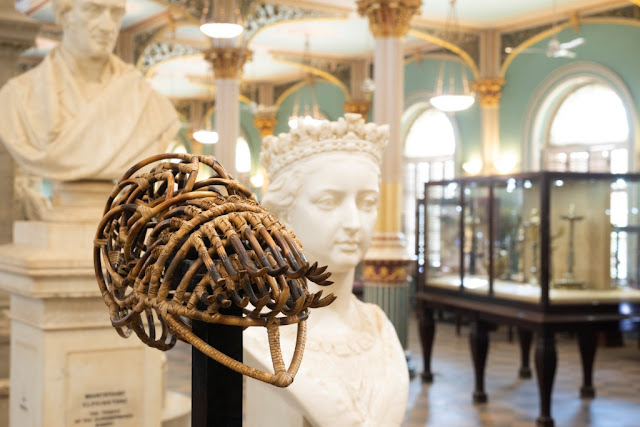
Shakuntala Kulkarni, Of Bodies, Armour and Cages
Kulkarni’s ‘ wearable sculptures’ as she calls them, traverse a space where historical objects like armour and the elaborately designed costume/dresses of different communities are brought together in a contemporary context by re-articulating the usage and the medium, collapsing and metamorphosing the two, thus blurring cultural and visual boundaries. Armour of the yonder days were worn by warriors to protect themselves during encounters and war. Made of metal and leather they were designed to look grand. Although the cane armour/costumes on display speak of that grandeur but these elaborately structured costumes are also feminine, linear, fragile and organic. This work attempts to address the relationship of the body to notions of protection and the notion of being trapped.
A century after Albers’s fabric inspired a generation of modern weavers, and a hundred years after the industrial revolution, where automation didn’t just evolve a refined aesthetic and produced fine goods, it also made our choices clonish. This facet is now among others, the incentive to renew corporeal parameters. Such that the unique, the original and the imperfections of handmade are fashionable, precisely because we have lost the sensibilities of feeling, holding and handling things before couriers from Amazon or Flipkart deliver them at our doorstep. Further heightened by the digital ‘touch’ of our smart-phones, and lack of physical engagement in socializing through social media, we are no longer compelled to touch the texture and glaze of the cup or bowl, run our fingers through that scarf or saree, or see if we actually enjoy sitting in a that funky looking chair or Avant Garde sofa. Fostering a growing disconnect with the dynamic physicality of being.

Shahzad Dawood, Point and I will Follow (a detail)
Dawood interweaves histories, realities and symbolisms to create richly layered artworks. The original textiles, from which Dawoods works are based, were created by nomadic weavers of South Asia, throughout the 1970’s . Composed from discarded scraps from textile factories, his vintage textiles form a key element of the artist’s multidisciplinary practice. Intervening on quilted surfaces, Dawood adds layers of screen-print, paint and shorthand to create a bricolage of elements. By working with the textiles’ pre-existing narratives and highlighting their resonance with other cultural phenomena, Dawood questions the established binaries between different value systems and cultures.
For Albers, weaving offered a means to regain connect to a bodily existence. This ideal becomes an important consideration in an era where we are we no longer making things for ourselves, nor engaged in everyday kinaesthetic experiences. It was especially pertinent while viewing this exhibition devoted to textiles within a contemporary Indian art ethic, where, despite a rich, unparalleled and ancient lineage of making, intellectual concepts prevailed over the tangible intricacies of fabric construction. Of textiles in modern-day art practices that were largely removed from the warping, weaving and embellishing of the cloth that, most of the artistic precepts presented, were fashioned on and by.

Priya Ravish Mehra, rafoogari on Pashmina cloth.
Growing up in the 1960s, her summer vacations were spent at the family ancestral home in Najibabad, in the Bijnor district of Uttar Pradesh, home to many rafoogars. These early interactions with them, inspired a life-long dedication of researching and documenting this art form. For Priya, a rafoogar, was not just a darner of torn textile but “ a healer of damaged cloth”. Diagnosed with cancer she used the act of ‘visible’ as opposed to their ‘invisible’ repairing in her thread-work, to creatively speak of her own inner transformations during periods of recovery. Conjuring the saint-poet Kabir who poetically meshed the tangible with the transcendental, she said that, “to revive darning is not just a revival of skill and craft……it is also about healing suppressed past emotions connected with memories and the mending of cloth.”
These insights, coupled with my recent observations in Kutch, left me pensive and perplexed. Still grappling with the expanding gulf between textiles in art and the art of textile-making, as also the lives and sensibilities of practitioners on either end of the spectrum, I travelled to Banaras, the mecca of textiles.

Nizamuddin at the loom, Ramnagar, Banaras
Engaging with weavers from all faiths and reminded of the vast difference in the ‘feel’ of fabric made by human hands and manufactured by machines, I was reminded that in the Indian tradition, the weaver or ‘julaha’, has always occupied a low station in the social hierarchy and even the wisdom of the weaver-saint Kabir hasn’t been able to alter that. We recite his ‘dohas’, laud the vitality of his verse and its pertinence centuries after he passed on, but we don’t seek to emulate the life-style that inspired his sagacity, nor uplift the makers, even as we celebrate cloth in our existence and art practices.
मन दीया कहीं और ही, तन साधन के संग ।
कह कबीर कोरी गजी, कैसे लागे रंग ।।
कह कबीर कोरी गजी, कैसे लागे रंग ।।
Mn diya kahi aur he, tan saadhan ke sang
Keh Kabir kori gaji kaise laage rang
Keh Kabir kori gaji kaise laage rang
-Kabir
When the mind digresses
from the task at hand, and
the body continues robotically,
it weaves an un-hued cloth
from the task at hand, and
the body continues robotically,
it weaves an un-hued cloth
(trans: gopika nath)

A peek into the interior of
Nizammudin's home


12cms+100dpi.tif)
+100dpi.tif)


