Showing posts with label Ceramics. Show all posts

Wednesday, 31 August 2016

Building Bridges - Exhibition Review - Ceramics


Neha Kudchadkar


‘Bridges’ was an exhibition of ceramics held at Stainless Gallery, New Delhi. This exhibition showcased the work of fifty studio potters who have trained with Deborah Smith and Ray Meeker at The Golden Bridges Pottery studio in Pondicherry.


Reyaz Badruddin
 
 
Playful porcelain and pen doodles by Neha Kudchadkar reminiscent of containers defied the weightiness of them. Reyaz Badaruddin had flattened the cup. A hollow container, usually thrown on the wheel had been painted on flat clay tiles.  Veena Chandran used a large, traditional earthen pot-form. But she flattened it out as if breaking the clay pot, and then smeared the moist clay with her hands in a gesture that sought to explore the potential of clay, beyond traditionally prescribed norms. Shayonti Salve’s thrown but altered forms were a reflection of the duality she experiences where, as she said: “my head is often tormented by the times we live in, while my heart tried to comfort it”
 

Veena Chandran


Shayonti Salve
 
 
Pottery is one of the oldest art forms in India. Known as Prajapati or Kumbhar, the potter played a significant role in ancient society. However, potters no longer command the same reverence that was once accorded to them, nor do contemporary potters continue the tradition of making pots for daily use. “Today our students are about as interested in making functional stoneware as the sons of Indian village potters are interested in continuing in their fathers’ footsteps”, say Smith and Meeker. This quantum shift from the traditional, ‘form follows function’ approach, towards the more ornamental and conceptual approach in contemporary ceramics, where ‘ideas’ supersede ‘function’, makes an interesting comment on the social and cultural values of our time.
 
 
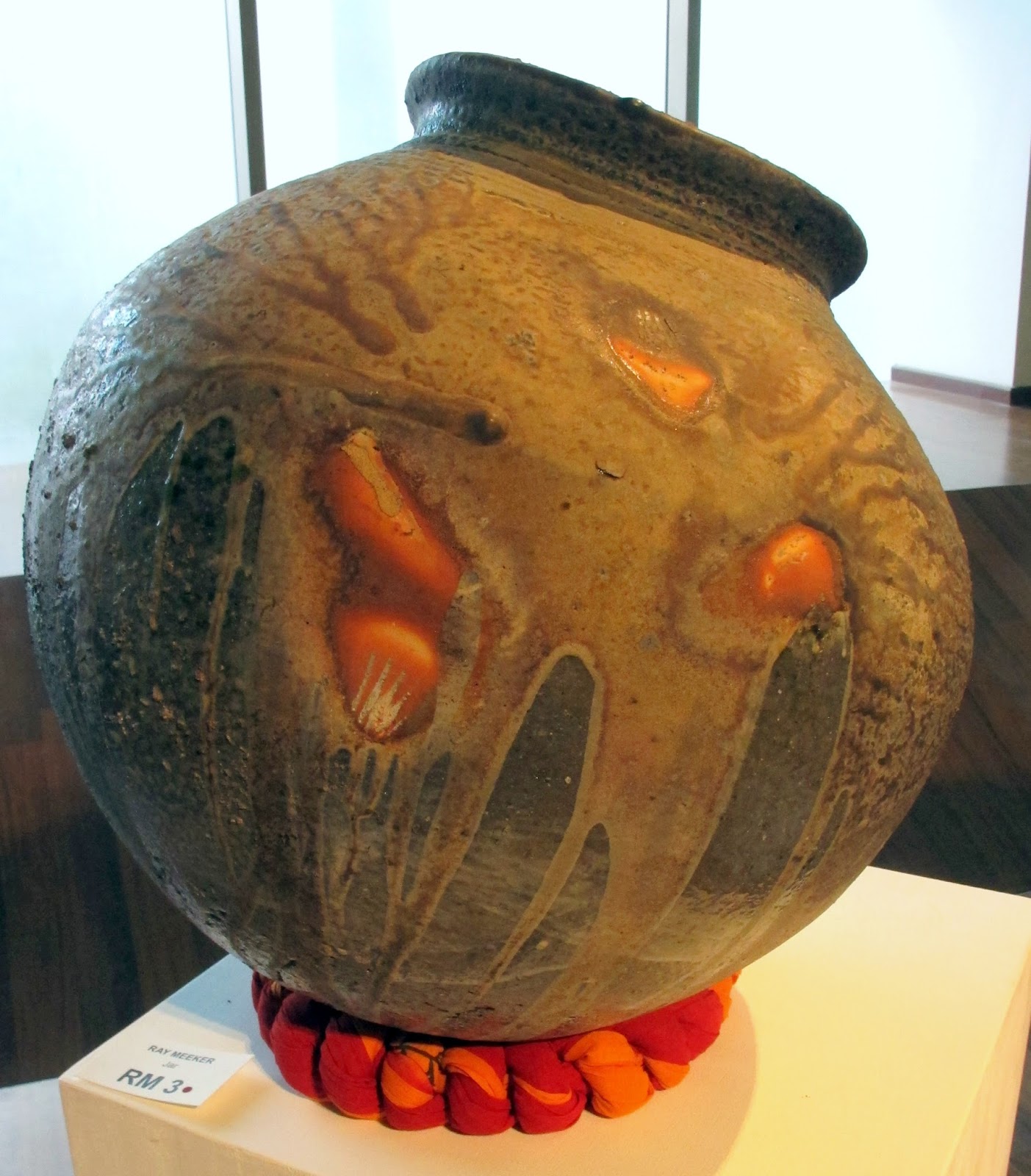
Ray Meeker
 
Golden Bridges, now a preeminent centre for ceramics, was set up in the mid 1970’s by Deborah Smith with her friend Ray Meeker, at the invitation of ‘The Mother’ spiritual head of the Aurobindo Ashram in Pondicherry. Cited as an exhibition of ceramics rooted in the Golden Bridges tradition and a tribute to the influence of Meeker and Smith one expected to find a thread that knitted together the work on display. To the contrary, the diversity of scale and style belied the fact that each of the fifty potters had been trained by the same two ceramic artists and more particularly, were trained using a specialized wood-firing technique.  Among the fifty potters participating, were Anjani Khanna, Michel Hutin, Aditi Saraogi, Manisha Bhattacharya, Adil Writer, Kristine Michael, Nehal Rachh, P. Daroz, Vineet Kacker and Sylvia Kerkar. Although primarily trained in making wood-fired studio-pottery, working in an urban context many of them have
explored gas and electric firings to evolve a differing aesthetic.
 
 
P.Daroz, From the 'Sea Bed' Series


Michel Hutin, a Frenchman who has lived and worked in Auroville for over twenty-five years, joins soft, undulating slabs of clay such that the interacting lines create rhythm, melody and counterpoint. P. Daroz has a passion for seascapes. Drawing upon memories of trips to various coasts and cliffs, his ceramic pieces from the ‘Sea Bed’ series are abstract in their presentation. For Nehal Rach an advertising graduate, who found her calling working in clay, pottery is not just something she does, but says that clay-work defines her.  Reyaz Badaruddin responds to urban spaces by evoking the disappearing fields of the agrarian landscape he grew up in. Each of these potters has moved beyond making a conventional vessel, to present abstract ideas where it is no longer about pots per se, but clay as art.
 
 
Neha Kudchadkar
 
The local potter and ceramic artist co-exist, but the local potter is not an artist in the contemporary sense of the word. He is technically skilled but doesn’t employ self-expression which is the basis of much art today. Ironically, this facet once deemed “pitiable rather than heroic” in ancient India, as cited by Ananda K. Coomaraswamy, is what is being keenly explored by contemporary ceramic artists. Pottery is essentially a skill-centric craft where the kind of clay used, kiln and techniques of firing, as well as glazes, play a significant role in the eventual product and how it looks. The firing process can be as intense as eighteen to seventy-five hours, with potters keeping vigil and maintaining logbooks. All of which is rarely mentioned in relation to exhibitions of clay work.  In positioning ceramics within the context of contemporary art, the technical process employed is seemingly superseded by the concepts explored.
 
 That the medium has evolved to transcend its functional origins, is a tribute to the creative minds that work with clay, as much as it is a yearning to bring attention and value to hands that have moulded  earth into vessel for centuries. However, the expression of self in the works on display, did not articulate an exploration authentic enough, to speak the language of contemporary art.
 
Manisha Bhattacharya


[This exhibition was held in September 2014]

Friday, 29 November 2013

Small Wonder -Rahul Kumar [ Review]


Astronomically Small was an apt title for Rahul Kumar’s exhibition of miniature pot sculptures at Art Heritage Gallery, New Delhi, from the 2nd of March to the 3rd of April. These minuscule works made us wonder if a pot could be more than just a pot..

Near the entrance of the gallery, three very small cadmium-red glazed pots placed in an unglazed terracotta niche appeared like votive offerings. Many such miniature works filled the gallery – placed on walls or on raised, uneven ceramic pedestals. Collectively, they evoked the poetry of Omar Khayyam.

One of the works featured an indigo vase, just over an inch high, on the edge of a scroll-like strip of white textured porcelain marked with occasional black swirls. In a similar vein, a small white teapot, merely two inches high, stood on the edge of a flat patch of terracotta with a wave-like form at its far end.

To make his delicate pots, Kumar’s doesn’t throw clay on a wheel but moulds each sculpture by hand. The scale of the works commands close examination and inspires contemplation. 

In the show, Kumar also displayed sets of larger tiles mounted on grid frames. These works seemed to have no relationship with the ‘Astronomically Small’ theme. This slight confusion detracted from the power and beauty of the exquisitely small pots. 


Saturday, 1 December 2007

In Conversation [ Essay] Bridging the divide between Art and Design


The Tsunami in Indonesia and Sri Lanka by Amrita Das
Art making is no longer just about paint and canvas or watercolours. It encompasses variety of media from canvas to steel, glass and photographs to digital art, pottery, textiles and jewellery. The whole gamut of human experience, invention and endeavour is a medium of expression for the artists of this millennium.

This diversity may compound the viewing process, but ideals of art keep the gaze affixed, generating greater interest among the business community, than ever before. Today, art is a viable instrument of investment. It no longer has much esoteric value, yet its intangible, deviant voice is complex to decipher.

How does one look at works of art; unravel their complexities? For me the question is not about art for art's sake but, about understanding art from the point of view of the human being that created it. Fundamentally, art making is just another form of human expression. Then logically, understanding and appreciating art is quite simply about recognizing the human state that creates it. Can you truly divorce the human being from his art?

When I interviewed the artist Satish Gujral, I went with a million questions and some reservations. There were many incongruities in his work, which I could not reconcile. To understand its diversity and contradictions, it is not art history that one turns to but one’s humanity. It was in meeting the man, rather than the artist, that I found some answers.

We see a young and emotional Gujral in the brutal, anguished strokes that define his harrowing portraits of Partition. He concedes the story of Partition was evocative of personal anguish; that the horror and violence he portrayed, exorcised some of the disbelief and horror of losing his hearing at the age of eight. The stark reality of this enforced silence was “terrible” and subsequently shaped his whole being. Painting became a means to substantiate his existence, for he says, “What proof you have, when you cannot hear the sounds around you that you really exist?”

Gujral has worked in many media from painting on canvas and paper
collages to some outstanding work in wood and an architectural masterpiece, in The Belgian Embassy in New Delhi. Each phase of work is complete in itself, not an adjunct to other media. This is disconcerting if looked at from a narrow, orthodox perspective. However, seeing it from this artist’s viewpoint of being inside a train in transition, where the constant changes allowed him to ‘break’ the otherwise stifling silence; one realizes that we take much for granted in our stereotyped expectations of artists and their creative endeavour, losing track of the human being. How, when, where and why do we separate the artist from the man?

Sandeep Singh
Photography is no different to a painting when it comes to seeing, for it reveals as much or as little as you are able to see. Sandeep Singh’s photographs draw you into their silence. He achieves this by the sheer starkness of imagery that precludes any kind of human life or suggestion thereof, beyond what we can imagine or ferret from memory. You find a large playing field with a football in the foreground, but not a player in sight. There are empty benches and spaces made for human living but not a soul around. It is positively eerie to see endless empty roads; a market devoid of any human activity; or Terminal 4 at Heathrow, one of the busiest airports in the world, with not a sign of human life. You think life on earth abandoned, and ask why?  Why has this neat, orderly, technologically progressive world been abandoned by the beings that created it?

Sandeep Singh
The photographer intentionally seeks to separate man from his grounds, presenting modern design without its encumbrance. It is his attempt to find silence in these urban-scapes, away from the “pandemonium of post-modernity”. Singh believes that the basic premise of the post-modern world, built upon questions deconstructing existing paradigms of myth and reality; creates extreme anxiety in the human mind, causing us to run away from ourselves, fragmenting the wholeness of being.

Lines, contours, geometric patterns, vertical and horizontal lines, constitute the many elements that form each picture. There is no singular point of interest but the scape is stark nonetheless, because of the elimination of human forms. When I first saw the images, it was like a breath of fresh air - a haven away from the crowded, cacophonic spaces in India. The more I looked, the more the stillness spoke through its depths,  of a  silence not always restful, but tormenting; not empty but bursting to tell its story – your story and mine; for isn’t reality  a question of perception?

Satish Gujral with Alpana Gujral for Vistaar
Art is inseparable from the man, his emotions and quests. Satish Gujral further authenticates this when he says, “artists are not men of ideas; they are men of feeling”. Their responses to the world, governed by feelings of joy, inadequacy, pain and more is what they express as they paint, sculpt or design. Gujral recently worked with his daughter Alpana to design precious jewellery. Painter Thota Vaikuntam, joined hands with Hyderabad based designer Suhani Pittie to create unique necklaces - adornment for the body, as opposed to walls; while yet another painter, Bose Krishnamachari collaborated with Ezma to create a woven shawl masterpiece in Cashmere. These and the work of many other artists were on display at Vistaar, a recent exhibition of collaborative art held in New Delhi.


The emergence of new media, including a renewed interest in the old, poses a challenge to painters of canvas. In addition, Design and craft are gaining considerable significance as modes of creative expression, making the ‘variety’ awesome and seductive but the painter Mona Rai is not enamoured. She works stoically on the conventional canvas. While her choice of materials does not necessarily define her as a paints’ painter, you cannot question her use of canvas or materials she employs on this. Fabric plays an important role in Mona’s vocabulary, as do its processes and techniques.  She ‘dyes’ the fabric. She sews it.  She uses glitter, beads, buttons, mirrors and threads, but works essentially as a painter and not as a  Fiber Artist.

She does not revel in the making and use of fabric and its fibre, as the latter would, however she uses particularly, the same kind of materials to express specifically, her transition from conventional painting on canvas towards this newer dimension. Rai is a collector of the mundane and the useless. In her studio, she has accumulated a variety of bottle caps, coins, cutters, pencils and discarded washers, along with mud and sand as well as sequins, beads, glitter, powder colour and much more. Although inspired by materials associated with the world of textiles, fabric is merely the medium, not the essence of her expression. This allows a certain irreverence in the handling of the material that makes the eventual ‘canvas’ visceral, violent and macabre, imbuing it with a sense of repulsion which is often what attracts Mona’s attention to many aspects of life.

Madhubani Painting
At the other end of the spectrum of artistic expression, is Folk art. Largely identified with rural life, this is both a personal and cultural statement of expression. Anyone in the community is entitled to and able to create. It is an art form based on close observations of Indian life, precluding any reference to Western Art. Within an extraordinary mix of the ancient with the modern, folk artists record everyday events of family and community life. Using colour and lyrical elements of line, they express through a visual language that employs simplified form, ignoring perspective and proportion.

Much written about, the work of artist Madhavi Parekh cites her art as vital to reconciling the expressions of rural India with that of modern, urban India. Being a first generation migrant to urbanization, enables her to draw upon images, events, sounds and scapes etched in her memories of village life. Untrained in the formal mode of Art education she uses a kind of naïve, ‘folk’ narrative to tell her stories. 

Madhavi Parekh
 Modern, urban India, divested of the romance of an ethnic identity is keen to reclaim its heritage by iterating the importance of an infusion of folk elements in the Contemporary Art vocabulary. However, for the rural artists, whose folk idiom is not merely a memory, but a living discipline they naturally work within, categorizing their work as ‘folk’ is derogatory. This dichotomy intrigues and questions the positioning of our folk heritage vis-à-vis contemporary painting, because we do not regard the work of these rural artists in the same way as that of the modern-urbanized painter. Their brilliance seems eclipsed by the recognition accorded to artists such as Parekh for an innovative stance afforded by her changed environment. The fundamental reality of evaluating creativity in terms of visibility and therefore recognition, poses questions about deemed appropriate values. Yet the co-existence speaks of the vibrancy of a culture, lending equal voice to the other

Manisha Bhattacharya
Drawing from the depths of tradition, beyond the realm of folk iconography are studio potters like Manisha Bhattacharya, who transcend restrictive qualities of pottery. She does not define herself merely as a potter, nor does she see herself as a designer; but considers her work  more in the realm  as that of an artist-craftsman. Although not bound by pottery conventions even though her work does not necessarily break free of them either, she is a self-confessed ‘addict’ of working on the wheel. The vessel forms the basis of most of the objects she creates, but the surface of each vessel is akin to canvas. Working primarily in black and white, she manipulates the smoke on her pots, as a painter wields his brush, using the Raku technique of glazing.

At one level, a potter is a potter, so what sets Manisha Bhattacharya apart from the local kumhar? Is it her education? Is it her world exposure? Is it the challenge of our times? Can Manisha and other contemporary potters really provide an alternative to the local kumhar or has the indigenous tradition of pottery making undergone such a sea of change that we cannot turn the wheel to recast that mould? 
 
Is it just the tradition of pottery recast to deem a plate more than a mere platter to eat from, or is it an evolution of the aesthetics of contemporary society? With the growing interest in collaborative ventures between art and design and diversity in media of expression, we seem to aspire towards a life that celebrates each dimension of living, imbuing the functionality of the mundane with the expansiveness of the spirit. Art in ancient India was not a profession or an activity divorced from other spheres of living. It was a way of life that nourished the man “corpus anima et spiritus” The advent of machines has challenged this concept, but the aesthetic ideals of contemporary art seem to re-direct us towards this  holistic tradition.

Manisha Bhattacharya

Tuesday, 26 September 2006

The Raku Mistress - A Portrait of Manisha Bhattacharya in Clay


Manisha Bhattacharya, affectionately named the ‘Raku’ mistress by her friends is a potter who goes beyond the restrictive qualities of pottery. She does not define herself merely as a potter, nor does she see herself as designer; but considers her work  more in the realm  as that of an artist-craftsman. She is not bound by pottery conventions even though her work does not necessarily break free of them either. A self-confessed ‘addict’ of working on the wheel, the vessel forms the basis of most of the objects she creates, but she treats the surface of each vessel like a canvas. Working primarily in black and white, she manipulates the smoke on her pots, like a painter paints with a brush.

Pottery is an ancient craft of the Indian subcontinent and archaeological evidence dates its practice as far back as 4000 BC. Writing on the industrial arts of India in 1880, with reference to the potter, Sir George Birdwood has commented, that: “He is, in truth, one of the most useful and respected members of the community, and in the happy religious organization of village life there is no man happier than the hereditary potter, or kumhar.”

He supplied the entire village community, as well as the traveller, with pitcher, cooking pans and jars for storing grains, spices and salt. In addition he also made bricks and tiles.
 
A potter in ancient India is said to have enjoyed the dignity of certain ceremonial and honorific offices and earned enough through his work to be classified as rich. Many religious and political revolutions came and went as did the Greeks, Scythian, Afghans, Mongols, Portuguese, Dutch, English, French and Dane, but the religious trade union villages remained virtually unaffected. The village potter sat at his wheel which was of the “simplest and rudest kind”, amid all these shocks and changes, “steadfast and inchangeable for 3,000 years”.
  
Mechanization, electricity and modern industrial practices, have provided the consumer with more durable products available off-the-shelf, to overtake the business which was once monopolized by the local potter. Development has eroded the pride of place craftsmen held in the social and industrial hierarchy and hand-crafted produce has ‘novel’ and ‘exotic’ connotations today, as opposed to being considered the necessity they once were. While the village potter whose work has thus been devalued, makes do with a frustrated and frugal existence; the studio potter is perhaps finding a way to combat and overcome the blows dealt to the tradition of hand-crafting. Studio pottery is relatively new to India: pioneered by Sardar Gurcharan Singh of Delhi Blue Pottery in the 1920’s, ceramic artists are slowly finding awareness and appreciation for their work through exhibitions and retailing through designer stores.

At one level, a potter is a potter so what sets apart a potter like Manisha Bhattacharya from the local kumhar? Is it her education? Is it her world exposure? Is it the challenge of our times? Can Manisha and other contemporary potters really provide an alternative to the local kumhar or has the tradition of pottery undergone such a sea of change that we cannot turn the wheel to recast that mould?

Manisha is aghast at the sheer audacity of the idea, that studio potters could ever replace the local kumhars. She says that other than the medium and the love and feel that they have for it, their paths do not even cross. Each caters for a completely different niche market, with its own sense of aesthetics, sensibilities and needs. Bengali by birth, brought up in a ‘liberal’ environ, in North Delhi, Manisha represents a generation that does not bear the hallmark trauma of partition; or the identity ridden angst of those who grew up with a desire to define Indian as being apart from the rest of the world, as a rebuttal to years of colonization. She is as much at ease in the Sunder bans as she is in New York City or elsewhere in the world. This is reflected in the vessels she creates, in the marks she makes and those she chooses to leave out of her canvas of clay.


She says she is lucky to be Bengali, for art was revered in the environment she grew up in and one of the games she and her siblings played was to identify whether a painting had been painted by Botticelli or Caravaggio etc. Her siblings are all involved in the arts in some form or another, even if it’s a second profession or hobby and these criteria all sum up to give her considerable moral support to invest precious energy in a field of art that is yet marginalized from the mainstream and may perhaps never quite be on par with painting, is the way that Bhattacharya perceives the work she does.


Being close to Mother Nature keeps her rooted. Working with clay, is like Vipassana for her; where with a little music – no words, with a single minded focus, she meditates as she kneads the clay. An essential and integral part of being a potter, it is perhaps the most boring aspect but leads to the making of the pot where Manisha comes into her element. Awakened to the power of her hand and her fingers; of how a push and a shove can completely alter or create a form in clay, there is a sense of fulfilment and completion, replete with a sense of being which is difficult to articulate. She is at home with clay. She revels in the turning of the wheel but she truly comes alive when she works with the glaze. Here Raku is the mistress.

Raku is essentially a traditional Japanese firing technique, which has intimate connections with the Japanese tea ceremonies. Tea masters found that the Zen principles of harmony, simplicity and restraint, which were integral to the tea ceremony, were best reflected in the style of pottery made by a Korean potter Chojiiro, whose parents had migrated to Japan. The characteristics of the Raku tea bowls as pioneered by Chojiiro , are their exclusive use of monochrome black or red glazes. 
 
Traditional Raku-wares are hand-formed rather than thrown on the wheel. Hand-forming increases the potential for modelling and allows the spirit of the artist to speak through the work with directness and intimacy. Through negation of movement, decoration and variation of form, Chojiiro went beyond individualistic expression to manifest an abstract spirituality, as works which represented a ‘monochromatic silence’. The term ‘Raku-yaki’ or Raku ware is derived from ‘Jurakudai’, which denotes architecture of the Momoyama period (late 16th century). 400 years later, the issues of spirituality and artistic consciousness as addressed by the pioneer of Raku are as valid and relevant as they were then, but Raku then and now has undergone a vast change.     

Although Raku has its antecedents in 16th century Japan, what Manisha does is called American Raku (even in Japan!). She has not had a ‘Japanese experience’ in Raku, so far, but what she has learned is not deemed by her to be second hand either. Its practice in the western world began when Bernard leach had his first encounter with Raku firing at a Raku party in Japan in 1911;later taken to great heights of popularity by Paul Soldner in the U.S. in the 1960’s. This practice however is not without its share of prejudice and controversy. Some believe that Americans cannot do Raku as the Emperor has not given them the permission to do so. But beyond the realm of philosophy, there is a technical difference. In Japan, after firing, the pots are dunked in water, while in the west; they are smoked in sawdust or other combustible material. The first employs oxidization and the other reduction. Manisha uses the latter, reducing her pots in sawdust.
 
Her Raku journey began in 1992 while working with Jane Hamlyn in U.K. It was the first time that she had seen Raku work of various artists and was deeply moved. Her present working in the black and white genre is done much along the lines of Dave Roberts’ technical style, with deeper influences by Wayne Higby, both artists whom she interacted with on this visit to the U.K. and whose work she admires immensely. But that was not where it all started. Manisha’s tryst with clay began 18 years ago
 
In the absence of institutional teaching in ceramics, most artists in India begin learning under practicing ceramic artists who also accept students. Manisha began her studies, in 1984 with Nirmala Patwardhan who in turn had trained under Bernard Leach and Ray Finch. Then in 1989 she went to study with Ray Meeker and Deborah Smith of California, who established the Golden Bridge Pottery in Pondicherry 25 years ago. She says that the two years she spent at Golden Bridge left a strong imprint “as one absorbed their Japanese influences, aesthetics and approach”. 
 
Her focus on Raku began in 1993. A yet uncharted style in India, she worked boldly: built a portable fibre kiln for herself and despite the missing guidance of a master, persisted by trial and error, taking inspiration from the works of those she admired, to evolve a style that we recognize unmistakably as the work of Manisha Bhattacharya. With her subtle expressions in black, white and grey she is in a league all of her own. 
 
For potters, their lineage and its roots can be traced as far back as 4000 BC. This, along with personal experience and exposure to practices that have influence in philosophy, style and technique from Japan to the United States, U.K. and Pondicherry, Manisha could well be over-awed or overwhelmed but contrarily, she has managed to bring together all those elements, including her own Bengaliness into being, to complement rather than dwarf her progress. It is difficult to identify where one starts and the other ends. Her work can hold its own anywhere in the world, for it speaks in a global voice. Manisha represents through her work, the contemporary artist whose roots are within the parameters of an ancient practice, but with appropriate references to and from the rest of the world. Unlike a painter, she has not cast aside the crafting tradition, what has changed is the way the work is perceived.
 
The work of Manisha Bhattacharya and other contemporary studio potters is no longer about providing for the essential needs of the community. Contrarily, their work is a luxury that few can afford. It straddles the realm between art and craft, between decoration and function. The entire tradition of pottery has come a long way away from the local kumhar who held position of pride in the local community, neither the studio potter nor the kumhar have the standing in society the traditional potter once did.
 
Manisha’s work uses a primarily ‘functional’ form, deliberately eliminating its ‘functional’ purpose to use the form as mere decoration. The inherent paradox is reflective of the predicament of a potter, whose inherited psyche is attuned to function, re-born in a world that perceives the mould as ornamental rather than functional. The understated, subtle and sophisticated artistic statement, which encompasses vast issues of debate with restraint and refinement of expression, is one of the most charming attributes of her work. The Japanese is influence evident. Even if the experience of making has not been tutored by a Japanese master; her aesthetic sensibility reflects the minimalist qualities embodied in the philosophy of Zen that deemed Raku appropriate for the ritual tea ceremonies in Japan. It is this that sets her apart from the otherwise ‘Indian’ influences with their predictable, emotionally led, exuberant and often overwhelmingly decorative qualities.