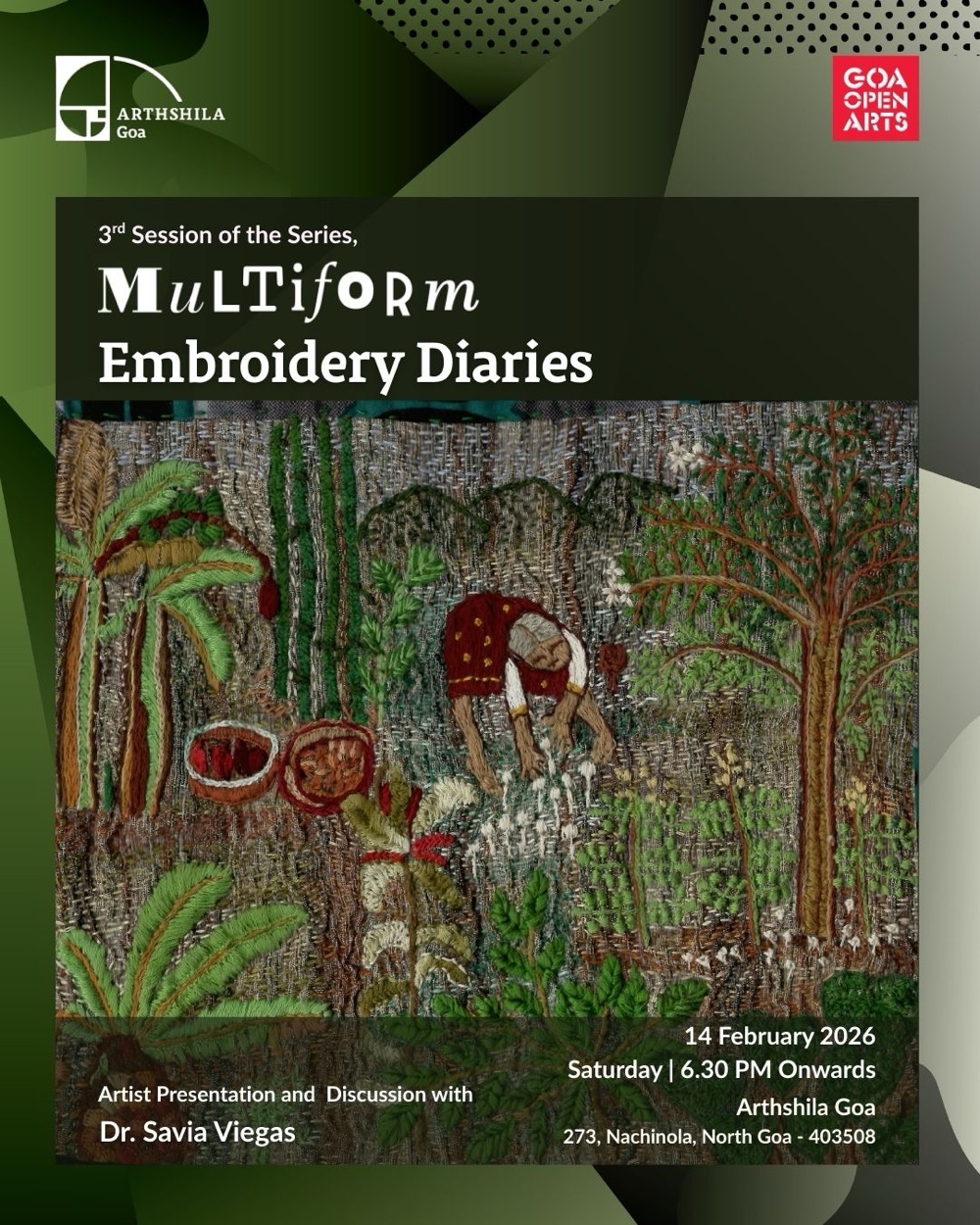
Embroidered Diaries was a talk given by Dr. Savia Viegas at Artshila, Goa, where one spent the evening listening to her speak about her embroidered narratives — works that hold village stories, whispered histories, remembered scandals, and impossible romances drawn from dining-table conversations of her childhood.
Her mother was a seamstress who worked until her last breath, yet did not want Savia to learn the craft. Having given up her own education to stitch and make ends meet, she was determined that her daughters would be educated. For Savia, embroidery entered her oeuvre by this sense of denial. She yearned to stitch but couldn’t. Later she taught herself and embroiders narratives much like a writer would — plots that are spicy, melodramatic, romantic — centred around her village of Carmona. These are real stories, and listening to Savia recount their intrigues was a treat.
Visually, the narratives unfold in layered, non-linear ways — sometimes circling clockwise or anticlockwise, sometimes breaking into fragments. In one piece, Patricia’s Prenup, a young woman is shown glancing out of a typical Goan window on her 27th birthday and sees a young man on a bicycle, his path blocked by buffaloes returning home from grazing. She steps out to help him; eyes meet, hearts soften, and they are betrothed — only for him to marry another. Rejected, she dresses in her bridal gown and lies upon a lotus pond, meeting an Ophelia-like end.
In another work, Magnu’s Penance, a man in love with a wealthy girl travels to South Africa to make his fortune. When he learns that her father is parading suitors before her, he overturns a poker table where his employer and friends have been gambling with gold ingots, seizes the gold, and sails back to Goa. He returns rich, marries his beloved, and lives well — until, on his deathbed, a priest tells him that restitution is required for his confessed theft if he wishes to enter heaven. As he fades, his wife scrambles to organise carpenters and construction as specified by the priest, while the village murmurs in curiosity.
The stories linger. They are quaint. They are real, and embellished with many threads.
The embroidered pieces draw from flattened figures reminiscent of folk embroidery traditions such as Kantha, from village memory, and from lived anecdote. For Savia, the visual field carries the narrative weight. The image seems primary; the stitch operates as vehicle rather than subject, and its tactile qualities are not fully utilised to augment the texture of each story.
I found myself thinking about how differently these stories might live in thread — how stitch could amplify texture, density, silence. Create tactile nuances to augment the intrigue in the narration of memories. Nonetheless, it was an engaging evening—compelling to see memories stitched onto cloth.

