Friday, 17 March 2017

Turning, Returning, Reclaiming: Day 2 at the Kochi-Muziris Biennale, 2017


Breakfast in Kochi was a soul indulging experience and a habit that could be hard to break. Each morning, I sat out on a verandah with gleaming red tiles that lead to a handkerchief-sized emerald green lawn, which overlooked the backwaters. Watching the coconut palm bending towards the Vembanad as I nibbled sweet, ripe, golden jackfruit or sipped some tea, beyond a white picket fence, I could also see the Thoppumpudy Bridge that crosses over the backwaters into Ernakalum. More often than not, it was packed bumper to bumper with traffic. But although I wasn’t too far, the water acted as a buffer and I could barely hear the urban cacophony. In the heart of this historic buzzing port of Kerala, I was fortunate to begin my day watching fishermen and birds on the large expanse of water gently rippling along with the tide, its fluid surface shimmering in the subtle light of morning. The empty plastic water bottles and polythene bags that were carried with the tide were disconcerting, but I was told that it is better than it used to be and people are becoming more conscious about such things.

View from Ginger House Restaurant, looking onto a naval base

                         
While today Kochi may be the busiest port, historically it was Calicut, modern day Kozhikode, that dominated in trade.  When Vasco da Gama landed on the shores of Kerala, it was in Kappad in Calicut that he disembarked with his crew, in May 1498. Calicut, then under the rule of the famed Hindu Rajah known as the Zamorin of Calicut, was the archetype of commercial prosperity and hosted merchants and goods from every trading nation in its lively bazars. But the Zamorin and Vasco and his crew didn’t hit it off and the Portuguese eventually sailed out to Cochin to load their ships. It was through the Portuguese that Kochi came into prominence prior to which its history is not well documented. The Rajah of Cochin befriended the Portuguese and with his help many battles were fought against the Zamorin who, with the help of the Dutch, eventually conquered Cochin in 1663. However, after the retreat of the Portuguese, the Dutch assumed the mantle of protecting the Rajah of Cochin and in various other ways by interfering with the prevalent trading practices, undermined the Zamorin’s powers. Although the Dutch had a longer stint in Cochin than the Portuguese, they didn’t stay too long either. Weakened by constant wars against Marthanda Varma of Travancore the Dutch eventually surrendered to British forces that marched from Calicut to Cochin in 1795, as part of the larger Napoleonic Wars between Holland and England in Europe. By the end of the 17th century Calicut’s pre-eminence and glory faded, and Kerala’s great age ended by the turn of the 18th century with the dawn of the colonial era.
 Brunton Boatyard, Fort Kochi
Fascinating as history can be, and walking through Kochi one cannot help but notice various colonial influences, nature is a powerful magnet. And, as if by design, a big chunk of Day 2 of the Kochi Biennale 2017 experience, was viewing works on nature. ‘Landscapes and Silences’, an Indo-Canadian Project curated by Tanya Abraham and Wayne Baerwaldt presented artists who explored the changing relationships between artists and nature in art, re-looking at the moral and aesthetic values towards nature in a changing rural landscape.


Terry Billings, Adjusted Landscape, 2006, Acrylic on archival digital-print paper

Within this exhibition, Terry Billings, created an aural installation, recorded in Saskatchewan and Kochi, of a 'Dawn chorus' - of birds singing at the start of the day, which was placed at the entrance and stairwell of the Kashi Art Gallery, an old Dutch house in the Fort Kochi area refashioned as a cultural space. This gentle, twittering chorus followed us throughout the gallery, sometimes complimenting, sometimes contrasting and sometimes overpowered by the art works on display. The natural landscape was presented in its many guises.
Regina Horowitz, Starfields and Fields, detail
Through black and white photographs made by a pin-hole camera, Regina Horowitz created images that brought a sense of timeless transience in the natural world through her wispy, grainy images in shades of grey and black. Gabriela Garcia-Luna photographically documented the seen and unseen in natural vistas to index personal memories, presenting them in a circular format as quasi-abstract imagery which drew its impetus from foliage and trees.

Gabriela Garcia-Luna, Regina, Canada, a detail


Gabriela Garcia-Luna, Regina,
 Canada, Set of 3
The unending circumference around the colourful photographic landscape, evocative of a seamless merging of the inner and outer world was a compelling visual metaphor that drew the viewing eye inside the form and then, further within, into the self, to create an intimate viewing experience. Zachari Logan's portraiture of wild plant-life, though reminiscent of botanical drawings of an age gone by, were not necessarily biologically accurate but were created as deliberately provocative, imaginative hybrids, referencing the four seasons.
Zachari Logan, graphite and pencil on paper, 15 in x 15 in
I'm irrepressibly drawn to plant-life and enjoyed these art-works immensely. Walking around Kochi, I've also been mesmerised by the over-arching, larger than life, flowering 'Rain Trees' that line the streets around Fort Kochi. Kerala, is abundantly blessed with natural munificence and the large water bodies around the city bring in many birds. I've seen Seagulls, Heron, Kingfisher, Cormorants, Eagles, Kites an abundance of crows, as well as unique small birds that I can't identify. Here, nature, the mechanical and man-made co-habit with ease. There are no 'green' auto-rickshaws and taxis around, as seen in Delhi but, the debris floating out to the Arabian Sea is a constant reminder of how careless we become when nature sustains us so effortlessly. Walking out of these exhibits expressive of a dwindling natural habitat, I wondered how much impact could the subtle voices of these Canadian artists have on the collective consciousness in Kochi, and, as artists, are we merely speaking among the converted - is that as far we can go?
David Hall, Cafe, Fort Kochi
Nearby, David Hall - also an old Dutch bungalow that has been restored and redesigned as a cultural centre, cafe and gallery for contemporary art, had actually been the first Biennale venue I visited that day. My hitherto languid mid-morning, after breakfast overlooking the Vembanad, had been confronted by Padmini Chettur's multi-channel video, Varnam, 2016, where she sought to redefine gender roles through the depiction of love and longing in classical dance. Intrigued by the rhythmic chant and free-flowing but tightly controlled body gestures of women dressed casually in sarees, evocative of western modern dance with mudras from classical Indian dance, I sat on the wooden bench and watched three simultaneous videos being screened. It's never easy to impress upon your audience, in the matter a few moments, the essence of ideas that have engaged an artist for many years. The language becomes personal and thus codified and needs deeper engagement and more time than such a large-scale Biennale viewer can spare. I can't say I understood what she was saying but I was intrigued enough to watch and listen and carried with me a sense of its power, even if the real meaning eluded my grasp.
Padmini Chettur's multi-channel video, Varnam, 2016

In an adjoining room, this idea of a codified language was also voiced by Dana Awartani, from Jeddah, Saudi Arabia, in 'Love is my Law, Love is my Faith', 2016, a large-scale (200 x 200 x 200 cms), white on white panels of hand embroidery on silk. I was curious about these love poems and who had done the embroidery. I searched on the internet and discovered that I share my alma mater of Central St. Martins with the artist and therefore assume that Dana does the embroidery herself. 
 
Maggie and Anjalee distracted while viewing Dana Awartani's,
 'Love is my Law, Love is my Faith', 2016, (200 x 200 x 200 cms)
Standing in front of the eight embroidered panels, or walking around, I found myself drawn into their depths, but that I was precluded from entering its inner recesses or sacred space. The white panels placed in the manner of eight receding doorways were hung from the ceiling and raised from the floor level and only a spirit floating inwards could possibly access the inner sanctum, as experienced by the poet. Ibn Arabi was an Andalusian Sunni Scholar of Islam, a Sufi mystic, poet and philosopher, regarded by Sufism as "the greatest master" and a genuine saint who wrote:
"The mystery of that is that in the world of subtle beauty
people are only infatuated with the world of form.
Were they like me in love, they would be satisfied
and they would witness his essence in every form of belief;
for they would be [sharing] in what my vision determines
if they were in love from the world of direct observing.”
[Translation anon]
Dana Awartani, 'Love is my Law, Love is my Faith', 2016,
(200 x 200 x 200 cms),detail
In concurrence with the aniconism reflected in the poem and the poetry of geometry which the Islamists believe created the universe; as an act of reviving the practice of Islamic geometry and its highly codified mathematically derived forms, Awartani embroidered familiar patterns from the Islamic repertoire. “Using the tradition of Saudi textiles” and creating “genealogies of meaning that act as a form of meditation, praying and search for the inner spirit”, with white thread on white Moire silk, Awartini delicately envisioned the purity of a spiritual encounter”, recalling Ibn Arabi’s experience at the Ka'aba in Mecca. I am a fan of Islamic art and was once a keen student of the concepts of geometry and mathematics that defined it. In Awartini’s “act of revival” of its highly-coded language, I had hoped for some contemporary light on the precepts that formulated this art, especially to decode the mystery of symbols embroidered in her work and their particular relevance with the poems of Ibn Arabi, but I was disappointed.
Avinash Veeraraghavan, After The End, 1, 2016, (150 x 100 cms),
In another gallery within David Hall, walking across the hallway and once again encountering Padmini Chettur's video performance on my way, were large, embroidered tapestries on organza by Avinash Veeraraghavan from Bengalaru. In 'After the End' 1 and 2, 2016, (150 x 100 cms), he used traditional embroidery techniques to evoke notions of what could have been an abandoned childhood - harking back to the past, through the present recording of absence - the absence of human form. Forgotten playgrounds, going to rust, were lushly portrayed with sequins, beads and thread work, seemingly celebrating rather than lamenting the empty and abandoned spaces. His use of padded beadwork to raise and highlight the relatively shining metallic structures of a rusting slide and carousel was most effectively contrasted against the organic and rough texture of the rest of the tapestry. And even though the extravagant use of material in the elaborately sequinned landscape, of fallen autumnal leaves and the sky, raised many questions about the shimmer and shine, there was, nonetheless, a haunted quality to the embroidered tapestries that evoked an emptiness which the gleaming plastic sequins could not disguise.
Avinash Veeraraghavan, After The End, 1, a detail
Although I inferred that the execution had been done by artisans, it wasn't stated whether Veeraraghavan had embroidered the works himself or employed skilled craftspeople to assist him. The Biennale Guide text references embroidery with its ancient tradition as a vehicle for reclamation of the past. But, do those continuing a tradition need to reclaim it, or is it for us now removed from such practices, to find ourselves through that tradition? In this instance, I am not sure how that could have been achieved, not unless the artist undertook to learn the skill and execute the embroidery himself. In addition, the absence of credit given to those who may have worked with him in continuance of the tradition of this embroidery practice, detracted from a statement that was also not corroborated visually. From the perspective of craft revival and enhancing the value of working with the hand, the craftsmen employed could well have been exposed to newer ways of using age-old techniques that would augment their vocabulary of form and texture and enhance the scope for embroidery. And, I was happy to see thread used so extravagantly and find its place in the third edition of the Kochi-Muziris Biennale. The skilful execution of these two tapestries was also a significant feature that attracted and sustained my interest.
Avinash Veeraraghavan, After The End, 2, a detail
Looking at so many works of art needs frequent pauses and the galleries at the Biennale are well located among cafes and restaurants to create a viewing experience that includes quaint lanes and expansive vistas of a charming city, its history and multi-layered culture. Quite naturally Maggie, Anjalee and myself sat back and relaxed in the natural environs of The David Hall cafĂ© to natter and mull over the art we’d just seen. Filter coffee, Kerala style, with an impeccably cooked French toast using banana bread, was the perfect punctuation after some intense art viewing. The swing, hung by coarse rope from a tall tree, was just too good to miss out on and taking off from Veeraraghavan’s embroidered playground, swinging high, I reconnected with a childhood pastime.  However, the eerie viewing of a chicken’s dismembered foot on the garden path as I walked past, created a horrified Eeeks! for the reality of everyday living, to offset the aah’s of art appreciation.

On our way to The Kashi Art Gallery, we walked through ‘The Passage Malabar’ to stop by and check out the merchandise at ‘Cinnamon’, a designer retail outlet. In the Passage, we encountered some curiously manipulated photos, as visual essays on the palaces of India, imagined by Karen Knorr where the inhabitants were creatures of the animal kingdom. It was part of a collateral event presented by Tasveer.
Meydad Eliyahu, The Box of Documents - Kadalassuppet, 2, Kashi Art Gallery

Some of the other art that I engaged with, included an installation at Kashi by Meydad Eliyahu [Jerusalem] who explored a lost personal history and connection to Kerala Jews, through ‘The Box of Documents/Kadalassuppet’, a compelling series of photographs by Endri Dani [Albania], at TMK Warehouse, expressing how people subvert the homogeneity imposed by totalitarian leadership, and Margaret Lanzetta [USA] speaking colourfully at Kashi, about the ‘Folded Language’ of patterns that have migrated through trade in textiles.
Endri Dani [Albania], CM 182, from a series of photographs,
 TMK Warehouse,
Margaret Lanzetta [USA] ‘Folded Language’, Kashi Art Gallery
Yesterday, Maggie and I had a sumptuous lunch at ‘Oceanos’ on Elphinstone street, where the ‘Thiru Kochi Mango Fish Curry’ and the ‘Syrian Catholic Fish Pollichathu’ were beyond delicious. Today’s choice was the Ginger House Restaurant in Mattanchery, which also houses an antique store.  Sitting on the waterfront, upon and among antique furniture including the tables, chairs, counters, pillars, door frames and traditional Kerala artefacts, the museum restaurant was a perfect counter point to contemporary art viewing and a reminder of the cultural palette of the city hosting it. 


365 days of Shringar, Nathdwara Pichvai,
Heritage Arts Antique Showroom Mattanchery, 2

It was also the venue for a Biennale collateral event presenting the Nathdwara Pichvais of Rajasthan where the highlight was a series of miniature-scale line-drawings depicting the various modes and forms of ‘shringar’ captured by an innovative artist.
Boats and a Boatyard, and Naval  ships in the distance, Mattachery
Thinking, about the art I had seen over the last two days, of being surrounded by the Arabian Sea, with large Naval ships and fighter aircraft flying above, I was waiting for my companions inside the antique store, seated on a darkly polished rosewood sofa-set with an ornately carved, large than life, Garuda backrest, when I glanced around me and found that I sat amidst dulled brass face and body masks used for dance performances, larger than life painted but faded wood carvings and other antique artefacts.
The Garuda backrest Sofa and brass body and face masks,
Ginger the Museum Restaurant Mattanchery,
In a city where civilisations have colluded and collided over trade and warring princes paved the way for colonial masters; where a culture once seeped in mythology and lore of an indigenous ethos had imbibed much yet ignored a great deal of the foreign influences of ruling factors, choosing to stay rooted in their own unique culture, I wondered how this city would be, or could be impacted by the world of International contemporary art and artists it was hosting. I wondered about the very language of art and its capacity to move others - especially the uninitiated public. Some of the artistic concepts that I had engaged with had been deep and required total commitment to viewing, letting go of preconceived ideas and just being part of the experience. This kind of viewing is a practiced art that comes from years of looking and making art, how then do others engage with such expression?
Alex Sexton [AUS] 'Refuge' 2015, [TKM Warehouse].
Though tired from stretching my mind to contextualise the art already seen, my day had not yet come to a close. Egged on by Maggie and Anjalee, I dragged myself to yet another Biennale venue to be utterly awed by Alex Sexton's 'Refuge' 2015, [TKM Warehouse], which highlights the struggles of those seeking political asylum. Powerful as the work is, I may well have overlooked it, not because it wasn't striking but because in my fatigued mind it appeared as if a tarpaulin fabric had been draped and cast in plaster of paris, so no big deal! But, as Maggie read out the details of the work posted on the walls of a run-down, possibly out of use warehouse, my senses perked up. Did she say carved marble statue? Yes, it was indeed carved as if the human being it draped had left a hollow of its earlier presence. By choosing to depict a single figure Seton [Aus] personalises the story of the refugee. The empty space could have been, or could be occupied by anyone, including myself.  His use of classic form, skills and material connecting to the history of sculpture that heralded the figurative and realistic representation, added another dimension. Not only did the concept gain strength through my admiring attention of its skilful execution, but the power that skill and excellence in execution has in drawing us into itself, was brought to the fore. In another, adjacent gallery, six, large (167 x 670 cms) water colour paintings by T.V Santosh compelled my attention in much the same way, marvelling at the technical expertise of using water colour at such a large scale.
T.V.Santosh,(167 x 670 cms) water colour
Yesterday too, despite relating to and thoroughly enjoying the deeply philosophical and socio-politically motivated conceptual art works at Aspinwall House, it was the lighter-veined, innovative drawings in a collaborative work with Madhubani artists, at a collateral event at OED gallery on Bazar Street, that had been just as memorable. Skilful in execution, imaginative in content and subject matter, with a lightness of being, were the hallmark of artworks that I found exceptionally attractive – be it embroidery, drawings, water colour or sculpture. The capacity for excellence in execution and presentation couldn't override the notions an artist explored, but somehow, it seems that conviction in the idea is often communicated and made consummate by the level of commitment in its execution, even if not done entirely by the artist him or herself.
Godh - in the lap of nature 2016, detail 2
The acquiring of a skill and facing challenges encountered in traversing newer conceptual terrain, is also about making a pledge to excel. Even where the artist is not the skilled executor, getting traditional craftsmen to interpret the concept and provide just the right technique and texture requires a tremendous level of commitment. It is perhaps this depth of engagement which can and does grip the imagination of even the uninitiated in art, leading to curiosity and awe and through this to impactful and far reaching dialogues - beyond that of the converted preaching to themselves. I am always moved by art that takes me deeper into myself, that enables an experience beyond the sensual. Yet, the sheer materiality of the embroideries, skilful water colour paintings and marble sculpture were breath-taking, even though the subject matter may have alluded to desolation, loss and trauma.
T.V.Santosh,(167 x 670 cms) water colour, panel of six
Indigenous art had found ways to incorporate a gamut of human emotional experience by embracing the disgusted and grotesque with as much power as the lovelorn and romantic. And these rasas became a highly-codified language now intelligible only to scholars and that ilk. In the realm of textiles, emphasis lay in the exquisite exploration of skill in making and embellishing fabric, prompted as much by trade as by a spiritual quest towards discovering greater and greater heights of excellence in human endeavour.  The ancients in India, had devised an art practice which eschewed personal glory by extolling the gods or creative forces of the universe that blessed the hands that created in its name. This encountered its own set of complications in the modern world dominated by western ideals of art making compelling a shift in the practices of art making in the subcontinent.
Dana Awartani, 'Love is my Law, Love is my Faith', 2016, 
(200 x 200 x 200 cms)
Towards a return to traditional practices, Dana Awartini alluded to such ideals by emphasising the dominance of the art over the artist. However, in an era where personal glory is prized, such ideals are hard to sustain and her art, in keeping with the practices of the contemporary world, was presented with her individual identity. Placing technique at par with concept or of art over the artist, are ideals of the past, and perhaps in reclaiming the past, as Veeraraghavan attempts through the extravagantly embroidered abandoned playground, they become ideals for the future.  It is however, reassuring to see that no matter how tentative their steps, the masters of skill are beginning to find their feet in our contemporary world.  But, before renouncing identity to extol the forces of the universe that creates through the human form, they must  first find their place in a world of contemporary art that has overshadowed humble anonymity to exalt human vanity.
Avinash Veeraraghavan, After The End, 1,
a detail

Monday, 13 March 2017

That Thirst........ Day 1, Kochi-Muziris Biennale, 2017


Anjalee looking out at the Pyramid of Exiles
 
On my first day in Kochi, I hadn’t gone to the Biennale venues, choosing instead to take a sunset ride on the Vembanad. I wanted to go alone, in a country boat, without a motor, and somehow my hosts could organise this for me at short notice. I spent a delightful hour watching Peter, a fisherman cum sand transporter, manoeuvre his boat through the backwaters with a bamboo pole called karkol. The setting sun played all kinds of ‘light’ games with his silhouette, as his tall, lithe frame, turned the dark, long, wooden boat this way and that, or just letting it float in the rippling waves. 
 

Peter in his Vanji on  the Vembanad, Kochi


It was a photographer’s delight and I took almost 300 photos in that hour. Occasional fishermen in smaller boats passed by and Seagulls, Cormorants, Kites, Eagles and Crows flew past or overhead. This, my first day in Kerala was steeped in such wisps and views of the natural world amid the bustle of a successful commercial port that, I couldn’t help but envy the residents of Kochi who were blessed with the facilities of a city and the tranquillity of nature always so close by.
 
Breakfast in Kochi, overlooking the Vembanad

 The next day, I met up with Maggie Baxter who’d flown down from Australia and Anjalee Wakankar who’d adjourned her Ayurvedic medical treatment for the Biennale, and got down to some serious art viewing.  The way the exhibition venues are planned, one walks through different parts of Kochi, passing under the tall canopies of the overarching, shady ‘Rain Trees’, through the perfumes of myriad flower oils, masalas and fish aromas, added to which Dutch and Portuguese architectural accents, Chinese fishing nets and naval dock yards, make the viewing experience a uniquely enjoyable one. Everything mingles in the mind, making it a truly sensual experience, much beyond Biennale art.
 
Under the canopy of Rain Trees
 
As I looked back on the days’ viewing, in my recall, it was the last set of works I saw which came to mind first. At OED Gallery, on Bazar Street in the heart of the spice market of Kochi, were many interesting works that didn't come under the official Biennale banner, but were delightful to view, nonetheless.
 
Biennale Collateral Event curated by Helen Rayment 
 ‘Common Ground: the serendipitous happenstance project’
Madhubani artists Pradyumna Kumar and Pushpa Kumari collaborated with Ishan Khosla (Bangalore) and Mandy Ridley (Australia) to create fascinating, floor to ceiling, black and white scrolls on coated fabric panels, that transcended boundaries of culture - unique because of the visual and ideological exchange that created the forms, lines and language of visual communication. There was a distinct sense of the 'Western' style of drawing with an 'Alice in Wonderland' touch, but it was also refreshing to see a new vocabulary of marks and narrative emerging from ethnic artists that are wont to regurgitate ideas that don’t always resonate with the world we live in.
 
Godh - in the lap of nature 2016,


Godh - in the lap of nature 2016,
 
In ‘Godh: in the lap of nature’, 2016, the fluidity of Mithila lines and their naive representation of subject were seamlessly interwoven with skilful, realistic drawing techniques. I was intrigued: who drew them? Was the collaboration one where Ridley and Khosla conceived and gave sketches which the duo from Mithila inked, or were the marks a collective endeavour of the four artists. As part of a Biennale Collateral Event curated by Helen Rayment in ‘Common Ground: the serendipitous happenstance project’, this collaboration was based on collective memories of experiences in nature and from landscapes of childhood. And the different drawing styles of each of the artists were synthesised through the digital reproduction process. I wasn’t sure what stories these scrolls told, but the lines and marks tugged at my imagination and like Alice, I was tempted, but didn’t linger long enough to go down the rabbit hole.
 
 
Godh - in the lap of nature 2016, detail

Godh - in the lap of nature 2016, detail
 
In a complete shift from these playful drawings, Ales Steger in creating 'The Pyramid of Exiled Poets' at Aspinwall House, nagged at my conscience, compelling me to enter and experience what it feels like to walk in a world where your voice is unintelligible; where strangers, and not your kinsmen who share language and cultural values, hear your words. What does it feel like to be in exile, to have lost your home and not be heard? And if heard at all, to speak in a world darkened by the knowing of your unknowing?
 
 
Ales Steger 'The Pyramid of Exiled Poets'
 
Invited to experience that articulated but unutterable anguish of separation and the pain of not belonging, I entered a life-sized Pyramid - emblematic of life after death, which was covered with cow dung. Walking through a pathway, dimly lit as if from below, I tread carefully through a maze of dark passages within the triangular space created by woven mats that partially obscured the light. As lightness got dim and darkness grew so dark as to engulf me, and whence I could barely see, I felt as though I had somehow been suspended in mid-air. My stride was hesitant and taking small, tentative steps, not knowing where or what to put my foot upon and what I could step upon, the only sense of humanity around me was an aural one. Poems spoken aloud in unfamiliar tongues became my guide. As long as I could hear something I was reassured that I hadn't taken a wrong turn (even though there wasn't scope for it). As the blackness enveloped me, I experienced the suffocating darkness, evocative of those who have been summarily dismissed or cast out of public consciousness - whose ideas have been stifled and exiled. It was a disturbing experience but one that left its mark. If anything marred, it was the nervous giggles of a group of youngsters who walked ahead and behind me. But even so, the darkness and sense of insecurity was consummate enough to taunt me through the day, reminding that we are all exiles, where the human experience itself is one of banishment from the kingdom of heaven.
 
In another gallery, inside Aspinwall, on the first floor. There was an installation with numerous brown ceiling fans accompanied by the occasional, sharp, rasping bark of an unseen dog. Placed just above the stairs on the landing of the first floor, this installation by Lantian Xie who lives and works in Dubai: ‘Ceiling fans, stray dog barking, Burj Ali’, became a passage beyond that of a space connecting floors and rooms. The strange, sharp rasping bark of the dog was to echo through the gallery spaces within and without and even if I wanted to forget, I could not. Like the restive and traumatised spirit of a soul that hasn’t found peace, this dog and the memory of those fans haunted me as I made my way through the other exhibits. Was this ghostly bark the voice of another exile?
 
Dai Xiang - 'The New along the river During the Qingming Festival', 2014, detail 1
 
Moving into the adjoining gallery, we found that by contrast there wasn’t even one ceiling fan in this room.  The afternoon was balmy and humidity was high after heavy rainfall the night before. We were hot, uncomfortable and peeved enough to ask why there was just one pedestal fan in the corner of this long room, to be informed it was so as not to disturb the paper scrolls on display. And somehow, we accepted this explanation without demur because by this time, the sheer scale of the scrolls and intense detailing had engaged us totally. Much discussion ensued between Maggie, Anjalee and myself as to how it had been done and naturally none had the answers. The horizontally positioned 115 x 2500 cms long scroll by Dai Xiang - 'The New along the river During the Qingming Festival', 2014, juxtaposed traditional modes of transport, dress, customs and architecture with the contemporary, and presented an engaging dialogue between layers of culture that interact to form and transform into present-day society.
 
Dai Xiang - 'The New along the river During the Qingming Festival', 2014, detail 2
 
Inspired by Zang Zeduan (12th century, Song Dynasty) this panoramic, 25-metre-long photographic scene, which had been digitally ‘sewn’, highlighted the socio-cultural conflict from 1970/80's and the opening up of Chinese society, between imported Western ideas and local Chinese traditions. Re-imagining the Qingming Festival, artist Dai Xiang transformed a monumental social-cultural shift through subtle satire that was gripping not just in its Chinese context, but one which provoked much thought regarding India's own cultural confusion and the layers of history which, though assimilated, are still distinguishable as separate from local traditions. And Fort Kochi - it's Portuguese, Dutch, Syrian Christian and British accents in architecture and cuisine juxtaposed with the distinctive indigenous culture of Kerala, created an evident parallel to mull upon.
 
Dai Xiang - 'The New along the river During the Qingming Festival', 2014, detail 3
 
 
Pondering upon the amalgam of intertwining cultural influences, I reflect back to the exhibits at the OED galleries in the Spice market area, particularly Maggie Baxter's (Australia) collaboration with Kirit Dave (Kutch). ‘The Poetics of Nothing’ 1,2 and 3, were three scrolls on hand-woven fabric, block-printed and embroidered, with marks composed formally within an ellipse with the same ‘block’ overprinted in varying intensities. 
 
Maggie Baxter and Kirit Dave, 'The Poetics of Nothing
Large, tactile, textile scrolls with printed, hand-written text in English became the backdrop for hand-sewn threads to be inserted and hung from this base material. This technique created an illusion - as if the warp and weft of construction had unravelled to now hang from the fabric. It appeared as if the boundary of language had transcended, moving out of the egg-like elliptical form, which dominated the background, evoking a resonance with the essential womb of creation and its energies that create any form desired, encompassing all and nothing in the same breath.
 
Maggie Baxter and Kirit Dave, 'The Poetics of Nothing, detail 1
 
 In keeping with Maggie’s preoccupation with scribbles, scrawls and alphabets, the printed works and marks continued her trade-mark free-flowing gestures enhanced by the ubiquitous running stitch and contrasted by Ahir embroidery diamonds done by numerous artisans, all of whom have been named in the catalogue.
 
Maggie Baxter and Kirit Dave, 'The Poetics of Nothing, detail 2
 
In another exhibition, also at OED, Krupa Makhija's use of computer keyboard keys to create a map of lost language followed in a similar vein – how languages as marks of culture, are lost or recreated.


Krupa Makhija, Map of Lost Languages

 
In another work by Siji Krishnan from Kerala, soft colours evoked the time-worn textures carried as memories through photographs and souvenirs collected and often forgotten. In creating the layers of memory, especially childhood memories through small, life-sized wallets using papier-mâchĂ© and mixed media the works were so softly hued as to remind one of the many washes they have gone through – the washes of time which form the ritual of creating memories, more imagined than real.
 
Siji Krishnan


Siji Krishnan
 
Hours of viewing art can take their toll and the mind shuts down, but ‘Art’ also has the capacity to invigorate in precisely such moments. Mikhail Karikis, in ‘Ain't Got No Fear’, 2016, (Aspinwall) a single channel video with surround sound, used the noises of demolition in a recurring beat as young boys ‘rap’ about their lives. It was a compelling video with a mix of cultural references which I could hear but could not discern. But, from the rubble of the site being demolished and the dialogic beat from a complex and sometimes ‘hellish’ language of the past, you heard distinctly defiant voices of the young boys who had made this site their playground that they “Aint Got No Fear”. The juxtaposition of history and cultural voices, echoed the essence of changing values and ideas posed by most of the artists whose work we had seen today. But, it was the recurring beat and an insistently repeated chorus, amid shrill noises of the landscape that, hammered in the weighty question of how much could the human mind really eschew fear.
 
In another audio-visual presentation, Voldemars Johansons had created a documentation of the stormy North Atlantic Ocean, inviting us to enter a landscape of troubled waters. A large cinematic screen, with massive crashing waves and swirling waters, viewed in a gallery space could not have quite the same intensity of experience as being in the middle of the ocean to hear the roar and feel the turbulence of the waters, and the wind howling and beating around you. But I found myself watching, ‘Thirst’, 2015, (Aspinwall) intently, observing the roaring waves swell and break, to try and fathom what the artist was wanting to show me. Everything else that I had seen till then was momentarily relegated to the back of my mind. And despite the troubled waters before me, I felt a sense of quiet within my being to experience through this 'thirst’ for observation, the vital key towards understanding the ever-dynamic phenomenon of life, of going from without, within. Where briefly we are no longer in exile.
 
Through the day, I found myself surrounded by varied Art expressions and media, new vistas, water bodies, ships and ferries, spice markets and delicious food that beckoned, and realised how difficult it was to engage with it all.
 
Maggie at Brunton's Boatyard, Fort Kochi
We had started our viewing late in the day after an exotically flavoured lunch of Syrian Christian flavours steamed in banana leaf. Our first day therefore, was limited in its art-intake, and with periodic breaks for cardamom flavoured nimbu paani and impromptu shopping for spices, though slowing us down, also gave us scope to sit back and let the mind wander in other directions, to let art we did see, sink in effortlessly. 
 
Spice Market
Yet, the Art that we did see, left their scars, created parallel dialogues in my mind and invoked the spirit of intercultural influences, through trade, colonization or displacement - absorbed and amalgamated into the ever-dynamic traditions that we inherit and pass on. But above all, this first day of my viewing of the Kochi-Muziris Biennale 2017, created a thirst in me. That perennial thirst to know and understand the human experience, articulated through the visions and voices of artists from across the world: was it truly a universal one, and how much did the external world and its unique contours matter, in the ultimate analysis of things.


Wednesday, 31 August 2016

Building Bridges - Exhibition Review - Ceramics


Neha Kudchadkar


‘Bridges’ was an exhibition of ceramics held at Stainless Gallery, New Delhi. This exhibition showcased the work of fifty studio potters who have trained with Deborah Smith and Ray Meeker at The Golden Bridges Pottery studio in Pondicherry.


Reyaz Badruddin
 
 
Playful porcelain and pen doodles by Neha Kudchadkar reminiscent of containers defied the weightiness of them. Reyaz Badaruddin had flattened the cup. A hollow container, usually thrown on the wheel had been painted on flat clay tiles.  Veena Chandran used a large, traditional earthen pot-form. But she flattened it out as if breaking the clay pot, and then smeared the moist clay with her hands in a gesture that sought to explore the potential of clay, beyond traditionally prescribed norms. Shayonti Salve’s thrown but altered forms were a reflection of the duality she experiences where, as she said: “my head is often tormented by the times we live in, while my heart tried to comfort it”
 

Veena Chandran


Shayonti Salve
 
 
Pottery is one of the oldest art forms in India. Known as Prajapati or Kumbhar, the potter played a significant role in ancient society. However, potters no longer command the same reverence that was once accorded to them, nor do contemporary potters continue the tradition of making pots for daily use. “Today our students are about as interested in making functional stoneware as the sons of Indian village potters are interested in continuing in their fathers’ footsteps”, say Smith and Meeker. This quantum shift from the traditional, ‘form follows function’ approach, towards the more ornamental and conceptual approach in contemporary ceramics, where ‘ideas’ supersede ‘function’, makes an interesting comment on the social and cultural values of our time.
 
 
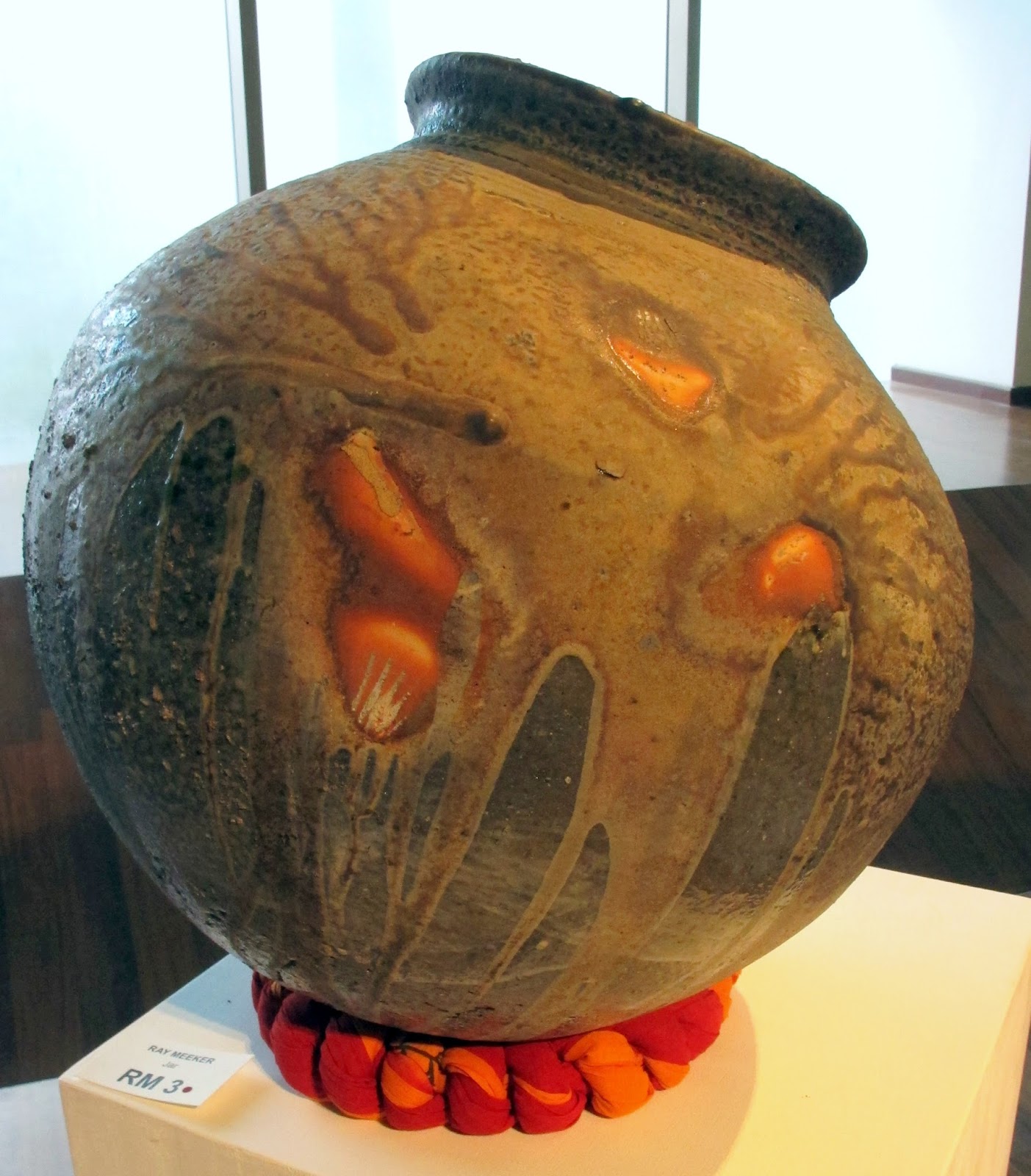
Ray Meeker
 
Golden Bridges, now a preeminent centre for ceramics, was set up in the mid 1970’s by Deborah Smith with her friend Ray Meeker, at the invitation of ‘The Mother’ spiritual head of the Aurobindo Ashram in Pondicherry. Cited as an exhibition of ceramics rooted in the Golden Bridges tradition and a tribute to the influence of Meeker and Smith one expected to find a thread that knitted together the work on display. To the contrary, the diversity of scale and style belied the fact that each of the fifty potters had been trained by the same two ceramic artists and more particularly, were trained using a specialized wood-firing technique.  Among the fifty potters participating, were Anjani Khanna, Michel Hutin, Aditi Saraogi, Manisha Bhattacharya, Adil Writer, Kristine Michael, Nehal Rachh, P. Daroz, Vineet Kacker and Sylvia Kerkar. Although primarily trained in making wood-fired studio-pottery, working in an urban context many of them have
explored gas and electric firings to evolve a differing aesthetic.
 
 
P.Daroz, From the 'Sea Bed' Series


Michel Hutin, a Frenchman who has lived and worked in Auroville for over twenty-five years, joins soft, undulating slabs of clay such that the interacting lines create rhythm, melody and counterpoint. P. Daroz has a passion for seascapes. Drawing upon memories of trips to various coasts and cliffs, his ceramic pieces from the ‘Sea Bed’ series are abstract in their presentation. For Nehal Rach an advertising graduate, who found her calling working in clay, pottery is not just something she does, but says that clay-work defines her.  Reyaz Badaruddin responds to urban spaces by evoking the disappearing fields of the agrarian landscape he grew up in. Each of these potters has moved beyond making a conventional vessel, to present abstract ideas where it is no longer about pots per se, but clay as art.
 
 
Neha Kudchadkar
 
The local potter and ceramic artist co-exist, but the local potter is not an artist in the contemporary sense of the word. He is technically skilled but doesn’t employ self-expression which is the basis of much art today. Ironically, this facet once deemed “pitiable rather than heroic” in ancient India, as cited by Ananda K. Coomaraswamy, is what is being keenly explored by contemporary ceramic artists. Pottery is essentially a skill-centric craft where the kind of clay used, kiln and techniques of firing, as well as glazes, play a significant role in the eventual product and how it looks. The firing process can be as intense as eighteen to seventy-five hours, with potters keeping vigil and maintaining logbooks. All of which is rarely mentioned in relation to exhibitions of clay work.  In positioning ceramics within the context of contemporary art, the technical process employed is seemingly superseded by the concepts explored.
 
 That the medium has evolved to transcend its functional origins, is a tribute to the creative minds that work with clay, as much as it is a yearning to bring attention and value to hands that have moulded  earth into vessel for centuries. However, the expression of self in the works on display, did not articulate an exploration authentic enough, to speak the language of contemporary art.
 
Manisha Bhattacharya


[This exhibition was held in September 2014]

Monday, 8 February 2016

In the Presence of Absence


Absesce13. Fabriano Paper 300 GSM. 2ft x 9ft. 2015

  ‘Absence’, an exhibition of paper works by Pune based artist Sachin Tekade was held at Gallery Art Motif, New Delhi, 31st October to 1st November 2015.  Four storeys above, narrow, car-filled streets, one entered a serene space - a contrast to the visually crowded and cacophonic journey there.


Absesce14. Fabriano paper 300GSM. 2ft x 9ft. 2015 


Finely cut strips of white Fabriano paper, like cloth, rose and fell. The carefully orchestrated folds, like the wave of an ocean caught in flow, or young peaks rising from a land yet flat, masked and filtered the light, in a play of shadows.
 

Absesce17.
Fabriano Paper 300GSM.
1.5ftx 4.5ft. 2015n
Absence 13 and 14 [9 ‘x 2’ each, 2015], were displayed one above the other, occupying an entire wall space. To behold these large white frames encasing delicate, quasi-sculptural lines of white paper was pure perfection. Minimal, despite the scale, the works on display were larger and more complex in execution, but visually simpler and ascetic, than his earlier expositions.  Tekade is not interested in self-expression but explores himself through a process that involves skilful dexterity. His art-making is not spontaneous. The artist first makes a maquette and then begins work on the larger piece.


Absesce18.
Fabriano Paper 300GSM.
1.5ftx 4.5ft. 2015
Tekade cuts each, even-sized and even-spaced line and then folds each line of the finely cut paper to create a desired effect. It appears as if the work is crafted from a singular sheet. But, it is the dexterity with which he carves, folds and joins additional strips of paper to complete the rectangular base, which is the challenge; enhancing the purity of his exploration in white.

Wednesday, 8 July 2015

Accidental Perfection - Mrinalini Mukherjee [Conversation/ Review - Nature Morte]


Palm Scapes, an exhibition of Bronze sculptures by veteran artist Mrinalini Mukherjee at Nature Morte, New Delhi [October 29th – November 23rd 2013] compelled me initiate a conversation with the artist.  Appendages of a Palm tree crafted so precisely, where every line of its delicate ridges appeared as though liquid bronze had been poured over a live specimen, aroused my curiosity. How was this perfection achieved?

Surrendering the knowing of the intellect in deference to the inner voice, which paves the path for perfection, is ancient wisdom. Often referred to as happenstance, it is not coincidence, but humility allowing perfection to manifest. But, rarely do artists say it just happened, in quite the way Mukherjee concedes.

The exhibition comprised a handful of bronzes from the Palm series and two works - ‘Bouquet’ I and II, from an earlier body of work. Palm Scape-V [49 x 39 x 30 inches, 2013] was a majestically crafted limb of the Palm, reclining as if on its spine. Its knee-like flexibility allowed it to bend and rest its ‘foot’ on a pedestal, appearing almost human. Placed in the centre of the basement gallery, the expansive space around it, created an aura of authority. In part, it evoked the ‘Machli Palm’ morphing into something that had little or no resemblance to the Palm species at all, but seemed akin to “fossilized trophies dug from a prehistoric swamp or the robotic armour of an alien orchid creature.” 


The ‘head’ of ‘Palm Scape-V’ opened up gladiola-like in full bloom. It’s sensuous, but rigid petal formations stretching themselves, reaching for the skies. The lower section grew into an amply fleshed, leaf-like calyx through which shoots emerged and kissed the table in a quasi reverential way. The leaf-calyx became the focus of attention not just for its placement at the centre of the limb but, because the extremely fine texture, where each fine line was delicately etched to utter perfection, commanded the eye’s focus. I asked Mukherjee how she achieved such replication of this texture. She replied saying this was not intentional: it could have been cast in plaster from an original specimen of the Palm and then in bronze, adding that when she is working, the forms being carved in wax take on the texture of the surface she is working upon and could not recollect exactly what surface created this.

Mrinalini Mukherjee is well-known for her elaborate, knotted and


plaited fibre sculptures. She has also experimented with ceramics, moving onto working with bronze. She carries forward the tradition of working with the hand, which both textiles and ceramics necessitate, and moulds the wax sculpture, before casting it in bronze, entirely with her bare fingers. If any tools are involved, they are only used to remove plaster stuck in ridges and hollow spaces of the finished piece. Here, she uses dentistry tools to extricate the residue.  Working with the hand is important to this artist who needs direct contact with her material. Where, through the conversation between the epidermal layers of her fingers and the soft skin of wax she ‘feels’ the form and its texture into being. 


The transition from fibre to bronze was not seamless but one that generated a great deal of experimentation and capacity to explore different media. Knotting for hours at a stretch, of fingers intertwining with jute to create large, anthropomorphic vegetal forms was laborious and time consuming. A chance opportunity in 1996, found Mukherjee responding well to the immediacy of handling clay, creating large pieces. But she began working with wax to make smaller, less time-consuming work - necessitated by a personal situation, which eventually led to casting in bronze through the lost wax process.  


In ‘Palm Scapes’, which marked a decade of working with bronze,  the work of hands that have felt and touched fibre in a very intimate way was evident -  as if thread had been cast in bronze. I wanted to discuss her experience from Fibre to Bronze. She was reluctant but a brief conversation ensued which was inspiring. Not because she revealed some elaborate secrets, but, for the very simplicity with which she spoke. Of how she had let chance lead her from one thing to the next, undeterred by technical limitations. Allowing this to re-define the way the medium she was experimenting with was going to be used. Mukherjee disclosed that ceramic artist Ray Meeker began his larger-than-life pieces after she had taken the scale of clay onto another dimension. 


Palm Scape-I [20.5 x 62 x 48 inches, 2013] recalls a Palm in flower, however the ‘flowers’ appear hostile and the leafy calyx is menacingly serpent-like. On the opposite end of the flowering tip was a stem extended about three feet in length, with a droopy head-like form at the far end which had a distinct similarity with the male sexual appendage. Despite the traditionally female association of a plant in flower, the form itself carried rather masculine attributes and like most of the sculptures on view appeared androgynous. The voluptuous folds and orifices of Palm Scape-VII [33 x 36 x 13 inches, 2013] could be interpreted as a feminine form, but there was harshness reflected through the use of metal and the grotesque and formidable aspect of the sculptural form. The intensified detailing evocative of a piercing gaze created an otherworldly aura, further fleshing out the masculine. The effect was ambiguous because for Mukherjee, plants have their own sexuality.

Studying these bronzed plant limbs, I was intensely aware of a
persona that was near-human.  Rigid and unmoving – stilled in time, sometimes evoking the vagina, sometimes a penile form and sometimes nothing more than a bouquet of textures, bringing forth myriad ideas  underlying which was a sense of reverence. The sculptures created a sense of awe but, Mukherjee does not speak of either her practice or her observation of palm trees encountered on her drives across the country, with the same devotion they invoke in the viewer. On the contrary, she is very matter-of-fact with words. The interplay of the sensual or erotic and meditative that manifests in the sculptures through attention to detail and intensity of gaze – making a connection that evokes divinity or puja as it were, is not part of her conscious practice either.

Mukherjee records her observations and translates them into her sculptures by neither drawings nor photographs. But driving around Kerala, Goa and other places, she just looked. Different palm forms found their way into each sculpture and it’s hard to say where one began and the other ended or when it took on a character that went beyond that of the palm, or that of any plant-form itself. 


Mukherjee doesn’t define the forms she doesn’t deify them either, but the works exhibited evoked an unseen presence. Some of the creative process is controlled but mostly not. Because she likes to look back at her work with a sense of awe, which is probably why her bronze sculptures bring forth a similar response in the viewer too.