Friday, 6 March 2009

A Journey Into Personal Engagement - Samar Jodha Review [Phaneng]

Savouring the adventure of travelling on the hitherto closed road from China into India in 2004; Samar Singh Jodha encountered a hamlet in the remote eastern reaches of Upper Assam, nestled between the Patkai rain forests and the Terap River near Ledo, which inexplicably drew him to undertake a journey of another kind. “Stunned by the natural beauty of Phaneng and mesmerized by the unique culture of its people” he could not remain a mere spectator to the plight of this diminishing community, so decided to use his “skills” to try and bring about change to “improve the chances of survival of the Tai Phakes of Phaneng.”

As you enter the darkened space of the ‘Religare art i gallery’, designed to evoke an atmosphere of coal and the ghostliness of a diminishing tribe; the near total lack of light perturbs but the scale of portraits is nonetheless compelling. Realistically captured on 72” x 60” canvas of photographic fine art prints, the facial details appear skilfully presented but viewing these portraits requires more than such obvious observation and the habitual city-dwellers glance, of moving hurriedly from one image to the next. It needs an engagement which is easily missed because the location, the language and culture are barely visible. Although curious about this facet, my initial reaction was that they resembled portraits of Tibetans drawn on silk which I recollect seeing on the Mall Road in Shimla in the 1970’s, so what was the point? However, the images haunted in a strange sort of way so I returned and through my conversation with Samar discovered nuances many others may have missed as well.

Today we are swamped by imagery that provokes and it’s become onerous upon the artist to grab your attention. Samar Singh Jodha desists for he is unable to make an emphatic statement. His engagement is filled with dilemmas and creates an air of simplicity which is deceptive. There are some artists whose work is meant to be looked at while some are meant to be felt and submitted to. The purity of an isolated emotion, its starkness, can be dramatic enough to evoke feeling in an objective viewer. However, when you speak of a people embroiled in the politics of coal, which you seek to help them with and return to the city where you consume the electricity that fuels the very politics you want to address, how does any honest human being even pretend to isolate the conflicting emotions?

The portraits have no titles. It’s almost as if unable to find a unilateral involvement, Jodha distances himself and us, implicit with a sense of guilt and unworthiness to know them personally. Using lighting techniques, Samar Jodha deliberately eliminates all details from the frame except for the facial features which are then dramatically highlighted. He asks you thus to make your own acquaintance with them. It is complex ideas such as these which engage, drawing us into those beady eyes that speak of enduring so much that nothing matters anymore. Each experience is etched in the sinews around the penetrating lens looking out at you and the marks on the forehead that ripple like a turbulent river. He looks straight at you without challenging you to change the world. He is not afraid and there is no sense of blame. It is the forthright acceptance of knowing that the world is a complex place of conflicting interests and that peace lies in reconciling the inevitable paradoxes. He indulges the photographer; enjoys the attention but without desire or rancour. He is an enlightened soul.

A photographer of international repute, Samar’s experience in the field of visual communication includes education and apprenticeship with renowned schools and studios as well as editorial and social communication projects of acclaim; that range from fashion to advertising, a United Nations sponsored presentation on ‘Ageing in India’ and an award winning book: ‘Jaipur – The Last Destination’. His involvement in Phaneng has included an education project, a monastery, and a unique eco-tourism venture that has built local capacity as well as raised incomes. Samar’s proximity to the Tai Phake tribals, their trust in him, evolving over the years spent documenting facets of their life, led him to this project of portraiture where the eyes speak and fleshed lines convey with exquisite subtlety the complexity of his participation.
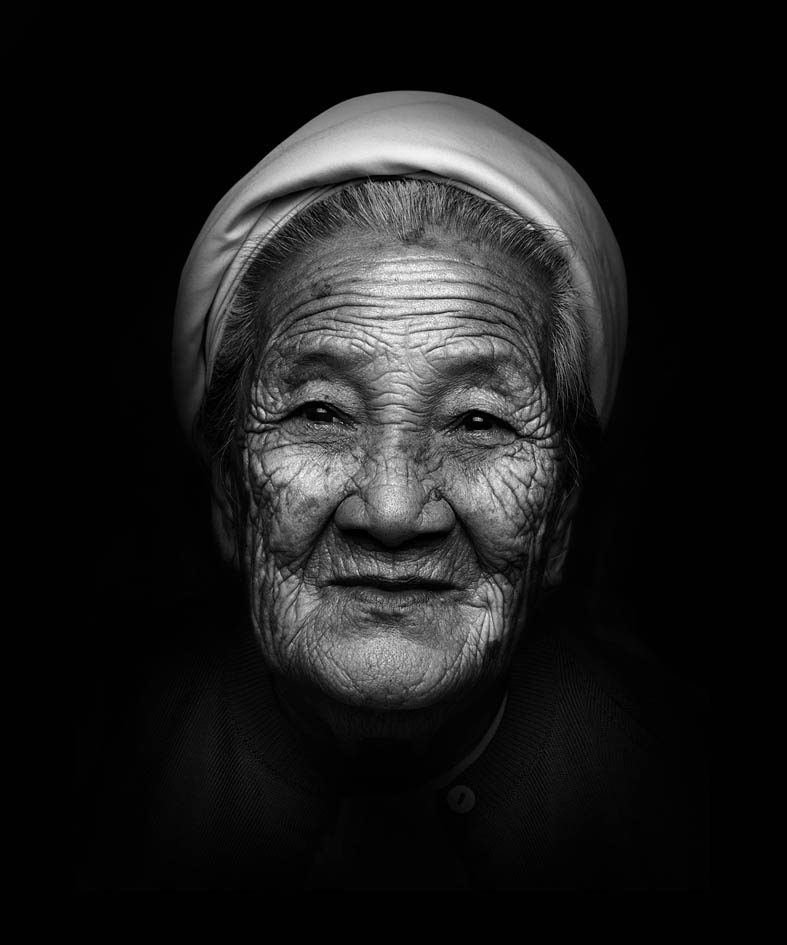
Her wrinkles are a painting in themselves. Who is she? Is she married to the enlightened one? We don’t know. Does it matter? In our chaotic lives are we likely to meet her? Perhaps not; but somewhere, somehow, we all know someone like her. The quintessential kindness of a nurturing bosom radiates from the eyes of a woman who has given birth many times; saddened by the shadow of infertility that looms because the mining of coal is polluting the water this community drinks. Can we change this reality? Will we consume less electricity to keep alive procreation in a community that is dying out? Why should Samar tell us who she is? Can we be more than the occasional, socially motivated voyeur?

By virtue of the nature of his profession, a photographer would essentially be seen as an observer, but digital technologies have facilitated the camera being more than a mere documentary witness. The world of art has expanded considerably to include much more than painting in its canvas. Today, we see manipulated photographic images that speak more as an excoriation of an artist’s inner reality, than the subtlety of putting forward visages as perceived through patient observation of the external world, which evoke the inner dimension. The distinction between artist and photographer is slowly diminishing, with photography becoming a tool for expression in much the same way as water-colour, installation or video. Images such as these portraits from Phaneng veer away from the dramatization of much that is being seen in art galleries, requiring an informed perspective to evaluate. These photographs emerge through interactions that have progressed gradually where the “gaze is mutual.” The scale of work and its positioning ensure the viewer engages with the eyes of the portrait head-on. Can you look away? Many did.

The angry youth, radiating a deep sense of dejection, the young child, astonished by the blaze of a powerful flash, all have a story to tell. If we had silence in our souls, if we could momentarily eliminate the sights and sounds of a frenetic city life, we may have heard the music of the insects at night; we would have empathy with the disillusioned knowing of their elders, the rebellious gaze of this defiant North-Eastern woman who does not challenge or provoke but simply is. Ironically the coal that is being mined in upper Assam, fuels our eccentrically electrified lives without uplifting theirs, for the locals do not work in the mines, immigrants do. So what does the photographer want us to see? What is his intent of sharing without overtly revealing?

The pace of their lives, contrasted with that which Samar Singh Jodha shares with us, is the essence of what is unfolded. In that environment his stride is different. He brings this to our notice by using the old-fashioned 4” x 5” format camera which he inconveniently lugged across unfriendly terrain, against many odds to record this silent tread that is without rush of purpose or anxiety. The format he uses is tedious, but in his mind it is reflective of the world they inhabit more so than the digital camera. The process of photographing them was in itself an experience. The format does not permit multiple frames and therefore the level of trust, the camaraderie between the community and him is expressed via such sophisticated subtleties that Jodha employs. He brings in the totality of his experience of being a part of this community, accepted by virtue of his involvement and yet never belonging. He faces complex dilemmas and guilt of his complicity with the paradoxical engagement to uplift not because he believes he can change the world, but in slowing his pace, living in their time reveals other dimensions of being that the city has robbed him of and us.

Is there a prayer that reverberates as we look into that middle-aged woman’s face? Did you notice the drawn lines that shield those lips which once readily smiled at the light? Wide eyes startled by an electric flash, lips fulsome with hope, what is the future this child inherits? Are the issues under view relevant to just a distant hamlet in upper Assam; don’t they need to belong in our world with as much engagement as Samar Singh Jodha has ventured into theirs?

In reviewing the nuances etched by the refined details of these black and white portraits one feels chided, for the photographer reminds that viewing is not about being seduced by colour, emotion and digital manipulation. He does not impose his views but prods you to question his reticence and once you touch the core, another whole world is uncovered. Its perspective of time and material so alien to ours, that in not connecting with the initial glance we almost let its beauty pass us by. Samar’s diffidence in the words that accompany the exhibition does not facilitate easy access into the sanctum of his engagement. Is this a telling comment on our viewing facility? Have we have lost the ability to assess the visual dimension which is traditionally equated with a value greater than that of a thousand words? Somehow, it seems evident that no matter how consummate the visual art, we need clarity of thought revealing the artists intent or dilemma. In our hectic over-crowded lives, a worthy vision may well be overlooked without this.


Tuesday, 3 March 2009

A Philosophical Fantasy - [Seema Kohli Essay, Mumbai]

In deep seas Fish don’t need their fins; to soar in the sky, I need my Eagle wings…
“Tu shaheen hai, basera kar paharon ki chattano par
ke shaheen ke liye zillat hai, kaare ashian bandi”[i]
- Dr. Iqbal

Travelling through an imagined world created by Seema Kohli, you undertake a journey into many realms of life. Her presentations are multi-layered in meaning. Through them Seema explores ideas she grew up with and then studied as a student of philosophy. The ‘Vedas’ and ‘Bhagavad Gita’ form an essential part of her oeuvre. Her forms are simple. She says they are a kind of rebellion; where reprimanded as a child for these unconventional representations of nature, she now asserts them wilfully. Her fish have no fins. Her cows are clearly masculine and Krishna effeminate by comparison. Traditionally in this ‘avataar’, he has no mythological steed or ‘vahana’ but in these paintings he rides the cow-bull and peacock too. Her birds and butterflies do not have much bearing with natural facets. Her figures are disproportionate; her ‘Gandharvas’ have wings and trees grow on the sun wherein a maiden rides the moon with eagle-winged angels pulling her crescent sledge. All these ideas beg to be questioned. Filled with extraordinary detail that could easily be mistaken for ornamentation, each canvas is a complex tapestry of a highly imaginative mind that playfully investigates deep philosophical realities of life.

Somewhere, a lush but mono-chromatic tree spreads itself covering the whole span of an eye’s view. Women are flying, walking around or sitting on its richly coloured orange branches. Unclothed, they move uninhibitedly, liberated from social conventions. Leaves, roots, clouds and waves create a continuous unending pattern signifying a seamless continuity of life. Nestled deep among its roots the golden womb or ‘Hiryanyagarbha’[ii] has been drawn. Representing the ultimate dimension of consciousness which encompasses the whole universe, this cosmic womb signifies the fruit of a life well-lived. It is this that the woman aspires for in ‘Her Quest’, as she falls gracefully from the sky. Her descent enshrined in an inverted pyramid suggesting a possible inversion or representation of hitherto perceived ideals. She gently wafts down from the higher reaches of heaven; dreamy spaces of cotton-wool clouds that cushion rather than daunt or hinder. Etched in spartan sepia hues exuding a tentative sensuality, she extends an arm, reaching out to Krishna the eternal lover; a simple gesture cognizant of need. He is surrounded by dancing nymphs exulting in his flute-song, separated yet, by the womb of consciousness they have not penetrated. Can she reach him? Has she evolved to enter the realm wherein he resides? Before she can converse with him, she must tackle the tree of life, descend through its branches and unravel the roots of her existence. This is the essence of Seema Kohli’s canvasses. She explores philosophy through the exotic colour she gives form, through her drawings of pen and ink on canvas, carefully layered with acrylic paint.

Her technique is unusual. She layers the canvas with thin coats of acrylic, sometimes as many as twelve, to get just the right shade and richness of the medium. This process is often emotionally liberating as she stands on the roof-top of her studio, splashing or throwing the colour onto the canvas, while maintaining the consistency of paint on the surface. This methodology is in direct contrast to the details she draws on this surface. Using a fine ‘Rotring’ pen Seema Kohli works on the prepared canvas, drawing the plan. The forms are rarely filled evenly with pigment. Making jagged, scratch-like marks Seema fills in coloured ink with pen, employing a deliberate unevenness that allows the multi-layered base to add its own hue. This could also be seen as being evocative of a restless spirit hungering for liberation from within these forms. The characters whether figures meditating, trees or clouds, are usually repeated. This could be mistaken for mindless repetition or doodling, but for the artist it is a visual chant, akin to repeating a mantra.

The present exhibition draws upon ideas postulated in the ‘Yajur Veda’, pertaining to the ‘Hirayangarbha’ or cosmic womb and the fifteenth Chapter of the ‘Bhagavad Gita’ which explores the concept of the Tree of Life or Eternal Asvattha[iii], outlining consequence of action or fruits of labour as being the basis of the life we live today. The link between the two may seem obscure until you delve deep into the curious but profound connection the artist makes between the cosmic womb as being representative of that ultimate state of consciousness which contains the whole universe; and the knower of the Vedas as one who has understood the foundation of existence by pondering the boughs and roots of the ‘Asvattha’ tree.

This eternal tree of life is invoked in almost all of Seema Kohli’s paintings as a kind leit-motif that spreads its pattern of seamless branches and roots to represent clothing, skin or the backdrop of the whole visual plan. It is the foundation for contemplation on the purpose and deeds that delineate the pattern of our daily lives. This enduring tree of life which finds mention in scriptures all over the world, including the Bible, is a representation of the human body and mind. In a book on anatomy, turn the chart of the human nervous system upside down and it is possible to discern that the human form has similarity to an inverted tree, a trunk with many branches. If this chart is turned right-end up, the nervous system looks like an inverted tree with hair, brain and spine above; and numerous branches of nerves below. “As trees spring out of the soil beneath them, the human tree of thought, life force, and nerves grow invertedly downward from the ‘soil’ or ground of cosmic consciousness.”[iv] Our thoughts form the fertile ground from which our hands and feet execute the actions that define our lives, through which we grow to perceive the deeper implication of these, towards an emancipation of mind that finally opens up to encapsulate the secrets of the universe: the ‘Hiranyagarbha’.

In our contemporary high-rising world, the windows of perception are conversely narrowing. Confined mostly to everyday routines pertaining to the needs of a shrinking nucleus family or solitary existence, we rarely have the opportunity to contemplate the mysteries of life and what it is that keeps us going as we mechanically strive for this that or the other, whichever is the agenda of the day. Seema Kolhi’s canvasses give us a glimpse into ideas that form the core of Indian spiritual thought and ideology. Philosophy uplifts life from the mundane and petty giving it a renewed purpose and sanctity. Seema says that the life of Krishna, as a child or as the charioteer who guided Arjuna through the battle of life ennobles us for his actions sanctify ours. When sibling battle, they are judged harshly for being unable to perpetuate love, but when Krishna tells Arjuna it is his ‘dharma’, the right action for a misdeed; he gives him the wisdom to find moral courage, absolving him of his dilemmas to kill his kin. It is ideas such as these that the artist ponders upon as she paints.

In ‘Krishna, Krishna, Krishna –a prayer’, Seema depicts the playful element of Krishna, as he exults in the natural splendour of being, simultaneously atop a cow and riding a peacock within the cosmic womb. Here the cosmos appears in intertwining layers, each a kind of womb that leads to the other. Often, thinkers focus intermittently upon philosophical ideas and their roots in the physicality of existence. Logically, the ‘Hiranyagarbha’ can only be attained if the ‘Asvattha’ has been explored, not the other way around, but for a sincere seeker, focus on the larger dimensions of knowing also bring them to the mundane-ness of being which in effect exalts the mind towards cognition of the hymns of the ‘Vedas’; represented in the mythological ‘Asvattha’ tree as its leaves, symbolizing sensitivity and vitality. The rustling of the leaves denote whispering of knowledge and the green colour is evocative of the life-force flowing through living beings.

An avid observer of nature, Seema often watches the plants sway in the breeze and imagines what their life must be. She attributes each thing animate or inanimate with a particular rhythm that governs its life. A wooden table was once a tree. It continues to live but with a different rhythm. In watching the fish swim in the deep sea, Kohli notes that they find their way without really knowing how or where they must go. It does not seem to matter if there is a purpose to their existence. She envies them, fantasizes and extends these ideas to draw them without fins. Deep seas become a metaphor for human despair, when in total surrender to the forces of life the being is carried effortlessly towards destinations unforeseen. In such a context ‘Fish’ do not need their fins but paradoxically, in her paintings the ‘Gandharvas’ are often given eagle wings.

Angels of positive energy, the ‘Gandharva’ have their roots in many ancient Indian texts and scriptures. Traditionally they do not have wings and exist unseen in the atmosphere aiding human beings to their goals. She paints eagle wings on these angels, inspired by a verse by Dr.Iqbal, invoking this free spirit residing high in the mountain peaks; for whom the poet states, it would be a travesty to nest. The correlation between the fish and eagle is an unusual one, yet is a simple but profound metaphor for evolution of the human mind; presenting the Gandharva as an angel evolved from fish that once swam in the deep seas. This spirit, liberated through trials and tribulations that evoked a total surrender to the forces of life, epitomizes the essence of the energy which governs us. In the painting ‘I couldn’t fly without these Eagle wings’, Kohli implies that the wings are a garb, not a natural attribute. The angel seems to be clothed in a highly patterned but transparent costume that fits the body like skin, onto which the wings are awkwardly sewn, implying that an angel that needs these wings, is unaware of her powers to soar high in the sky.

‘The Magician’ conjures fantastic imagery. Chinese cloud forms, angels riding peacocks, Krishna riding alongside them, but isolated in separation by his elevated consciousness depicted by his containment within the cosmic womb. Through this the artist suggests that the difference is merely a state of mind. Be it Gandharava, Gopi, Krishna or artist, what separates is the level of evolution of the mind’s perception; for the physicality of the world and its environs remain the same. The female magician, arms outstretched seems to hold the cosmic womb in them but that is just an illusion. Look closer and it’s not yet within her reach. Dressed in a gaily patterned, flowing robe, with garlands in each hand she yearns to, but is grounded in another reality where ducks, stiff like wooden artefacts, create a dense atmosphere of obstacles for mermaids to swim through these waters, below which lies the Asvattha tree. Is the magician dancing in the physical plane that we know of? Has she transcended some, but not enough? What place is this where trees grow below water, where mermaids swim among wooden ducks? Is it just imaginary or did it really exist in the realm of the Vedas? Has Seema Kohli uncovered a world the ancients knew?

Thus the artist extols the viewer to question the veracity of her landscape, delve into its philosophical depths to uncover the mysteries of life that keep her fascinated with each day. Seema reveals that she awakens with a smile, looking forward to the challenges that will uncover yet another facet of being, taking her closer to her ‘Krishna’ waiting in the cosmic womb. She is separated yet by virtue of an incomplete knowing of the hymns of the Vedas, which can only be explored through the mundane realm of living on the physical plane. This is a powerful message. It reveals as it fascinates and through extraordinary imagery that compels us question, Seema Kolhi takes us on a dream-like journey of hope, re-colouring the dimensions of the mundane, exalting it by connecting lofty philosophical ideals with the everydayness of being.


Gopika NathJanuary 2009
[i] You are an eagle, go live high on those mountain peaks.
It would be a travesty indeed, to build yourself a nest.
[ii] om! hiranya garbha samvartaghraha bhutasya jata patirakeaseet, sadadhara prithveem dyamuttem kasmayee devayahavishavidhema
Yajurveda 13. 4[source: the artist]

[iii] Sribhagavan uvaca
Urdhvmulam adhahsakham ashvattham prahur auyayam
Chandamsi yasya parnani yas tam veda sa vedavit.

Bhagavad Gita XV.1
[The blessed lord said: they (the wise) speak of an eternal asvattha tree, with roots above and boughs beneath, whose leaves are Vedic Hymns. He who understands this tree of life is a Veda-knower.] from
God talks with Arjuna, The Bhagavad Gita by Sri Sri Pramahansa Yogananda, Vol. II published by Self Realization Fellowship 1999.

[iv] God talks with Arjuna, The Bhagavad Gita by Sri Sri Pramahansa Yogananda, Vol. II published by Self Realization Fellowship 1999 page 929.

.

Thursday, 22 January 2009

The Way We Are [VIART Exhibition essay]

“The real function of art is not to transmit feeling so that others may experience the same feeling. The real function of art is to express feeling and transmit understanding.”- Herbert Read


Art reflects social values and aesthetic sensibilities, indicating broader developments in society and in doing so, presents the way we are. Contemporary Indian art is primarily preoccupied with the moral dilemmas of the urban environment and an ethos which has unwittingly evolved to entangle the spirit of being in its multifarious directions or lack thereof. There appears to be no prescribed ethic for the urban metropolis denizen. It’s each to their own will; free for all. A consequence of liberated economic policies, capitalized upon by the rest of the world, we are presented with choices we never had. This is creating an environment of want that goes beyond necessity to manifest as greed, which complicates the mechanics of life and its value thus far imbibed.

These young contemporary artists are exploring, deconstructing and reconciling with the chaos of being. Shivani Aggarwal defines this via the metaphor of thread, Sonia Mehra Chawla evolves through a dialogue with her inner and outer-urban self, patterns that represent the coagulation of the heart of society; while Vibha Galhorta exhorts us to re-view the innocence of childhood versus its senseless abuse today, and Oli Ghosh reminds us not to forget so easily. In our past paced lives, we move on without a catharsis of emotion that permits us flow with purity into another circumstance. Often not emotionally present in tragedy, merely seeing this as an opportunity for selfish gain. The paradoxes of life are tough to reconcile and these artists inform and engage us with the dynamics of their personal visual conversations.

The perceived changing values conflict with an aesthetic deeply rooted in an ancient cultural sensibility, compelling the artist to question, present, resolve and/or compromise with the circumstance and experience. Surender K. Mishra was born in Madhuban, in a farming community where animals were integral to their livelihood and thus cared for; unlike today where cattle run amok, eating from garbage dumps, run down by cars and truckers alike. Mechanization of farming activities has highlighted the selfishness of the human temperament. He is further occupied with attempting to understand the ethos that walks past sleeping bodies, uncaring if they be in pain or discomfort, so caught up in our focus to get somewhere, we seem unaware of the intricacies of living around us; walking as if asleep. He thus questions the pace of contemporary living and its toll on human compassion, depriving us of the solace of its embrace. Presenting each image in multiples Surender compels us to look, reflect and re-align with our humanness, through these black and white photographs of a life within the ambit of our existence but not necessarily included in its purview of thought.

Life is cold and calculating and this disturbs. It is the way we are, but do we need to be so brutal and callous? Oli Ghosh’s involvement as a volunteer rescue worker in the 2001 Gujarat earthquake left indelible marks; not so much of the devastation but of human resilience, where within a matter of two years, she found that there was no physical evidence of the destruction. Everything had been re-built, life seemed back to normal, and this was despite the fact that all the aid did not reach the victims as corruption was rife. Her multi-media installation recalls images of the trauma experienced by some of the victims she encountered. Unable to accommodate the slickness of the physical re-construct with these harrowing visions recorded in her mind, she asks we identify with these memories, register the torment in them and her. She beseeches you not to treat it as a reference point for idle conversation while simultaneously recognizing the resilience of the human spirit akin to that of a rubber band; pulled in a million ways returning to its original form, until it snaps.

From being a mechanical engineer to product designer, design consultant and artist, Kumar Kanti Sen, has walked many paths in life, questioning the creation of the homo-sapiens. He says it is not the present urban chaos that distorts the human spirit, but coerces us to dwell upon the demon within, which he believes, regardless of circumstance, exists in the genetic design of the species. In coming to terms with our humanity or lack of it, Kumar Kanti examines through sexuality, various dimensions of being. He crafts a chair made in the image of a tongue, provoking with its surface of simulated hair, as opposed to skin, and legs moulded on the human toe. The digital photographs evoke a grotesqueness of being, where the eye of the beholder and what is seen is distorted by lack of ability to perceive the truth. His angst is deep and personal. Anger at man’s capacity for subterfuge, camouflaging the baser instincts and the general lack of compassion, are what drive him to question the veracity of human existence. Why do we exist? What do we contribute to life? If we chained the demon which he believes emerges through hedonistic pursuit, will we be worthy of creation?

Floating in the greyness of ambiguity, clarifying to create order; not unlike Sen, Shivani Aggarwal is also seeking a means to define herself. Sometimes as thread, sometimes a mechanically produced reel of yarn, or a blank space and even as a shadow of it all is the tangible evidence of her intangible mind. She engages with each thread of thought, unravelling, entangling, presenting the mind as a knot of threads, whose shadow defines a body, attempting to fly, weighted by its mass of unresolved ideas. Shivani observes herself, commenting upon her performance in life, not that of others. She reveals a compassionate stance that creates a greater mess in attempting to repair relationships and contentious situations where she lacks a self-observed quality of detachment. Her quest thus takes her beyond the mundane activities of living and engaging with urban turmoil. Working with acrylic on canvas, as opposed to using the needle and thread which she meticulously paints, Shivani sublimates the tedium of thought clarifying itself, whose intensity is absorbed in the observation and presentation of each minute detail of her photo-realistic images.

A pre-occupation with devising patterns is how Sonia Mehra Chawla’s generates a sense of harmony amidst the pulls of a life driven by myriad desires. Her canvas is an intricate maze of sensual imagery that draws the gaze into its labyrinth of thought. Human faces metamorphose into tentacles which represent the hardening arteries of society, which the artist delineates is being caused by the great urban development, growing higher into the lunarian sphere. The body becomes her map for recording this human experience, alienated from the nature of being, not in form but in un-knowing. The frenzy of the environment is inescapable impinging in ways incomprehensible to the conscious mind, waking and sleeping. She extends her own personal encounters to present the implications of mechanization in our lives, eliminating the charmed distinction between inner and outer worlds. The artist questions an urban phenomenon that thoughtlessly uproots trees to grow cemented walls; where the once revered cow scourges for food, becoming a double headed menace in a world of mortar and steel. Through organic forms, she explores the possibilities of fecundity and fertility with its consequences in such a world. Her paintings attempt reconciliation with the dynamics of this ‘urban-biomorphic’ nature of life.

The metropolis is also Vibha Galhotra’s site of exploration. In the present installation she extends a childhood caprice by creating a larger than life-sized kaleidoscope. The structure is covered with newsprint stories of child abuse, with particular reference to the horrendous Nithari killings, a blot on the nation’s attitude towards the children of its future. Vibha thus re-creates the inner world of imagination without denying the tyranny of the outer. The implications are tremendous. It speaks to us on dual levels. The first comments on the polarities of the internal and external constructs of mind and the other presents a strategy for a child-like approach to life. Making, more than representing is important for Vibha who relishes the engagement with an idea and the dynamics of its fabrication. When she paints as opposed to sculpting, she reveals that the idea is not as empowered for she has discovered, as did the artisans of ancient India that in the plasticity of hand lays the plasticity of thought. Its pliancy arising from the humility of knowing for the process curtails imagination with physical constraints of doing.

Immersed in the mechanics of contemporary living, this collective endeavour is not merely a presentation of their existence, but equally an exploration of it. The quest of each is a comprehension of experience, its inner and outer dimensions, represented as sexuality and the city, creativity and compassion; with evident tensions between logic and faith, denoted by the cow which symbolizes many things in the Indian culture from deity to mother; the womb and fruit as symbols of growth; toys and their simple pleasures as a means to re-define recreation, and the delightful notion of thread as a metaphor for the complexity of mind. Carnal instincts, industrialization and the urban-rural divide are merely the means for the larger existential quest. These ideas manifest the materiality of survival. Some are reconciling, some are vehement in their condemnation of the demons within us and some are quietly synchronizing with a system beyond this chaos, finding grace in imagination. This in essence is the way we are.


Gopika Nath
11th October 2008

Friday, 19 September 2008

Damien Hirst in India-of Cadavers, Gaffar Market, Butterflies and Gurgaon

Damien Hirst may not yet have set foot on Indian soil, but his presence is certainly being felt. When I caught a glimpse of the news that his work had sold for £ 10.35 million, breaking Picasso’s record, I did not blink, but later realized that this record breaking fact had caught everyone else’s attention. The very next day, sitting in a tiny cubicle, in a lawyer’s office, in the high court, I was asked: “who is this Damien Hirst guy?”, the lawyer said, hesitatingly pronouncing his name. I blinked then, many times, for the context and environment in which this question had been posed was odd to say the least.

Are artists and their work garnering attention for appreciation of the aesthetics they infuse our lives with? Is this even a consideration? When you see the kind of money people seem to spend buying works of art, it’s natural to question what motivates them to do so. However the manner in which art is being traded today, it may as well be a commodity on the stock exchange.

This past week has been a rather disturbing one. The bomb blasts across Delhi have been too close to home to be shrugged aside. Braving the necessary but disorganized security checks creating long, snaking queues of cars at Khan Market, not withstanding, what have each one of us done to awaken the conscience of change? Are we still shrugging it off, as how could ‘they’ do such a thing? Are we still denying our role in creating ‘them’? What has Damien Hirst’s work, shown recently at The Oberoi, in New Delhi, had to say to us, that he and his work is a subject of such interest?

Much of art that is being done today is not beautiful in the context of being pleasant to behold. It reflects the environment we live in. Art is as much about beauty as it is about truth and plays a pivotal role in re-defining both. A work of art that raises questions succeeds, for it makes you think about what the artist wants to say, but people are dismissing Hirst for passing off cadavers in the name of art. Conceptual art is easy to dismiss as it is easy to fake, but when you question Hirst, can you really dismiss him?

In viewing the small section of works shown in Delhi less than a month ago, aside from the rest we have read about and seen visuals of, it is not easy to dismiss him as either grotesque or fake. He uses such unusual means to get your attention. This is as much a sign of the times, as his creative genius. To re-create the idea of stained glass cathedral windows using butterfly wings with the precision and dexterity Hirst does, presents his conviction in his own point of view. Do we have what it takes to make the kind of stained glass windows created in Renaissance Europe without taking fragile lives? I think it’s a very powerful statement on how we perceive ourselves today – as fragile as butterflies, beautiful as they may be. Where then is the spiritual strength, we’re constantly talking about? Where’s man’s supremacy?

He also questions our notions of faith, if we let him, by penetrating the layers that reveal the anatomy of an angel. These works are beautiful for what they say, the truth they reveal, but what most of us learn about, are the prices collectors are willing to pay to own them. A recent column in a daily newspaper has questioned why anyone “would wish to display such a work at home or in a public space”, as a mystery. The piece under consideration is a rather grotesque box of maggots turning into flies to feed off a severed cow’s head. The mirror does not always reflect what we would like to see, just like the chink in our armour against terrorists, reveals how vulnerable we are, despite high security.

I cannot drive past an auto rickshaw today, without thinking about the picture of the mangled remains of the one that blew up in Gaffar market on Saturday. Bumbling along, gasping to keep pace with the Toyota and Mercedes, the auto-rickshaw in many ways represents the mayhem in our minds, filled with the chaos of aspiration and inequities. How do we even begin to address, what is a mammoth situation that we happily leave to the ‘authorities’? When do we begin to claim responsibility in creating the world we hate to live in? Art should help us introspect. Art is not about beautification. In today’s world it cannot be. Art should be society’s conscience, but sadly it is not.

We’ve built fantastic steel and glass offices in Gurgaon. The city boasts of a beautiful hotel, The Trident. It’s a veritable oasis just off NH8, but further down that road, past the many offices and factories that position Gurgaon as the millennium city, the road is nothing more than a deeply gouged gutter, filled with stones and has been so, untended for a whole year. For every such road you avoid taking, there are traffic snarls on the few remaining tractable ones. There is power back-up in the multi-storey buildings but everywhere else, there are long outages, not enough water to cook or bathe.

There is so much lacking in the infrastructure of cities that rise higher or spread horizontally, it’s terrifying to live in this chaos, but we do and the stress of it is gruelling. It is no longer good enough to comment via art or words. Each one of us has to become a kind of activist in our own environments, with courage to confront each other with the dysfunctional dimensions of being each presents. It is only this that will awaken the conscience of change. It is only when issues impinge on our daily lives and being that we question. Art is a mirror that no longer speaks to our souls. Sometimes, because it is not coming from the realm of soul and sometimes, ours is too steeped in materiality and needing tangible proof we dismiss the subtlety of our own perceptions.


Gopika Nath
19th September 2008

Tuesday, 16 September 2008

Citing the City - Sudhir Patwardhan

As an artist Sudhir Patwardhan has made a significant contribution to the landscape of contemporary Indian Art. Working in a distinctly individual style, his paintings have focused in different ways, over the years, on the working classes. “For 30 years, it is the human figure as the vehicle and site of those relationships which has fascinated Patwardhan--especially the proletarian figure which is stationed at the receiving end of society's most exploitative impulses.”[1] His paintings have presented a series of portraits of the heroic tableaux of the common people of the city of Mumbai. ‘Citing the City’, a recent exhibition of his works by Sakshi Gallery, at Triveni Kala Sangam, New Delhi, brings this city into focus yet again. For many years, he has presented himself as a “spokesman for the oppressed”, but in this exhibition he seems to have distanced himself from the people, focusing on the chaos of the ever-developing urban landscape instead.
Mumbai is a city of contradictions. The visual aberration of slums against the backdrop of high rise buildings and luxurious living is accompanied by its sound and smells; of “the continuous din of traffic… the stench of bombil fish drying on stilts…the inescapable humid touch of many brown bodies in the street.”[2] As Suketu Mehta, author of ‘Maximum City’ tells us, the new inheritors of the city are “badly educated, unscrupulous, lacking a metropolitan sensibility – buffoons and small time thugs, often – but, above all, representative”[3]. His research reveals that murderers are successful in Bombay through engagement in local politics, “where burning the bread seller alive” got a thug [Sunil] appointed as special executive officer, “a person in whom public trust is reposed”[4].
It is a city where justice is not executable because perpetrators of crime are often the politicians and police who are virtually impossible to prosecute for various complex reasons. Five years after the riots, when the findings of the Srikrishna Report placed the blame “on Thackeray and on the city police”[5], the Sena government officially rejected the report as being biased. Its only remaining value was that “for many of the poorer victims, it is enough that the judge has listened to them, acknowledged that some wrong was done to them. That’s how little they expect of the justice system.”[6]
This city with all its inordinate inequities and frustrations is the one that Patwardhan is citing. The scale of his canvas is awesome and impressive. The skill with which he presents the complex panorama compels the eye to look. His attention to detail in recording the landscape, his selective juxtaposition of buildings, highlighting the chaos, is intriguing. Although the imagery is compelling, as you delve deeper, close enough to read between the lines and shades, you realize that the people, who were once at the forefront of his exploration and presentation, no longer seem to engage with the viewer, as they once did.
In ‘Death on the Street’(2007) a 38 x 46 inch canvas painted with acrylic, he presents an oft visited scene where a pedestrian has been mowed down by some automobile or other and the passersby are curious but do not help. Here, Patwardhan depicts a policeman looking the other way and someone unconvincingly hollers, pointing towards, a long gone from the scene, erring vehicle and driver, while a Sardar and others inexpressively look on. Jitish Kallat, in his catalogue commentary tells us that “deaths on the streets of Mumbai, or Thane, have the potential of being treated as commonplace simply because of the frequency of such occurrences” for “when so many people set out on the street the startling statistic of 30,000 accidents in a year in Mumbai city no longer seem exceptional”[7] His statement appears to condone the apathy, which is alarming. If the sensitive become insensitive, what hope does society have to redeem itself? This poses another question: if Art is about infusing life with a sense of aesthetics, do our cities have this? If not, and surely it is not, can artists distance themselves when and where this infusion is sorely needed?
The city is impossible. It’s become worse, but is it the city that creates the problems or us? Can any one of us afford to create this distance from what goes on, even in defeat? It is not just about Mumbai, it is the same story all over the country. Life in the city can be a veritable nightmare. But the sense of its trauma and frustrations is just not explored enough in these paintings to bring forth our indignation or any sense of self-disgust, condemning ourselves for having let it become so. We need to be faced brutally with what is, to bring about any measure of change. The point then seems to be: does the artist want it to change? If not, then the burning question is why not? How can it be acceptable? Perhaps it does not yet impinge enough to demand change?
In ‘The Clearing’ (2007, acrylic on canvas 54 x 72 inches) we see lots of shanties, cement houses and tall buildings which in part, have been painted evoking a Cezanne-like depiction. Elsewhere, Patwardhan presents with considered detail, almost every shadow and curve of the landscape. People are reduced to matchstick figures or virtually absent from this huge panoramic view of the city which veers on romanticizing rather than condemning the apparent chaos. The artist thus, disconcertingly evokes the ‘Stockholm syndrome’ effect, where it is assumed that the condition is now perceived as inescapable therefore conformed to.
All around us media cites the ‘Incredible India” growth story, its super power potential et al. The euphoria is unbelievable and nothing short of self-delusional. Patwardhan has been telling us how unbalanced and disorganized life in this country is, but the problem is that he no longer says it powerfully enough. What he says, we already know and do seemingly nothing about, for the situation has got worse, not better. Maybe somewhere, through this we should acknowledge that passive presentation or protest via art is just not good enough. Now, each one of us has to engage with the city and its problems, become ardent activists in our individual capacities, becoming involved with the moral dilemmas of our personal worlds, within the city, to even begin to heal the situation. Is this what the artist intends? Or is he telling us that this is the way it will now always be and therefore in his acceptance, romanticizing it?
In the drawings too, this thread prevails. Kallat informs of the challenge of painting/drawing on the street, where unlike studio models, the people being drawn do not oblige by “eyes fixed in one direction offering a blank stare without batting the eyelid”, reminding us that Patwardhan, “didn’t attend the conventional art class in an art institute.”[8] He seems to ask us to make allowances for the simplified figures Sudhir Patwardhan presents. Simple lines have their own way of conveying ideas as strongly as the intensely detailed observational life drawing of an art class, if not more so. Artists such as Cezanne and Van Gogh and many others have amply demonstrated this, paving the way for our appreciation of the emotional stance simplicity affords, which is often far more expressive than the stultified school of still-life studies they broke away from. This argument therefore is quite unnecessary. However, the drawings do lack punch. The figures appear more wooden than alive. The charcoal on paper drawing entitled ‘Threat’, does not threaten, nor does the ‘Slap’ intimidate, with only an occasional sense of emotion in ‘Punch’ (acrylic on paper, 2007- 30 x 22 inches). The drawings do not in themselves inform of what actually was observed, perhaps because of the fleeting nature of street life and this has not been augmented with the artists own emotional data bank to draw from similar experiences, imagined or real.
In an interview, given almost a decade ago, Patwardhan said the artist, “bears the responsibility of addressing the moral issues that confront every individual, and must dramatize that encounter in memorable, even perplexing images elaborating with the idea”[9] and further that: “We don't resolve these complex issues by addressing them,” but “Rather, we remind ourselves of how important it is to go on addressing them instead of pretending that they don’t exist.”[10] At some point he has also expressed that in presenting himself as the “spokesman for the oppressed”, he wondered whether he “did not somehow appropriate their voice, turn them into pretexts for the expression of my own anxieties and dilemmas.”[11]
Looking at the recent paintings and comparing this with the imagery cited in ‘Maximum City’, what struck me was the way in which Mehta began the dialogue, with his own personal experiences. Ironically, it is this “personal geography” that Patwardhan seems to aver from. In his concern to not impose upon the common man, his own “anxieties and dilemmas”, he becomes an observer; without an intellectual and/ or emotional view-point. Thus he does not allow himself to get involved with the situation beyond his role of commentator which now lacks the indignation, the frustration and anger, because in removing his own personal dialogue of his “anxieties and dilemmas”, the situations do not affect him as perhaps he once he allowed them to. Although he lends insight into the predicament that generated the emotional distance, one is left wondering what really changed and why. This question lingers persistently, invoking greater interest than the painted views.
Gopika Nath
13th March 2008
[1] Ranjit Hoskote, Times of India, 2 February 1999- ‘A doctor trains his X-ray vision on his art’
[2] Suketu Mehta, Maximum City- Bombay lost and found, Pg. 15
[3] Suketu Mehta, Maximum City – Bombay lost and found, Pg. 81
[4] Suketu Mehta, Maximum City – Bombay lost and found, Pg. 81
[5] Suketu Mehta, Maximum City – Bombay lost and found, Pg. 87
[6] Suketu Mehta, “ “ Pg. 88
[7] Citing the City, Sudhir Patwardhan, Sakshi Galery, catalogue essay,2008, Jitish Kallat, Pg, 7
[8] “ “ “ “ ,2008 Jitish Kallat, Pg. 5
[9] Ranjit Hoskote, Times of India, 2 February 1999- ‘A doctor trains his X-ray vision on his art’
[10] Ranjit Hoskote, Times of India, 2 February 1999- ‘A doctor trains his X-ray vision on his art’
[11] Ranjit Hoskote, Times of India, 2 February 1999- ‘A doctor trains his X-ray vision on his art’